About the Black Bee Fly
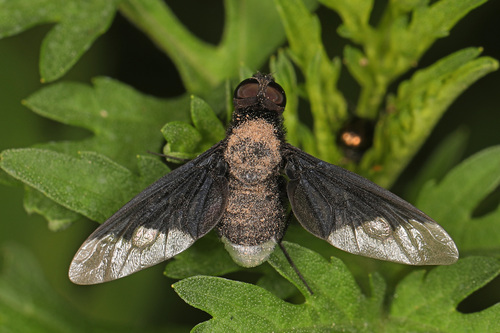
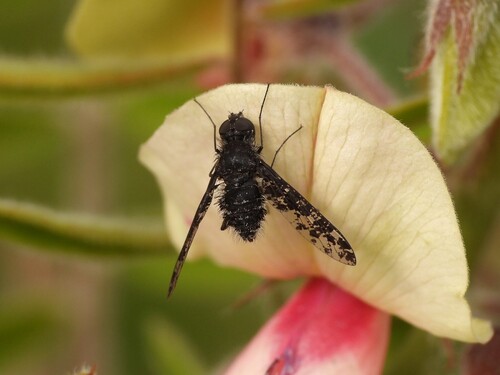
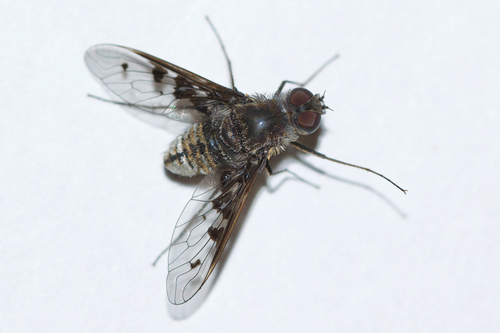
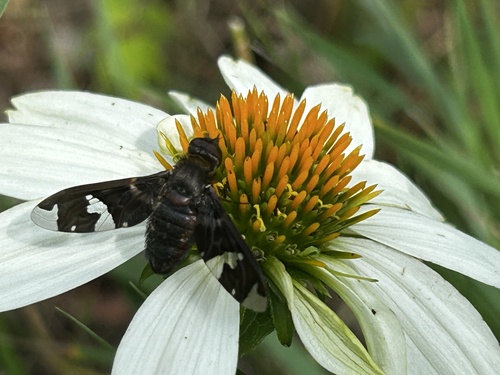
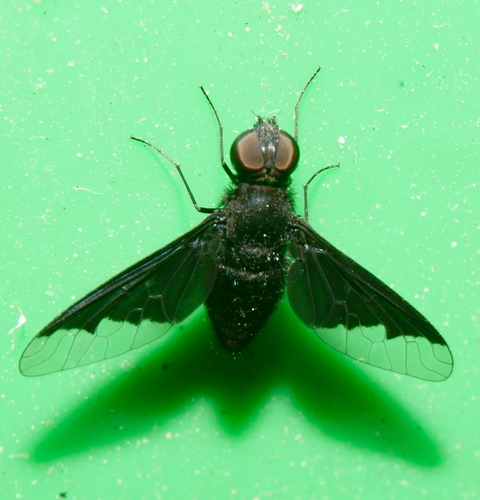
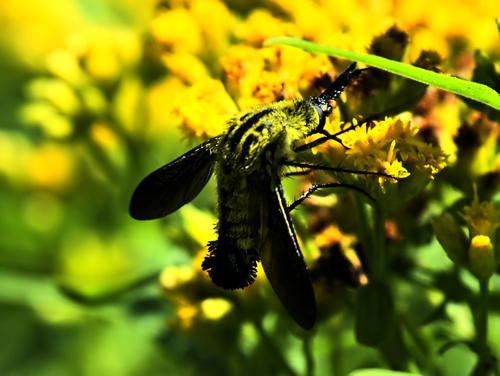
Anthrax analis, the black bee fly, is a species of bee fly in the family Bombyliidae. It can be found throughout North America, from the Yukon east to Quebec in Canada, the entire mainland United States, most of Mexico, and as far south as Costa Rica and Cuba. As an adult it is a pollinator, and as a larva it is a parasitoid of tiger beetles in the genus Cicindela, and likely also of solitary bees. It is variable in appearance, with the posterior half of the wings usually transparent, but in the eastern United States the wings may be entirely dark. The body itself is covered in black hair, but the tip of the abdomen usually has silvery scales.
Egg — The life cycle of Anthrax analis begins with the egg. After fertilization, the adult black bee fly lays its eggs on soil near the nests of tiger beetles, which their larvae will parasitize. These tiny, oval-shaped eggs are often camouflaged to blend in with the environment. The strategic placement of eggs ensures that once they hatch, the larvae will have direct access to their prey.
Larva — Upon hatching, the larvae resemble small worms, lacking wings and having soft bodies. They begin their parasitic behavior by invading... Wikipedia →