Azure Tit

Azure Tit

Cyanistes cyanus

LCLeast ConcernNTVUENCR
Daily sighting probability ~50% · Likely
at Ulaanbaatar

In 3 days ~90% in a week >90%

75 Verified sightings at Ulaanbaatar
February Best month

About the Azure Tit

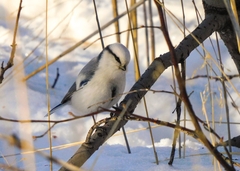
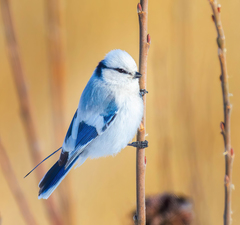
The azure tit (Cyanistes cyanus) is a species of Eurasian birds in the order of passeriformes in the family Paridae. This small species is the only member of the family Paridae to have a white cap, and was described in 1770 by Peter Simon Pallas. Its closest cousins are the blue tit and the African blue tit (Cyanistes teneriffae)

It is a widespread and common resident breeder throughout Russia, Central Asia, northwest China, Manchuria, and Pakistan.There are some records of the species in other parts of Europe, including in Finland, Sweden, Poland and Austria.

It is found in temperate and subarctic deciduous or mixed woodlands, scrub, and marshes. It is a resident species, and most birds do not migrate. It nests in tree holes, laying approximately 10 eggs. The bird is a close sitter, displaying defensive behaviors such as hissing and biting when disturbed. Its diet primarily consists of insects, seeds, small invertebrates, bug larvae, and eggs.

This 12–13 cm (4.7–5.1 in) bird is unmistakable. Its head, tail corners, wing bars, and underparts are white, while the upperparts are blue. It has a distinctive dark line running through its eye. The... Wikipedia →

Sounds

Alarm call0:25

Mongolia · 2026

© Ding Li Yong · XC1143227 · CC BY-NC-ND 4.0

Call0:19

Mongolia · 2025

© Richard E. Webster · XC1027960 · CC BY-NC-SA 4.0

Song1:03

Kazakhstan · 2023

© Peter Boesman · XC813346 · CC BY-NC-ND 4.0

Global Distribution

Parks Where Found

# Park Country Daily sighting probability

More parks will be added in future updates.

Cities Where Found

# City Country Daily sighting probability
1 Ürümqi 🇨🇳 China
~60%
2 Ulaanbaatar 🇲🇳 Mongolia
~50%
3 Dushanbe 🇹🇯 Tajikistan
~20%
4 Bishkek 🇰🇬 Kyrgyzstan
~20%
5 Novosibirsk 🇷🇺 Russia
~20%
6 Almaty 🇰🇿 Kazakhstan
~10%
7 Tashkent 🇺🇿 Uzbekistan
~10%
8 Astana 🇰🇿 Kazakhstan
~10%
9 Yekaterinburg 🇷🇺 Russia
<5%

Before you go

What are the chances of seeing an Azure Tit in Ulaanbaatar?

Likely

About 50% of wildlife watchers report an Azure Tit sighting in Ulaanbaatar on a given day, based on 75 verified sightings from GBIF citizen-science data. It is the 8th most-seen of the 63 birds we can rate there. Over three days the chance rises to about 90%, and over a week to over 90%, if each day is a fresh chance.

When is the best time to see an Azure Tit in Ulaanbaatar?

February

In that month about 90% of wildlife watchers report an Azure Tit in Ulaanbaatar on a given day, against about 30% in January, March and May–June, the lowest months. That is one of Ulaanbaatar's driest months, with almost no rain against 70 mm in July.

Is Ulaanbaatar the best place to see an Azure Tit?

2nd of 9

Of the 9 cities where we can rate Azure Tit sightings, Ulaanbaatar ranks 2nd at about 50%. The best odds are in Ürümqi (China, about 60%).

Which relatives of the Azure Tit live in Ulaanbaatar?

Same family: Paridae

The closest relatives of the Azure Tit that you can see in Ulaanbaatar (family Paridae, Tits, Chickadees, and Titmice) are Great Tit (about 80%), Willow Tit (about 30%) and Coal Tit (about 10%), with each one's daily chance of a sighting.

Where does the Azure Tit sighting chance come from?

GBIF citizen-science records

It is estimated from how often the Azure Tit is recorded against all the birds logged in Ulaanbaatar (75 verified sightings), calibrated against known sighting rates. Figures are rounded to the nearest 10% because citizen-science data supports honest approximations, not decimals, and months with records from fewer than five people show "—". How it works.

← Back to Ulaanbaatar