Chinese Bamboo Partridge

Chinese Bamboo Partridge

Bambusicola thoracicus

Silhouette: Sheatherius · PhyloPic

LCLeast ConcernNTVUENCR
Daily sighting probability ~10% · With luck
at Wuhan

In 3 days ~20% in a week ~50%

49 Verified sightings at Wuhan
August Best month
☀️ Diurnal When it's spotted

About the Chinese Bamboo Partridge

The Chinese bamboo partridge (Bambusicola thoracicus) is a small Galliform bird. It is one of three species in the genus Bambusicola, along with the mountain bamboo partridge of the Himalayas, and the Taiwan bamboo partridge of Taiwan. Chinese bamboo partridge is a monotypic species.

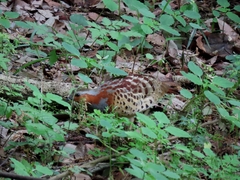
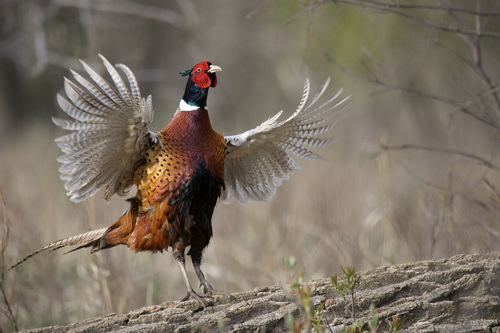
The Chinese bamboo partridge is a small bird, intermediate in size between the Coturnix and Perdix species, reaching a size of 31cm, with males being slightly larger than females. The breast and back are mottled in black, chestnut, and cream colours, with black spots on the flanks and above. The partridge's face and throat have rich fulvous and rufous tints. The breast is yellow-ochre, with pale greyish blue and taupe above the eye and down to the neck. Like the long-billed partridge, bamboo partridge exhibit well-developed flight feathers. Their tails are broad and squared. The wings are long and narrow. The birds are capable of sustained flight and move from the sub-canopy of steep hillside forest to the forest floor several times throughout the day.

Like many Galliform bird species, the birds prefer hiding to flight, but will readily flush if approached, startling pursuers... Wikipedia →

Sounds

Call1:01

China · 2025

© Lim Ying Hien 林勇贤 · XC1040818 · CC BY-NC-ND 4.0

Song0:35

China · 2020

© Bo Shunqi 薄顺奇 · XC840817 · CC BY-NC-SA 4.0

Call1:08

China · 2024

© Bo Shunqi薄顺奇 · XC909549 · CC BY-NC-SA 4.0

Global Distribution

Parks Where Found

# Park Country Daily sighting probability

More parks will be added in future updates.

Cities Where Found

# City Country Daily sighting probability
1 Jinhua 🇨🇳 China
~40%
2 Sendai 🇯🇵 Japan
~10%
3 Nanjing 🇨🇳 China
~10%
4 Hangzhou 🇨🇳 China
~10%
5 Chongqing 🇨🇳 China
~10%
6 Wuhan 🇨🇳 China
~10%
7 Tokyo 🇯🇵 Japan
~10%
8 Xiamen City 🇨🇳 China
~10%
9 Nagoya 🇯🇵 Japan
<5%
10 Chengdu 🇨🇳 China
<5%

Zoos & Centres Where Found

# Zoo / Centre Country
1 Pairi Daiza 🇧🇪 Belgium In captivity
2 Dresden Zoo 🇩🇪 Germany In captivity
3 Ostrava Zoo 🇨🇿 Czechia In captivity
4 Zoo Pilsen 🇨🇿 Czechia In captivity
5 Chengdu Research Base of Giant Panda Breeding 🇨🇳 China In captivity
6 Bronx Zoo 🇺🇸 United States In captivity
7 Ueno Zoo 🇯🇵 Japan In captivity
8 Inokashira Park Zoo 🇯🇵 Japan In captivity
9 Ueno Zoological Gardens (West Garden) 🇯🇵 Japan In captivity
10 Bird Park Steinen 🇩🇪 Germany In captivity

Before you go

What are the chances of seeing a Chinese Bamboo Partridge in Wuhan?

With luck

About 10% of wildlife watchers report a Chinese Bamboo Partridge sighting in Wuhan on a given day, based on 49 verified sightings from GBIF citizen-science data. It is the 53rd most-seen of the 143 birds we can rate there. Over three days the chance rises to about 20%, and over a week to about 50%, if each day is a fresh chance.

When is the best time to see a Chinese Bamboo Partridge in Wuhan?

April and August

In those months about 20% of wildlife watchers report a Chinese Bamboo Partridge in Wuhan on a given day, against under 5% in July, September and December–January, the lowest months.

What time of day is best to see a Chinese Bamboo Partridge?

Between 3 and 6 pm

Across all the parks we cover, that three-hour window holds the most Chinese Bamboo Partridge sightings with a recorded time, and about 9 in 10 of them come between 6 am and 6 pm: it is a daytime animal.

Is Wuhan the best place to see a Chinese Bamboo Partridge?

6th of 12

Of the 12 cities where we can rate Chinese Bamboo Partridge sightings, Wuhan ranks 6th at about 10%. The best odds are in Jinhua (China, about 40%), Sendai (Japan, about 10%) and Nanjing (China, about 10%).

Where does the Chinese Bamboo Partridge sighting chance come from?

GBIF citizen-science records

It is estimated from how often the Chinese Bamboo Partridge is recorded against all the birds logged in Wuhan (49 verified sightings), calibrated against known sighting rates. Figures are rounded to the nearest 10% because citizen-science data supports honest approximations, not decimals, and months with records from fewer than five people show "—". How it works.

← Back to Wuhan