
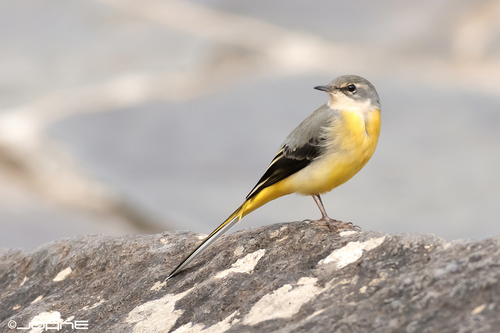
Chinese Blackbird

Chinese Blackbird

Turdus mandarinus

Silhouette: Sharon Wegner-Larsen · PhyloPic

LCLeast ConcernNTVUENCR
Daily sighting probability ~30% · Possible
at Xiuying District

In 3 days ~70% in a week ~90%

20 Verified sightings at Xiuying District
38 In 1 park From 2019 to 2026
January Best month
☀️ Diurnal When it's spotted

About the Chinese Blackbird

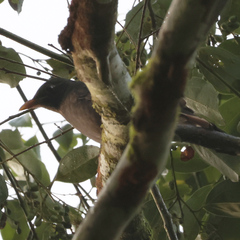
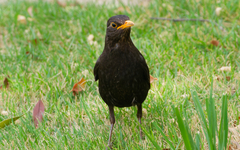
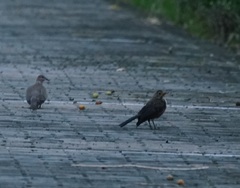
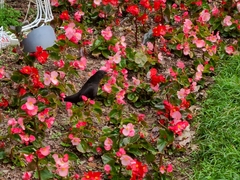
The Chinese blackbird (Turdus mandarinus) is a member of the thrush family Turdidae. It was formerly considered conspecific with the related common blackbird (T. merula). The Chinese blackbird (T. m. mandarinus) breeds throughout much of southern, central and eastern China. It is a partial migrant to Hong Kong and south to Laos and Vietnam. The male is sooty black, and the female is similar but browner, and paler on the underparts. It is a large subspecies.

Sowerby's blackbird (T. m. sowerbyi), named for James Sowerby, British naturalist and illustrator, breeds from eastern Sichuan to Guizhou. It is partially migratory, with some individuals spending the winter in southern China and northern Indochina. It resembles mandarinus, but is smaller and darker below.

It is typically monogamous, but some exceptions have been observed. It is omnivorous. During the breeding season, it primarily feeds on earthworms. Wikipedia →

Sounds

Song0:46

China · 2026

© Bo Shunqi 薄顺奇 · XC1180530 · CC BY-NC-SA 4.0

Call0:30

China · 2026

© Peter Boesman · XC1147853 · CC BY-NC-ND 4.0

Song0:30

China · 2026

© Penghui Lou · XC1070216 · CC BY-NC-SA 4.0

Global Distribution

Parks Where Found

# Park Country Daily sighting probability
1 Cuc Phuong National Park 🇻🇳 Vietnam
~10%

More parks will be added in future updates.

Cities Where Found

# City Country Daily sighting probability
1 Suzhou 🇨🇳 China
~90%
2 Shanghai 🇨🇳 China
~90%
3 Hefei 🇨🇳 China
~90%
4 Ningbo 🇨🇳 China
~80%
5 Wuhan 🇨🇳 China
~80%
6 Chengdu 🇨🇳 China
~80%
7 Nanjing 🇨🇳 China
~80%
8 Nanchang 🇨🇳 China
~80%
9 Xi'an 🇨🇳 China
~80%
10 Changsha 🇨🇳 China
~80%

Zoos & Centres Where Found

# Zoo / Centre Country
1 Chișinău Zoo 🇲🇩 Moldova In captivity

Before you go

What are the chances of seeing a Chinese Blackbird in Xiuying District?

Possible

About 30% of wildlife watchers report a Chinese Blackbird sighting in Xiuying District on a given day, based on 20 verified sightings from GBIF citizen-science data. It is the 23rd most-seen of the 43 birds we can rate there. Over three days the chance rises to about 70%, and over a week to about 90%, if each day is a fresh chance.

When is the best time to see a Chinese Blackbird in Xiuying District?

December to February

In those months about 40% of wildlife watchers report a Chinese Blackbird in Xiuying District on a given day, against about 20% in April, June–July and November, the lowest months. Those are among Xiuying District's driest months, with about 35 mm of rain a month against 310 mm in August. May and August–October have too few records to rate.

What time of day is best to see a Chinese Blackbird?

Between 3 and 6 pm

Across all the parks we cover, that three-hour window holds the most Chinese Blackbird sightings with a recorded time, and about 9 in 10 of them come between 6 am and 6 pm: it is a daytime animal.

Is Xiuying District the best place to see a Chinese Blackbird?

29th of 40

Of the 40 cities where we can rate Chinese Blackbird sightings, Xiuying District ranks 29th at about 30%. The best odds are in Suzhou (China, about 90%), Shanghai (China, about 90%) and Hefei (China, about 90%).

Which relatives of the Chinese Blackbird live in Xiuying District?

Same order: Passeriformes

The closest relatives of the Chinese Blackbird that you can see in Xiuying District (order Passeriformes, Perching Birds) are Oriental Magpie-Robin (about 90%), Light-vented Bulbul (about 70%) and Long-tailed Shrike (about 70%), with each one's daily chance of a sighting.

Where does the Chinese Blackbird sighting chance come from?

GBIF citizen-science records

It is estimated from how often the Chinese Blackbird is recorded against all the birds logged in Xiuying District (20 verified sightings), calibrated against known sighting rates. Figures are rounded to the nearest 10% because citizen-science data supports honest approximations, not decimals, and months with records from fewer than five people show "—". How it works.

← Back to Xiuying District