Fire Skink

Fire Skink

Mochlus fernandi

Silhouette: David Orr · PhyloPic

LCLeast ConcernNTVUENCR
Daily sighting probability ~50% · Likely
at Yaoundé

In 3 days ~90% in a week >90%

5 Verified sightings at Yaoundé
March Best month
🌅 Crepuscular When it's spotted

About the Fire Skink

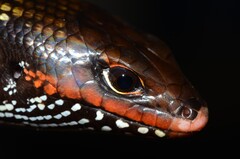
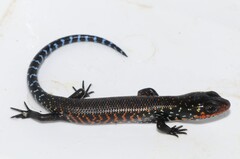
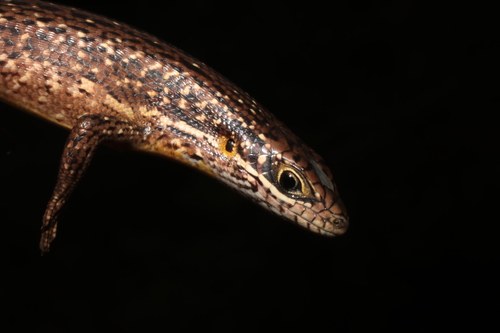
The fire skink (Lepidothyris fernandi), also known commonly as Fernand's skink, the Togo fire skink, and the true fire skink, is a fairly large skink, a species of lizard in the family Scincidae. The species is known for its bright and vivid coloration. Native to tropical forests in West and Central Africa, the fire skink lives 15 to 20 years. This species is a diurnal lizard that burrows and hides. It is relatively shy and reclusive, but may become tame in captivity.

The specific name, fernandi, refers to the island formerly known as Fernando Po, which has been called Bioko since 1979. It is known in the Yoruba language, spoken in Western Africa, as Oloronto. Historically, the fire skink has been placed in several different genera and was until recently placed in Riopa together with several skinks from southeast Asia. While these are superficially similar to the African fire skink, they are closer to some other Asian skinks, resulting in their move to Mochlus. The fire skink is not closely related to other skinks and belongs to the genus Mochlus. However, a review of the taxonomy of the fire skink did reveal that it, as traditionally defined, actually... Wikipedia →

Global Distribution

Parks Where Found

# Park Country Daily sighting probability

More parks will be added in future updates.

Cities Where Found

# City Country Daily sighting probability
1 Yaoundé 🇨🇲 Cameroon
~50%

Zoos & Centres Where Found

# Zoo / Centre Country
1 Prague Zoo 🇨🇿 Czechia In captivity
2 Bronx Zoo 🇺🇸 United States In captivity
3 Yaroslavl Zoo 🇷🇺 Russia In captivity
4 Cologne Zoological Garden 🇩🇪 Germany In captivity
5 Łódź Zoo 🇵🇱 Poland In captivity
6 Rákosův pavilon 🇨🇿 Czechia In captivity
7 Velemlokárium 🇨🇿 Czechia In captivity
8 Cologne Zoo Aquarium 🇩🇪 Germany In captivity

Before you go

What are the chances of seeing a Fire Skink in Yaoundé?

Likely

About 50% of wildlife watchers report a Fire Skink sighting in Yaoundé on a given day, based on 5 verified sightings from GBIF citizen-science data. Over three days the chance rises to about 90%, and over a week to over 90%, if each day is a fresh chance.

When is the best time to see a Fire Skink in Yaoundé?

March

In that month about 70% of wildlife watchers report a Fire Skink in Yaoundé on a given day, against about 10% in October, the lowest month. February, June and September have too few records to rate.

What time of day is best to see a Fire Skink?

Between 2 and 5 pm

Across all the parks we cover, that three-hour window holds the most Fire Skink sightings with a recorded time, and about 7 in 10 of them come between 6 am and 6 pm: it is most active around dawn and dusk.

Where else can you see a Fire Skink?

Only Yaoundé, in our data

Yaoundé is the only city on Wallace's Line with enough records to rate Fire Skink sightings: about 50% of wildlife watchers there report one on a given day.

Where does the Fire Skink sighting chance come from?

GBIF citizen-science records

It is estimated from how often the Fire Skink is recorded against all the reptiles logged in Yaoundé (5 verified sightings), calibrated against known sighting rates. Figures are rounded to the nearest 10% because citizen-science data supports honest approximations, not decimals, and months with records from fewer than five people show "—". How it works.

← Back to Yaoundé