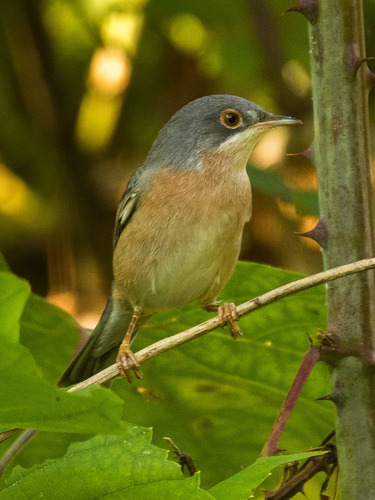
Marmora's Warbler

Marmora's Warbler

Sylvia sarda

LCLeast ConcernNTVUENCR
Daily sighting probability ~20% · Possible
at Corsica Regional Natural Park (Parc naturel régional de Corse)

In 3 days ~40% in a week ~80%

145 Verified sightings at Corsica Regional Natural Park (Parc naturel régional de Corse) From 2019 to 2026
145 In 1 park
April Best month
☀️ Diurnal When it's spotted

About the Marmora's Warbler

Marmora's warbler (Curruca sarda) is a species of passerine bird in the Sylviidae family. The specific sarda is a Latin feminine form for a person from Sardinia. Marmora's warbler was formerly described in 1820 by the Dutch zoologist Coenraad Jacob Temminck under the binomial name Sylvia sarda. Temminck based his account on a manuscript by the Italian soldier and naturalist Alberto della Marmora that had been read at the Academy of Turin in August 1819. Marmora's warbler is now one of 27 species placed in the genus Curruca that was introduced by the German naturalist Johann Matthäus Bechstein in 1802. The species is monotypic: no subspecies are recognised.

It breeds on Mediterranean islands, typically including Corsica and Sardinia. The smaller Balearic Islands bird is given specific status as Balearic warbler, Curruca balearica. These two seem to form a superspecies which in turn groups with Tristram's warbler and the Dartford warbler. They are generally resident but some birds migrate south to winter in north Africa. They are rare vagrants to northern and western Europe. These small passerine birds are found in open country with thorny...

Wikipedia →

Global Distribution

Parks Where Found

# Park Country Daily sighting probability
1 Corsica Regional Natural Park (Parc naturel régional de Corse) 🇫🇷 France
~20%

More parks will be added in future updates.

Before you go

What are the chances of seeing a Marmora's Warbler in Corsica Regional Natural Park (Parc naturel régional de Corse)?

Possible

About 20% of wildlife watchers report a Marmora's Warbler sighting in Corsica Regional Natural Park (Parc naturel régional de Corse) on a given day, based on 145 verified sightings from GBIF citizen-science data from 2019 to 2026. It is the 39th most-seen of the 122 birds we can rate there. Over three days the chance rises to about 40%, and over a week to about 80%, if each day is a fresh chance.

When is the best time to see a Marmora's Warbler in Corsica Regional Natural Park (Parc naturel régional de Corse)?

April–August and November

In those months about 20% of wildlife watchers report a Marmora's Warbler in Corsica Regional Natural Park (Parc naturel régional de Corse) on a given day, against about 10% in September–October and December–March, the lowest months.

What time of day is best to see a Marmora's Warbler?

Between 8 and 11 am

Across all the parks we cover, that three-hour window holds the most Marmora's Warbler sightings with a recorded time, and about 9 in 10 of them come between 6 am and 6 pm: it is a daytime animal.

Where else can you see a Marmora's Warbler?

Only Corsica Regional Natural Park (Parc naturel régional de Corse), in our data

Corsica Regional Natural Park (Parc naturel régional de Corse) is the only park on Wallace's Line with enough records to rate Marmora's Warbler sightings: about 20% of wildlife watchers there report one on a given day.

Which relatives of the Marmora's Warbler live in Corsica Regional Natural Park (Parc naturel régional de Corse)?

Same genus: Sylvia

The closest relatives of the Marmora's Warbler that you can see in Corsica Regional Natural Park (Parc naturel régional de Corse) (genus Sylvia, Sylvia Warblers) are Blackcap (about 60%) and Dartford Warbler (about 10%), with each one's daily chance of a sighting.

Where does the Marmora's Warbler sighting chance come from?

GBIF citizen-science records

It is estimated from how often the Marmora's Warbler is recorded against all the birds logged in Corsica Regional Natural Park (Parc naturel régional de Corse) (145 verified sightings from 2019 to 2026), calibrated against known sighting rates. Figures are rounded to the nearest 10% because citizen-science data supports honest approximations, not decimals, and months with records from fewer than five people show "—". How it works.

← Back to Corsica Regional Natural Park (Parc naturel régional de Corse)