Moltoni's Warbler

Moltoni's Warbler

Curruca subalpina

Silhouette: Alexis Lours · PhyloPic

LCLeast ConcernNTVUENCR
Daily sighting probability ~20% · Possible
at Corsica Regional Natural Park (Parc naturel régional de Corse)

In 3 days ~40% in a week ~70%

112 Verified sightings at Corsica Regional Natural Park (Parc naturel régional de Corse) From 2019 to 2026
112 In 1 park
May Best month
☀️ Diurnal When it's spotted

About the Moltoni's Warbler

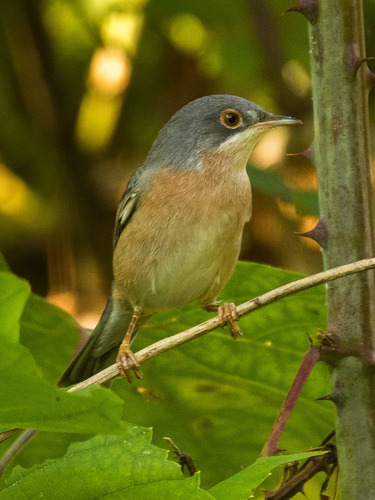
Moltoni's warbler (Curruca subalpina) is a small bird species belonging to the family Sylviidae, often referred to as the typical warblers. This species is native to Italy and islands of the Tyrrhenian Sea. Moltoni's warbler was first formally described as Sylvia subalpina in 1820 by the Dutch zoologist Coenraad Jacob Temminck from specimens collected in Northern Italy. In 1937 C. Orlando named a subspecies of the subalpine warbler Sylvia cantillans moltonii from Sardinia and this is now regarded as a synonym of Temminck's name. This taxon was regarded as a synonym of the subalpine water (Sylvia cantillans) until the 2000s when morphological, phylogenetic and biogeographical data were used to show that Moltoni's Warbler was a valid species which bred sympatrically with Sylvia cantillans. The result was that the subalpine warbler sensu lato was split into three species, the Western subalpine warbler (Curruca iberiae), the Eastern subalpine warbler (Curruca cantillans) and Moltoni's warbler. This species is classified in the genus Curruca in the family Sylviidae.

The specific name subalpina is Latin for "below the mountains". The common name honours the...
Wikipedia →

Sounds

Song0:48

Spain · 2026

© Daniel Hinckley · XC1104028 · CC BY-NC-SA 4.0

Call0:16

Italy · 2025

© Jonas Bonnedahl · XC1044472 · CC BY-NC-SA 4.0

Alarm call0:38

Italy · 2019

© Alessandro Ghiggi · XC489679 · CC BY-NC-SA 4.0

Global Distribution

Parks Where Found

# Park Country Daily sighting probability
1 Corsica Regional Natural Park (Parc naturel régional de Corse) 🇫🇷 France
~20%

More parks will be added in future updates.

Before you go

What are the chances of seeing a Moltoni's Warbler in Corsica Regional Natural Park (Parc naturel régional de Corse)?

Possible

About 20% of wildlife watchers report a Moltoni's Warbler sighting in Corsica Regional Natural Park (Parc naturel régional de Corse) on a given day, based on 112 verified sightings from GBIF citizen-science data from 2019 to 2026. It is the 42nd most-seen of the 122 birds we can rate there. Over three days the chance rises to about 40%, and over a week to about 70%, if each day is a fresh chance.

When is the best time to see a Moltoni's Warbler in Corsica Regional Natural Park (Parc naturel régional de Corse)?

May and August

In those months about 30% of wildlife watchers report a Moltoni's Warbler in Corsica Regional Natural Park (Parc naturel régional de Corse) on a given day, against under 5% in January, the lowest month.

What time of day is best to see a Moltoni's Warbler?

Between 7 and 10 am

Across all the parks we cover, that three-hour window holds the most Moltoni's Warbler sightings with a recorded time, and about 9 in 10 of them come between 6 am and 6 pm: it is a daytime animal.

Where else can you see a Moltoni's Warbler?

Only Corsica Regional Natural Park (Parc naturel régional de Corse), in our data

Corsica Regional Natural Park (Parc naturel régional de Corse) is the only park on Wallace's Line with enough records to rate Moltoni's Warbler sightings: about 20% of wildlife watchers there report one on a given day.

Where does the Moltoni's Warbler sighting chance come from?

GBIF citizen-science records

It is estimated from how often the Moltoni's Warbler is recorded against all the birds logged in Corsica Regional Natural Park (Parc naturel régional de Corse) (112 verified sightings from 2019 to 2026), calibrated against known sighting rates. Figures are rounded to the nearest 10% because citizen-science data supports honest approximations, not decimals, and months with records from fewer than five people show "—". How it works.

← Back to Corsica Regional Natural Park (Parc naturel régional de Corse)