Grey-backed Thrush

Grey-backed Thrush

Turdus hortulorum

Silhouette: Sharon Wegner-Larsen · PhyloPic

LCLeast ConcernNTVUENCR
Daily sighting probability ~10% · With luck
at Cuc Phuong National Park

In 3 days ~40% in a week ~70%

47 Verified sightings at Cuc Phuong National Park From 2019 to 2026
47 In 1 park
January Best month

About the Grey-backed Thrush

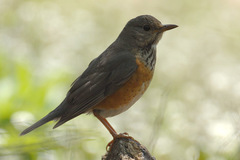
The grey-backed thrush (Turdus hortulorum) is a species of bird in the family Turdidae. It breeds in northeastern China and the Russian Far East and winters in southern China and northern Vietnam. Its natural habitat is temperate forests. A captive bred pair laid five eggs, which hatched 14 days after the first egg was laid. The young left the nest 12 days later.

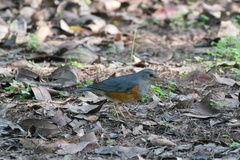
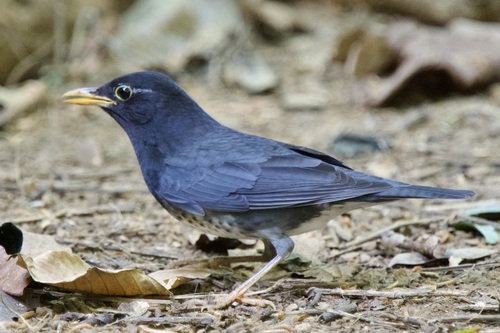
The grey-backed thrush is a medium-sized Passerine. It is a sexually-dimorphic species, with males having a slate grey back and chest and white chin and belly, with rufous flanks. Females have grey or brown backs, with dark spots on the chest and similar plumage to males on the belly and flanks.

These birds are 20-23 cm long, and weigh a mean 66.7 g (range: 61-69 g). The grey-backed thrush primarily nests and forages in deciduous or evergreen forests with rolling terrain, rarely venturing above 1100 m in elevation. They eat both fruit and insects. The grey-backed thrush is currently listed as a species of Least Concern by the IUCN. Wikipedia →

Sounds

Call0:48

China · 2025

© Bo Shunqi 薄顺奇 · XC1101767 · CC BY-NC-SA 4.0

Song1:07

China · 2024

© Ding Li Yong · XC917334 · CC BY-NC-ND 4.0

Alarm call0:49

China · 2018

© Geoff Carey · XC726233 · CC BY-NC-SA 4.0

Global Distribution

Parks Where Found

# Park Country Daily sighting probability
1 Cuc Phuong National Park 🇻🇳 Vietnam
~10%

More parks will be added in future updates.

Cities Where Found

# City Country Daily sighting probability
1 Shanghai 🇨🇳 China
~20%
2 Suzhou 🇨🇳 China
~20%
3 Nanjing 🇨🇳 China
~20%
4 Fuzhou 🇨🇳 China
~20%
5 Changsha 🇨🇳 China
~20%
6 Nanchang 🇨🇳 China
~20%
7 Hangzhou 🇨🇳 China
~20%
8 Seoul 🇰🇷 South Korea
~20%
9 Xiamen City 🇨🇳 China
~20%
10 Gwangju 🇰🇷 South Korea
~20%

Before you go

What are the chances of seeing a Grey-backed Thrush in Cuc Phuong National Park?

With luck

About 10% of wildlife watchers report a Grey-backed Thrush sighting in Cuc Phuong National Park on a given day, based on 47 verified sightings from GBIF citizen-science data from 2019 to 2026. It is the 52nd most-seen of the 159 birds we can rate there. Over three days the chance rises to about 40%, and over a week to about 70%, if each day is a fresh chance.

When is the best time to see a Grey-backed Thrush in Cuc Phuong National Park?

January and February

In those months about 30% of wildlife watchers report a Grey-backed Thrush in Cuc Phuong National Park on a given day, against under 5% in April, the lowest month. Those are among Cuc Phuong National Park's driest months, with about 65 mm of rain a month against 390 mm in August. July has too few records to rate.

Where else can you see a Grey-backed Thrush?

Only Cuc Phuong National Park, in our data

Cuc Phuong National Park is the only park on Wallace's Line with enough records to rate Grey-backed Thrush sightings: about 10% of wildlife watchers there report one on a given day.

Which relatives of the Grey-backed Thrush live in Cuc Phuong National Park?

Same genus: Turdus

The closest relatives of the Grey-backed Thrush that you can see in Cuc Phuong National Park (genus Turdus, Typical Thrushes) are Japanese Thrush (about 50%), Black-breasted Thrush (about 40%) and Chinese Blackbird (about 10%), with each one's daily chance of a sighting.

Where does the Grey-backed Thrush sighting chance come from?

GBIF citizen-science records

It is estimated from how often the Grey-backed Thrush is recorded against all the birds logged in Cuc Phuong National Park (47 verified sightings from 2019 to 2026), calibrated against known sighting rates. Figures are rounded to the nearest 10% because citizen-science data supports honest approximations, not decimals, and months with records from fewer than five people show "—". How it works.

← Back to Cuc Phuong National Park