Blue-capped Motmot

Blue-capped Motmot

Momotus coeruliceps

Silhouette: Sofía Terán Sánchez · PhyloPic

LCLeast ConcernNTVUENCR Endemic
Daily sighting probability ~10% · With luck
at Cumbres de Monterrey National Park

In 3 days ~30% in a week ~60%

244 Verified sightings at Cumbres de Monterrey National Park From 2019 to 2026
244 In 1 park
June Best month
☀️ Diurnal When it's spotted

About the Blue-capped Motmot

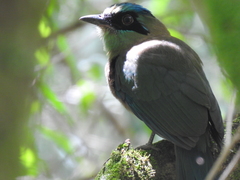
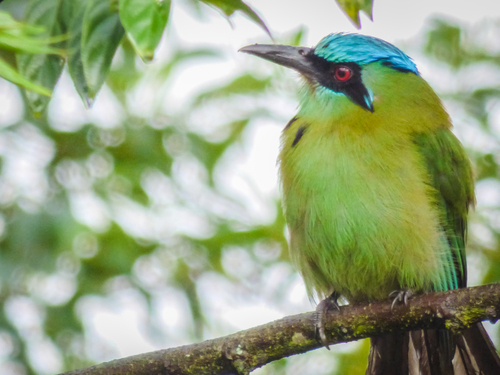
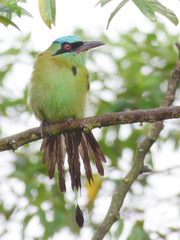
The blue-capped motmot (Momotus coeruliceps) or blue-crowned motmot, is a colorful near-passerine bird found in forests and woodlands of eastern Mexico. This species and the Lesson's Motmot, Whooping Motmot, Trinidad Motmot, Amazonian Motmot, and Andean Motmot were all considered conspecific. The IUCN uses blue-crowned as their identifier for this species; however, it was also the name used for the prior species complex.

It is the only species in the former complex where the central crown is blue. There is a black eyemask. The call is a low owl-like ooo-doot. Blue-crowned motmots have a body length ranging from 38 to 43 cm (15 to 17 in). These birds often sit still, and in their dense forest habitat can be difficult to see, despite their size. They eat small prey such as insects and lizards, and will also regularly take fruit.

Like most of the Coraciiformes, motmots nest in tunnels in banks, laying about three or four white eggs. Wikipedia →
Sounds

Call1:00

Mexico · 2026

© Richard E. Webster · XC1183223 · CC BY-NC-SA 4.0

Song0:06

Mexico · 2024

© Leonardo Guzman Hernandez · XC914415 · CC BY-NC-SA 4.0

Dawn song0:21

Mexico · 2016

© Oscar Marin · XC444735 · CC BY-NC-SA 4.0

Global Distribution

Parks Where Found

# Park Country Daily sighting probability
1 Cumbres de Monterrey National Park 🇲🇽 Mexico
~10%

More parks will be added in future updates.

Zoos & Centres Where Found

# Zoo / Centre Country
1 Cincinnati Zoo and Botanical Garden 🇺🇸 United States In captivity
2 Minnesota Zoo 🇺🇸 United States In captivity
3 Parc zoologique de Montpellier 🇫🇷 France In captivity
4 Phoenix Zoo 🇺🇸 United States In captivity
5 Woodland Park Zoo 🇺🇸 United States In captivity
6 Houston Zoo 🇺🇸 United States In captivity
7 Reid Park Zoo 🇺🇸 United States In captivity

Before you go

What are the chances of seeing a Blue-capped Motmot in Cumbres de Monterrey National Park?

With luck

About 10% of wildlife watchers report a Blue-capped Motmot sighting in Cumbres de Monterrey National Park on a given day, based on 244 verified sightings from GBIF citizen-science data from 2019 to 2026. It is the 70th most-seen of the 275 birds we can rate there. Over three days the chance rises to about 30%, and over a week to about 60%, if each day is a fresh chance.

When is the best time to see a Blue-capped Motmot in Cumbres de Monterrey National Park?

June

In that month about 30% of wildlife watchers report a Blue-capped Motmot in Cumbres de Monterrey National Park on a given day, against under 5% in November and December, the lowest months. That is one of Cumbres de Monterrey National Park's wettest months, with about 150 mm of rain against 20 mm in December.

What time of day is best to see a Blue-capped Motmot?

Between 8 and 11 am

Across all the parks we cover, that three-hour window holds the most Blue-capped Motmot sightings with a recorded time, and about 9 in 10 of them come between 6 am and 6 pm: it is a daytime animal.

Where else can you see a Blue-capped Motmot?

Only Cumbres de Monterrey National Park, in our data

Cumbres de Monterrey National Park is the only park on Wallace's Line with enough records to rate Blue-capped Motmot sightings: about 10% of wildlife watchers there report one on a given day.

Where does the Blue-capped Motmot sighting chance come from?

GBIF citizen-science records

It is estimated from how often the Blue-capped Motmot is recorded against all the birds logged in Cumbres de Monterrey National Park (244 verified sightings from 2019 to 2026), calibrated against known sighting rates. Figures are rounded to the nearest 10% because citizen-science data supports honest approximations, not decimals, and months with records from fewer than five people show "—". How it works.

← Back to Cumbres de Monterrey National Park