Chihuahuan Raven

Chihuahuan Raven

Corvus cryptoleucus

Silhouette: Peileppe · PhyloPic

LCLeast ConcernNTVUENCR
Daily sighting probability <5% · Rare
at Cumbres de Monterrey National Park

In 3 days <5% in a week ~10%

26 Verified sightings at Cumbres de Monterrey National Park From 2019 to 2026
26 In 1 park
April Best month
☀️ Diurnal When it's spotted

About the Chihuahuan Raven

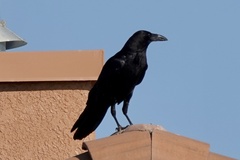
The Chihuahuan raven (Corvus cryptoleucus) is a species in the family Corvidae that is native to the United States and Mexico. The proportions resemble the common raven with a heavy bill, but is about the same size as a carrion crow, or slightly larger than the American crow (44–51 cm (17–20 in) long). The plumage is all-black with a rich purple-blue gloss in good light. Like the forest raven, little raven, fan-tailed raven and Australian raven, it is one of the smaller raven species. The larger species of raven are the common raven, thick-billed raven, white-necked raven and brown-necked raven, with the common and thick-billed ravens being the world's largest raven species and the little and fan-tailed ravens being the smallest. The Chihuahuan raven is similar in appearance to the Australian raven, although with dark brown irises and whiter feather bases. The nasal bristles extend further down the top of the bill than in any other Corvus species to about two-thirds the length. In addition, the Chihuahuan raven is similar in appearance to the white-necked raven of east Africa because the base of the neck has feathers that are white-ish (seen only when ruffled in strong... Wikipedia →

Sounds

Begging call0:56

United States · 2023

© Richard E. Webster · XC1185262 · CC BY-NC-SA 4.0

Call0:37

United States · 2019

© Phoenix Birder · XC495245 · CC BY-NC-SA 4.0

Flight call0:30

United States · 2016

© Paul Marvin · XC456974 · CC BY-NC-SA 4.0

Global Distribution

Parks Where Found

# Park Country Daily sighting probability
1 Cumbres de Monterrey National Park 🇲🇽 Mexico
<5%

More parks will be added in future updates.

Cities Where Found

# City Country Daily sighting probability
1 Ciudad Juárez 🇲🇽 México
~10%

Zoos & Centres Where Found

# Zoo / Centre Country
1 African Lion Safari 🇨🇦 Canada In captivity
2 Wildlife West Nature Park 🇺🇸 United States In captivity
3 Arizona-Sonora Desert Museum 🇺🇸 United States In captivity

Before you go

What are the chances of seeing a Chihuahuan Raven in Cumbres de Monterrey National Park?

Rare

Under 5% of wildlife watchers report a Chihuahuan Raven sighting in Cumbres de Monterrey National Park on a given day, based on 26 verified sightings from GBIF citizen-science data from 2019 to 2026. It is the 183rd most-seen of the 275 birds we can rate there. Over three days the chance rises to under 5%, and over a week to about 10%, if each day is a fresh chance.

When is the best time to see a Chihuahuan Raven in Cumbres de Monterrey National Park?

Any time of year

In every month with enough records, under 5% of wildlife watchers report a Chihuahuan Raven in Cumbres de Monterrey National Park on a given day, so our monthly data shows no clear season.

What time of day is best to see a Chihuahuan Raven?

Between 8 and 11 am

Across all the parks we cover, that three-hour window holds the most Chihuahuan Raven sightings with a recorded time, and about 9 in 10 of them come between 6 am and 6 pm: it is a daytime animal.

Where else can you see a Chihuahuan Raven?

Only Cumbres de Monterrey National Park, in our data

Cumbres de Monterrey National Park is the only park on Wallace's Line with enough records to rate Chihuahuan Raven sightings: under 5% of wildlife watchers there report one on a given day.

Where does the Chihuahuan Raven sighting chance come from?

GBIF citizen-science records

It is estimated from how often the Chihuahuan Raven is recorded against all the birds logged in Cumbres de Monterrey National Park (26 verified sightings from 2019 to 2026), calibrated against known sighting rates. Figures are rounded to the nearest 10% because citizen-science data supports honest approximations, not decimals, and months with records from fewer than five people show "—". How it works.

← Back to Cumbres de Monterrey National Park