

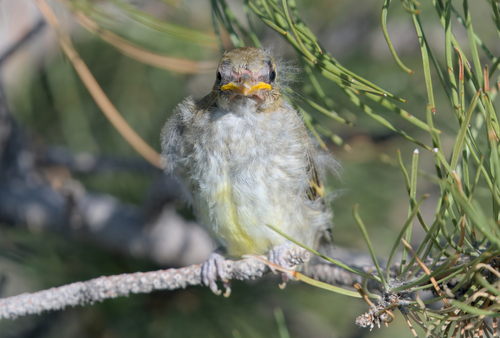
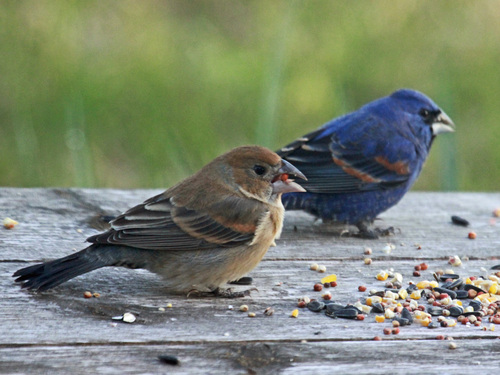
Crimson-Collared Grosbeak

Crimson-Collared Grosbeak

Rhodothraupis celaeno

Silhouette: Jonah Duckles · PhyloPic

Daily sighting probability ~30% · Possible
at Cumbres de Monterrey National Park

In 3 days ~60% in a week ~90%

538 Verified sightings at Cumbres de Monterrey National Park From 2019 to 2026
538 In 1 park
June Best month
☀️ Diurnal When it's spotted

About the Crimson-Collared Grosbeak

The crimson-collared grosbeak (Periporphyrus celaeno) is a species of bird in the family Cardinalidae, the cardinals, grosbeaks, and “tanager” allies. It is endemic to Mexico but has occurred several times as a vagrant in southern Texas in the U. S.

The crimson-collared grosbeak was formally described in 1830 with the binomial Tanagra Celaeno [sic]. Its further taxonomy is unsettled. The crimson-collared grosbeak was long placed as the only species in genus Rhodothraupis. By 2026 most taxonomic systems had placed it in genus Periporphyrus with the red-and-black grosbeak (P. erythromelas). However, BirdLife International's Handbook of the Birds of the World (HBW) places it in genus Caryothraustes.

The crimson-collared grosbeak is monotypic. The crimson-collared grosbeak is 21 to 22 cm (8.3 to 8.7 in) long; one female weighed 60 g (2.1 oz). The species is sexually dimorphic. Adult males have a black head, throat, and upper breast. Their nape is dark crimson, their mantle deep crimson, and their back and rump black with crimson feather edges. Their wings are blackish with very thin dark crimson edges on the coverts. Their tail is black.... Wikipedia →

Sounds

Song0:19

Mexico · 2024

© Leonardo Guzman Hernandez · XC923830 · CC BY-NC-SA 4.0

Uncertain0:10

Mexico · 2021

© Gustavo Contreras Cuevas · XC679694 · CC BY-NC-SA 4.0

Call0:18

United States · 2016

© MiriamEaglemon · XC304602 · CC BY-NC-SA 4.0

Global Distribution

Parks Where Found

# Park Country Daily sighting probability
1 Cumbres de Monterrey National Park 🇲🇽 Mexico
~30%

More parks will be added in future updates.

Cities Where Found

# City Country Daily sighting probability
1 Monterrey 🇲🇽 México
<5%

Before you go

What are the chances of seeing a Crimson-Collared Grosbeak in Cumbres de Monterrey National Park?

Possible

About 30% of wildlife watchers report a Crimson-Collared Grosbeak sighting in Cumbres de Monterrey National Park on a given day, based on 538 verified sightings from GBIF citizen-science data from 2019 to 2026. It is the 29th most-seen of the 275 birds we can rate there. Over three days the chance rises to about 60%, and over a week to about 90%, if each day is a fresh chance.

When is the best time to see a Crimson-Collared Grosbeak in Cumbres de Monterrey National Park?

June

In that month about 50% of wildlife watchers report a Crimson-Collared Grosbeak in Cumbres de Monterrey National Park on a given day, against about 10% in February, the lowest month. That is one of Cumbres de Monterrey National Park's wettest months, with about 150 mm of rain against 20 mm in December.

What time of day is best to see a Crimson-Collared Grosbeak?

Between 10 am and 1 pm

Across all the parks we cover, that three-hour window holds the most Crimson-Collared Grosbeak sightings with a recorded time, and about 9 in 10 of them come between 6 am and 6 pm: it is a daytime animal.

Where else can you see a Crimson-Collared Grosbeak?

Only Cumbres de Monterrey National Park, in our data

Cumbres de Monterrey National Park is the only park on Wallace's Line with enough records to rate Crimson-Collared Grosbeak sightings: about 30% of wildlife watchers there report one on a given day.

Which relatives of the Crimson-Collared Grosbeak live in Cumbres de Monterrey National Park?

Same family: Cardinalidae

The closest relatives of the Crimson-Collared Grosbeak that you can see in Cumbres de Monterrey National Park (family Cardinalidae, Cardinals and Allies) are Hepatic Tanager (about 30%), Flame-colored Tanager (about 20%) and Northern Cardinal (about 10%), with each one's daily chance of a sighting.

Where does the Crimson-Collared Grosbeak sighting chance come from?

GBIF citizen-science records

It is estimated from how often the Crimson-Collared Grosbeak is recorded against all the birds logged in Cumbres de Monterrey National Park (538 verified sightings from 2019 to 2026), calibrated against known sighting rates. Figures are rounded to the nearest 10% because citizen-science data supports honest approximations, not decimals, and months with records from fewer than five people show "—". How it works.

← Back to Cumbres de Monterrey National Park