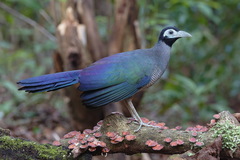
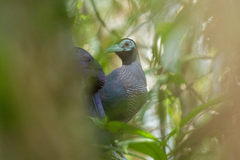

Bornean Ground-Cuckoo

Bornean Ground-Cuckoo

Carpococcyx radiceus

Silhouette: Nicolas Huet le Jeune and Jean-Gabriel Prêtre (vectorized by T. Michael Keesey) · PhyloPic

LCNTVUVulnerableENCR
Daily sighting probability <5% · Rare
at Danum Valley Conservation Area

In 3 days ~10% in a week ~30%

70 Verified sightings at Danum Valley Conservation Area From 2019 to 2026
264 In all 2 parks
February Best month

About the Bornean Ground-Cuckoo

The Bornean ground cuckoo (Carpococcyx radiceus) is a large, terrestrial species of cuckoo in the family Cuculidae. As suggested by its common name, it is endemic to the island of Borneo, being found in the sections belonging to Brunei, Malaysia, and Indonesia. It is restricted to humid forest. It is threatened by habitat loss. It was formerly considered conspecific with the Sumatran ground cuckoo.

The Bornean ground cuckoo was described as Calobates radiceus by the Dutch zoologist Coenraad Jacob Temminck in 1832 based on a female specimen from Pontianak district in Borneo. In 1840, George Robert Gray established it as the type species of a new genus, Carpococcyx, because Calobates was similar to the fly genus Calobata. Additionally, it is also a junior homonym of the genus Calobates, established by the German naturalist Johann Jacob Kaup in 1829. The specific name, radiceus, is either from the Neo-Latin radius (rod or staff) or radicis (foundation). It is thought to be an error for radiatus or radiosus, with Temminck himself referring to the species by those names in other writings, but the original description does not provide enough evidence to emend... Wikipedia →

Sounds

Song0:31

Malaysia · 2023

© Daan Drukker · XC829197 · CC BY-NC-SA 4.0

Call0:29

Malaysia · 2022

© Kim Chuah Lim · XC769274 · CC BY-NC-SA 4.0

Alarm call0:29

Malaysia · 2010

© David Edwards · XC70602 · CC BY-NC-ND 2.5

Global Distribution

Parks Where Found

# Park Country Daily sighting probability
1 Kinabatangan Wildlife Sanctuary 🇲🇾 Malaysia
~10%
2 Danum Valley Conservation Area 🇲🇾 Malaysia
<5%

Before you go

What are the chances of seeing a Bornean Ground-Cuckoo in Danum Valley Conservation Area?

Rare

Under 5% of wildlife watchers report a Bornean Ground-Cuckoo sighting in Danum Valley Conservation Area on a given day, based on 70 verified sightings from GBIF citizen-science data from 2019 to 2026. It is the 168th most-seen of the 258 birds we can rate there. Over three days the chance rises to about 10%, and over a week to about 30%, if each day is a fresh chance.

When is the best time to see a Bornean Ground-Cuckoo in Danum Valley Conservation Area?

January–March, May, August and October

In those months about 10% of wildlife watchers report a Bornean Ground-Cuckoo in Danum Valley Conservation Area on a given day, against under 5% in April, June–July, September and November–December, the lowest months.

Is Danum Valley Conservation Area the best place to see a Bornean Ground-Cuckoo?

2nd of 2

Of the 2 parks where we can rate Bornean Ground-Cuckoo sightings, Danum Valley Conservation Area ranks 2nd at under 5%. The best odds are in Kinabatangan Wildlife Sanctuary (Malaysia, about 10%).

Which relatives of the Bornean Ground-Cuckoo live in Danum Valley Conservation Area?

Same family: Cuculidae

The closest relatives of the Bornean Ground-Cuckoo that you can see in Danum Valley Conservation Area (family Cuculidae, Cuckoos) are Raffles's Malkoha (about 30%), Chestnut-breasted Malkoha (about 30%) and Greater Coucal (about 20%), with each one's daily chance of a sighting.

Where does the Bornean Ground-Cuckoo sighting chance come from?

GBIF citizen-science records

It is estimated from how often the Bornean Ground-Cuckoo is recorded against all the birds logged in Danum Valley Conservation Area (70 verified sightings from 2019 to 2026), calibrated against known sighting rates. Figures are rounded to the nearest 10% because citizen-science data supports honest approximations, not decimals, and months with records from fewer than five people show "—". How it works.

← Back to Danum Valley Conservation Area