Cinnamon-rumped Trogon

Cinnamon-rumped Trogon

Harpactes orrhophaeus

Silhouette: Keith Murdock (photo), John E. McCormack, Michael G. Harvey, Brant C. Faircloth, Nicholas G. Crawford, Travis C. Glenn, Robb T. Brumfield & T. Michael Keesey · PhyloPic

LCNTVUVulnerableENCR
Daily sighting probability <5% · Rare
at Danum Valley Conservation Area

In 3 days ~10%

31 Verified sightings at Danum Valley Conservation Area From 2019 to 2026
79 In all 3 parks
March Best month
☀️ Diurnal When it's spotted

About the Cinnamon-rumped Trogon

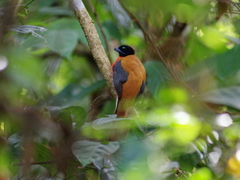
The cinnamon-rumped trogon (Harpactes orrhophaeus) is a species of bird in the family Trogonidae, known for their colorful plumage. The cinnamon-rumped trogon is a part of the family Trogonidae, which is monotypic within their order, Trogoniformes.

The cinnamon-rumped trogon is a close relative of the scarlet-rumped trogon, which also resides in the Malay peninsula and Indonesia. These two birds have similar appearances, but the cinnamon trogon is slightly larger, and the birds can be distinguished by the eponymous coloration of the plumage on their backs and tails.

Both subspecies exhibit distinct sexual dimorphism. The nominal subspecies (H. o. orrhophaeus) ranges from 45 – 61g and it is about 25 cm in length. Males of the subspecies have a black hood, distinct blue bill, and a narrow head. Their backs and tail plumage are a pale brown (cinnamon), and the plumage under the tail is white, bordered by black. Males have pink underbellies, which can be used to differentiate them from females, along with the female's dark brown hood... Wikipedia →

Sounds

Song0:38

Malaysia · 2025

© Ding Li Yong · XC1024778 · CC BY-NC-ND 4.0

Call0:14

Malaysia · 2022

© Wai Loon Wong · XC734406 · CC BY-NC-SA 4.0

Song0:20

Malaysia · 2025

© Kim Chuah Lim · XC997241 · CC BY-NC-SA 4.0

Global Distribution

Parks Where Found

# Park Country Daily sighting probability
1 Gunung Leuser National Park 🇮🇩 Indonesia
~10%
2 Taman Negara National Park 🇲🇾 Malaysia
<5%
3 Danum Valley Conservation Area 🇲🇾 Malaysia
<5%

Before you go

What are the chances of seeing a Cinnamon-rumped Trogon in Danum Valley Conservation Area?

Rare

Under 5% of wildlife watchers report a Cinnamon-rumped Trogon sighting in Danum Valley Conservation Area on a given day, based on 31 verified sightings from GBIF citizen-science data from 2019 to 2026. It is the 193rd most-seen of the 258 birds we can rate there. Over three days the chance rises to about 10%, if each day is a fresh chance.

When is the best time to see a Cinnamon-rumped Trogon in Danum Valley Conservation Area?

March

In that month about 10% of wildlife watchers report a Cinnamon-rumped Trogon in Danum Valley Conservation Area on a given day, against under 5% in April to February, the lowest months.

What time of day is best to see a Cinnamon-rumped Trogon?

Between 9 am and noon

Across all the parks we cover, that three-hour window holds the most Cinnamon-rumped Trogon sightings with a recorded time, and nearly all of them come between 6 am and 6 pm: it is a daytime animal.

Is Danum Valley Conservation Area the best place to see a Cinnamon-rumped Trogon?

3rd of 3

Of the 3 parks where we can rate Cinnamon-rumped Trogon sightings, Danum Valley Conservation Area ranks 3rd at under 5%. The best odds are in Gunung Leuser National Park (Indonesia, about 10%) and Taman Negara National Park (Malaysia, under 5%).

Which relatives of the Cinnamon-rumped Trogon live in Danum Valley Conservation Area?

Same genus: Harpactes

The closest relatives of the Cinnamon-rumped Trogon that you can see in Danum Valley Conservation Area (genus Harpactes, Asian Trogons) are Scarlet-rumped Trogon (about 20%), Diard's Trogon (about 20%) and Red-naped Trogon (about 20%), with each one's daily chance of a sighting.

Where does the Cinnamon-rumped Trogon sighting chance come from?

GBIF citizen-science records

It is estimated from how often the Cinnamon-rumped Trogon is recorded against all the birds logged in Danum Valley Conservation Area (31 verified sightings from 2019 to 2026), calibrated against known sighting rates. Figures are rounded to the nearest 10% because citizen-science data supports honest approximations, not decimals, and months with records from fewer than five people show "—". How it works.

← Back to Danum Valley Conservation Area