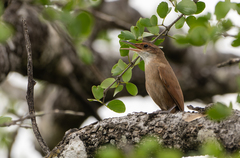

Chaco Earthcreeper

Chaco Earthcreeper

Upucerthia certhioides

Silhouette: Sheatherius · PhyloPic

LCLeast ConcernNTVUENCR
Daily sighting probability ~20% · Possible
at El Impenetrable National Park

In 3 days ~50% in a week ~80%

55 Verified sightings at El Impenetrable National Park From 2019 to 2026
55 In 1 park
September Best month
☀️ Diurnal When it's spotted

About the Chaco Earthcreeper

The Chaco earthcreeper (Tarphonomus certhioides) is a species of bird in the Furnariinae subfamily of the ovenbird family Furnariidae. It is found in Argentina, Bolivia, and Paraguay, and as a vagrant in Brazil. The Chaco earthcreeper has at times been placed in genera Ochetorhynchus and Upucerthia but since the early 2000s has been placed in its current Tarphonomus. It has at times been considered conspecific with the other member of Tarphonomus, the Bolivian earthcreeper (T. harterti). The two of them are sisters to the rusty-winged barbtail (Premnornis guttuliger), and these three are in turn sisters to the tuftedcheeks of genus Pseudocolaptes.

The Chaco earthcreeper is about 16 cm (6.3 in) long and weighs 18 to 31 g (0.63 to 1.09 oz). It is a small earthcreeper with a long and very slightly decurved bill. The sexes' plumages are alike. Adults of the nominate subspecies have an indistinct orange-rufous supercilium on a mostly dark brown face. Their... Wikipedia →

Sounds

Recording0:11

Argentina · 2024

ferferrari · iNaturalist · CC0

Recording0:10

Argentina · 2022

© Hugo · iNaturalist · CC BY-NC 4.0

Recording0:13

Argentina · 2026

© tuckylozano_pispeandoaves · iNaturalist · CC BY-NC 4.0

Global Distribution

Parks Where Found

# Park Country Daily sighting probability
1 El Impenetrable National Park 🇦🇷 Argentina
~20%

More parks will be added in future updates.

Before you go

What are the chances of seeing a Chaco Earthcreeper in El Impenetrable National Park?

Possible

About 20% of wildlife watchers report a Chaco Earthcreeper sighting in El Impenetrable National Park on a given day, based on 55 verified sightings from GBIF citizen-science data from 2019 to 2026. It is the 79th most-seen of the 219 birds we can rate there. Over three days the chance rises to about 50%, and over a week to about 80%, if each day is a fresh chance.

When is the best time to see a Chaco Earthcreeper in El Impenetrable National Park?

February–March, July and September–October

In those months about 30% of wildlife watchers report a Chaco Earthcreeper in El Impenetrable National Park on a given day, against about 10% in January, May–June and August, the lowest months. December has too few records to rate.

What time of day is best to see a Chaco Earthcreeper?

Between 9 am and noon

Across all the parks we cover, that three-hour window holds the most Chaco Earthcreeper sightings with a recorded time, and about 9 in 10 of them come between 6 am and 6 pm: it is a daytime animal.

Where else can you see a Chaco Earthcreeper?

Only El Impenetrable National Park, in our data

El Impenetrable National Park is the only park on Wallace's Line with enough records to rate Chaco Earthcreeper sightings: about 20% of wildlife watchers there report one on a given day.

Which relatives of the Chaco Earthcreeper live in El Impenetrable National Park?

Same family: Furnariidae

The closest relatives of the Chaco Earthcreeper that you can see in El Impenetrable National Park (family Furnariidae, Ovenbirds and Woodcreepers) are Narrow-billed Woodcreeper (about 70%), Rufous Hornero (about 60%) and Sooty-fronted Spinetail (about 50%), with each one's daily chance of a sighting.

Where does the Chaco Earthcreeper sighting chance come from?

GBIF citizen-science records

It is estimated from how often the Chaco Earthcreeper is recorded against all the birds logged in El Impenetrable National Park (55 verified sightings from 2019 to 2026), calibrated against known sighting rates. Figures are rounded to the nearest 10% because citizen-science data supports honest approximations, not decimals, and months with records from fewer than five people show "—". How it works.

← Back to El Impenetrable National Park