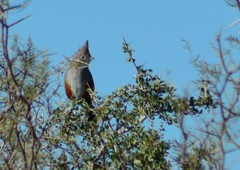
Crested Gallito

Crested Gallito

Rhinocrypta lanceolata

Silhouette: Ferran Sayol · PhyloPic

LCLeast ConcernNTVUENCR
Daily sighting probability ~20% · Possible
at El Impenetrable National Park

In 3 days ~40% in a week ~80%

48 Verified sightings at El Impenetrable National Park From 2019 to 2026
48 In 1 park
September Best month
☀️ Diurnal When it's spotted

About the Crested Gallito

The crested gallito (Rhinocrypta lanceolata) is a species of suboscine passerine bird in the tapaculo family Rhinocryptidae. It is the only species placed in the genus Rhinocrypta. It is found in Argentina, Bolivia, and Paraguay.

The crested gallito is the only species in its genus. The crested gallito is genetically most closely related to the sandy gallito (Teledromas fuscus). The crested gallito is 21 cm (8.3 in) long. The male weighs 59 to 63.5 g (2.08 to 2.24 oz) and the female 51.5 to 64 g (1.82 to 2.26 oz). It is an unusual tapaculo, having long crown feathers that it often erects as a crest and even bends forward. It also has a long tail that it cocks upward. The nominate subspecies' head is cinnamon with white streaks, its upper parts including wings and tail olive gray. The throat and chest are pale gray, the sides of the breast chestnut, and the lower belly olive gray. R. l. saturata is similar but all of the colors are darker.

The nominate subspecies of crested gallito ranges from northern... Wikipedia →

Sounds

Song0:32

Paraguay · 2023

© Edgar Romero · XC799113 · CC BY-NC-SA 4.0

Call0:13

Bolivia · 2019

© Jacob Wijpkema · XC489694 · CC BY-NC-SA 4.0

Alarm call0:28

Bolivia · 2001

© Dan Lane · XC150588 · CC BY-NC-SA 3.0

Global Distribution

Parks Where Found

# Park Country Daily sighting probability
1 El Impenetrable National Park 🇦🇷 Argentina
~20%

More parks will be added in future updates.

Before you go

What are the chances of seeing a Crested Gallito in El Impenetrable National Park?

Possible

About 20% of wildlife watchers report a Crested Gallito sighting in El Impenetrable National Park on a given day, based on 48 verified sightings from GBIF citizen-science data from 2019 to 2026. It is the 92nd most-seen of the 219 birds we can rate there. Over three days the chance rises to about 40%, and over a week to about 80%, if each day is a fresh chance.

When is the best time to see a Crested Gallito in El Impenetrable National Park?

September

In that month about 30% of wildlife watchers report a Crested Gallito in El Impenetrable National Park on a given day, against about 10% in January–February, April, July and October, the lowest months. That is one of El Impenetrable National Park's driest months, with about 30 mm of rain against 120 mm in March. December has too few records to rate.

What time of day is best to see a Crested Gallito?

Between 9 am and noon

Across all the parks we cover, that three-hour window holds the most Crested Gallito sightings with a recorded time, and about 8 in 10 of them come between 6 am and 6 pm: it is a daytime animal.

Where else can you see a Crested Gallito?

Only El Impenetrable National Park, in our data

El Impenetrable National Park is the only park on Wallace's Line with enough records to rate Crested Gallito sightings: about 20% of wildlife watchers there report one on a given day.

Which relatives of the Crested Gallito live in El Impenetrable National Park?

Same order: Passeriformes

The closest relatives of the Crested Gallito that you can see in El Impenetrable National Park (order Passeriformes, Perching Birds) are Brazilian Cardinal (about 80%), Blue-gray Saltator (about 80%) and Pearly-vented Tody-Tyrant (about 70%), with each one's daily chance of a sighting.

Where does the Crested Gallito sighting chance come from?

GBIF citizen-science records

It is estimated from how often the Crested Gallito is recorded against all the birds logged in El Impenetrable National Park (48 verified sightings from 2019 to 2026), calibrated against known sighting rates. Figures are rounded to the nearest 10% because citizen-science data supports honest approximations, not decimals, and months with records from fewer than five people show "—". How it works.

← Back to El Impenetrable National Park