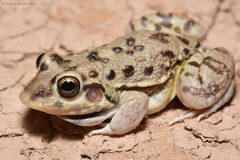
Vizcacheras' White-lipped Frog

Vizcacheras' White-lipped Frog

Leptodactylus bufonius

Silhouette: Jose Carlos Arenas-Monroy · PhyloPic

LCLeast ConcernNTVUENCR
Daily sighting probability ~40% · Likely
at El Impenetrable National Park

In 3 days ~80% in a week >90%

12 Verified sightings at El Impenetrable National Park From 2019 to 2026
12 In 1 park
April Best month
🌙 Nocturnal When it's spotted

About the Vizcacheras' White-lipped Frog

Leptodactylus bufonius, known commonly as the Oven frog, is a species of amphibian in the family Leptodactylidae. It is found in Argentina, Bolivia, Brazil, and Paraguay. The species was first described by George Albert Boulenger in an 1894 publication. He did not designate a holotype for the new species, instead having four syntypes. In 1931, Hampton Wildman Parker examined the syntypes, and placed the smallest two of them into Leptodactylus diptyx. Ronald Heyer would go on to designate one of the remaining two specimens as the lectotype in 1978, basing the selection on it being the closest match to Boulenger's original description. Boulenger did not comment on his choice of bufonius as the specific name of the species, but later authors have connected it to the Latin word for toad, bufo, and the presence of small bumps on the frog's back.

These generalist frogs live in many kinds of habitats. In Brazil, it has been reported in Amazonia, Pantanal, and Cerrado biomes. It has been observed as high as 800 meters above sea level. This frog has shown tolerance to anthropogenic disturbance.

The frog has been reported in many protected areas: Mburucuyá, Río Pilcomayo... Wikipedia →

Sounds

Recording0:17

Argentina · 2025

© Tomás Carranza Perales · iNaturalist · CC BY 4.0

Recording0:15

Argentina · 2011

© JuanMa PerezIglesias · iNaturalist · CC BY-NC 4.0

Recording0:26

Argentina · 2024

© Leonardo Adrián LEIVA · iNaturalist · CC BY-NC 4.0

Global Distribution

Parks Where Found

# Park Country Daily sighting probability
1 El Impenetrable National Park 🇦🇷 Argentina
~40%

More parks will be added in future updates.

Before you go

What are the chances of seeing a Vizcacheras' White-lipped Frog in El Impenetrable National Park?

Likely

About 40% of wildlife watchers report a Vizcacheras' White-lipped Frog sighting in El Impenetrable National Park on a given day, based on 12 verified sightings from GBIF citizen-science data from 2019 to 2026. It is the most-seen of the 5 amphibians we can rate there. Over three days the chance rises to about 80%, and over a week to over 90%, if each day is a fresh chance.

When is the best time to see a Vizcacheras' White-lipped Frog in El Impenetrable National Park?

April and November

In those months about 70% of wildlife watchers report a Vizcacheras' White-lipped Frog in El Impenetrable National Park on a given day, against under 5% in October, the lowest month. Those are among El Impenetrable National Park's wettest months, with about 120 mm of rain a month against 25 mm in July.

What time of day is best to see a Vizcacheras' White-lipped Frog?

Between 8 and 11 pm

Across all the parks we cover, that three-hour window holds the most Vizcacheras' White-lipped Frog sightings with a recorded time, and about 9 in 10 of them come between 6 pm and 6 am: it is mostly seen at night.

Where else can you see a Vizcacheras' White-lipped Frog?

Only El Impenetrable National Park, in our data

El Impenetrable National Park is the only park on Wallace's Line with enough records to rate Vizcacheras' White-lipped Frog sightings: about 40% of wildlife watchers there report one on a given day.

Where does the Vizcacheras' White-lipped Frog sighting chance come from?

GBIF citizen-science records

It is estimated from how often the Vizcacheras' White-lipped Frog is recorded against all the amphibians logged in El Impenetrable National Park (12 verified sightings from 2019 to 2026), calibrated against known sighting rates. Figures are rounded to the nearest 10% because citizen-science data supports honest approximations, not decimals, and months with records from fewer than five people show "—". How it works.

← Back to El Impenetrable National Park