Mountain Trogon

Mountain Trogon

Trogon mexicanus

Silhouette: Keith Murdock (photo), John E. McCormack, Michael G. Harvey, Brant C. Faircloth, Nicholas G. Crawford, Travis C. Glenn, Robb T. Brumfield & T. Michael Keesey · PhyloPic

LCLeast ConcernNTVUENCR
Daily sighting probability ~10% · With luck
at El Triunfo

In 3 days ~20% in a week ~40%

12 Verified sightings at El Triunfo From 2019 to 2026
186 In all 5 parks
March Best month
☀️ Diurnal When it's spotted

About the Mountain Trogon

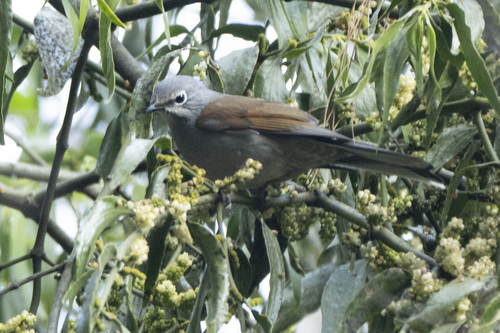
The mountain trogon (Trogon mexicanus), also known as the Mexican trogon, is a species of bird in the family Trogonidae. First described by William Swainson in 1827, it is resident in Guatemala, Honduras, and Mexico and has occurred in El Salvador as a vagrant. Like all trogons, the mountain trogon is sexually dimorphic. The male is metallic green on the crown, nape, upperparts and chest, the latter separated from its bright red belly and vent by a narrow band of white. The female is warm brown on the head, upperparts and chest, separated from its paler brown lower chest and red belly and vent by a narrow white band.

Its natural habitat is subtropical and tropical moist montane forests. It prefers pine-evergreen and pine-oak woodland between 3,000 and 10,000 ft (914 and 3,048 m) in elevation. Unlike some rarer trogons, this species shows some adaptability to human land use and has utilized coffee plantations with suitable shade trees like oaks.

When he first described the mountain trogon in 1827 from a specimen collected in Temascáltepec, Mexico, William Swainson gave the species its current scientific name. Most ornithologists have agreed with this assignment, though... Wikipedia →

Sounds

Song1:23

Mexico · 2025

© Barry Edmonston · XC1001117 · CC BY-NC-SA 4.0

Call0:09

Mexico · 2021

© Jessica Thompson Ambriz · XC675439 · CC BY-NC-SA 4.0

Song1:04

Mexico · 2024

© Matthew L. Brady · XC978365 · CC BY-NC-SA 4.0

Global Distribution

Parks Where Found

# Park Country Daily sighting probability
1 La Tigra National Park 🇭🇳 Honduras
~30%
2 Reserva de la Biosfera Mariposa Monarca 🇲🇽 Mexico
~10%
3 Celaque National Park 🇭🇳 Honduras
~10%
4 El Triunfo 🇲🇽 Mexico
~10%
5 Cumbres de Monterrey National Park 🇲🇽 Mexico
<5%

Cities Where Found

# City Country Daily sighting probability
1 Mexico City 🇲🇽 México
<5%

Before you go

What are the chances of seeing a Mountain Trogon in El Triunfo?

With luck

About 10% of wildlife watchers report a Mountain Trogon sighting in El Triunfo on a given day, based on 12 verified sightings from GBIF citizen-science data from 2019 to 2026. It is the 188th most-seen of the 221 birds we can rate there. Over three days the chance rises to about 20%, and over a week to about 40%, if each day is a fresh chance.

When is the best time to see a Mountain Trogon in El Triunfo?

March

In that month about 20% of wildlife watchers report a Mountain Trogon in El Triunfo on a given day, against under 5% in May, July–September and November–January, the lowest months. That is one of El Triunfo's driest months, with about 35 mm of rain against 420 mm in June. June has too few records to rate.

What time of day is best to see a Mountain Trogon?

Between 9 am and noon

Across all the parks we cover, that three-hour window holds the most Mountain Trogon sightings with a recorded time, and about 9 in 10 of them come between 6 am and 6 pm: it is a daytime animal.

Which relatives of the Mountain Trogon live in El Triunfo?

Same genus: Trogon

The closest relatives of the Mountain Trogon that you can see in El Triunfo (genus Trogon, New World Trogons) are Gartered Trogon (about 40%) and Collared Trogon (about 40%), with each one's daily chance of a sighting.

Where does the Mountain Trogon sighting chance come from?

GBIF citizen-science records

It is estimated from how often the Mountain Trogon is recorded against all the birds logged in El Triunfo (12 verified sightings from 2019 to 2026), calibrated against known sighting rates. Figures are rounded to the nearest 10% because citizen-science data supports honest approximations, not decimals, and months with records from fewer than five people show "—". How it works.

← Back to El Triunfo