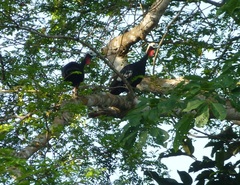
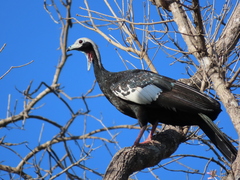
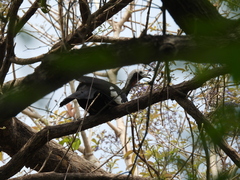

Red-throated Piping-Guan

Red-throated Piping-Guan

Pipile cujubi

Silhouette: Sheatherius · PhyloPic

LCNTVUVulnerableENCR
Daily sighting probability ~10% · With luck
at Parque Estadual Encontro das Águas

In 3 days ~30% in a week ~60%

242 Verified sightings at Parque Estadual Encontro das Águas From 2019 to 2026
242 In 1 park
December Best month
☀️ Diurnal When it's spotted

About the Red-throated Piping-Guan

The red-throated piping guan (Pipile cujubi) is a species of bird in the chachalaca, guan, and curassow family Cracidae. It is found in Bolivia and Brazil. The taxonomies of the International Ornithological Committee (IOC), The Clements Checklist of Birds of the World, and Handbook of the Birds of the World treat the red-throated piping guan as one of four species in genus Pipile. Though also agreeing with this treatment, the South American Classification Committee of the American Ornithological Society notes that "evidence for species rank for the four species of Pipile is weak". Various authors have proposed instead that the genus contains one, two, or three species, or that it should be subsumed entirely into genus Aburria with the wattled guan (A. aburri).

As currently accepted, the red-throated piping guan has two subspecies, the nominate Pipile cujubi cujubi and P. c. nattereri. The latter is sometimes treated as a subspecies of blue-throated piping guan (P. cumanensis) or as a species in its own right.

The red-throated piping guan is 69 to 76 cm (2.26 to 2.49 ft) long; P. c. nattereri weighs 1,100 to 1,300 g (2.4 to 2.9 lb). Both... Wikipedia →

Sounds

Song0:05

Brazil · 2017

© JAYRSON ARAUJO DE OLIVEIRA · XC414136 · CC BY-NC-SA 4.0

Call1:01

Brazil · 2011

© Daniel Lane · XC75712 · CC BY-NC-ND 2.5

Wing display0:06

Bolivia · 2001

© A. Bennett Hennessey · XC3274 · CC BY-NC-ND 2.5

Global Distribution

Parks Where Found

# Park Country Daily sighting probability
1 Parque Estadual Encontro das Águas 🇧🇷 Brazil
~10%

More parks will be added in future updates.

Zoos & Centres Where Found

# Zoo / Centre Country
1 Rio de Janeiro Zoological Garden 🇧🇷 Brazil In captivity

Before you go

What are the chances of seeing a Red-throated Piping-Guan in Parque Estadual Encontro das Águas?

With luck

About 10% of wildlife watchers report a Red-throated Piping-Guan sighting in Parque Estadual Encontro das Águas on a given day, based on 242 verified sightings from GBIF citizen-science data from 2019 to 2026. It is the 121st most-seen of the 308 birds we can rate there. Over three days the chance rises to about 30%, and over a week to about 60%, if each day is a fresh chance.

When is the best time to see a Red-throated Piping-Guan in Parque Estadual Encontro das Águas?

November and December

In those months about 30% of wildlife watchers report a Red-throated Piping-Guan in Parque Estadual Encontro das Águas on a given day, against about 10% in May–July and September, the lowest months. Those are among Parque Estadual Encontro das Águas's wettest months, with about 160 mm of rain a month against almost none in July. January to April have too few records to rate.

What time of day is best to see a Red-throated Piping-Guan?

Between 6 and 9 am

Across all the parks we cover, that three-hour window holds the most Red-throated Piping-Guan sightings with a recorded time, and about 8 in 10 of them come between 6 am and 6 pm: it is a daytime animal.

Where else can you see a Red-throated Piping-Guan?

Only Parque Estadual Encontro das Águas, in our data

Parque Estadual Encontro das Águas is the only park on Wallace's Line with enough records to rate Red-throated Piping-Guan sightings: about 10% of wildlife watchers there report one on a given day.

Where does the Red-throated Piping-Guan sighting chance come from?

GBIF citizen-science records

It is estimated from how often the Red-throated Piping-Guan is recorded against all the birds logged in Parque Estadual Encontro das Águas (242 verified sightings from 2019 to 2026), calibrated against known sighting rates. Figures are rounded to the nearest 10% because citizen-science data supports honest approximations, not decimals, and months with records from fewer than five people show "—". How it works.

← Back to Parque Estadual Encontro das Águas