
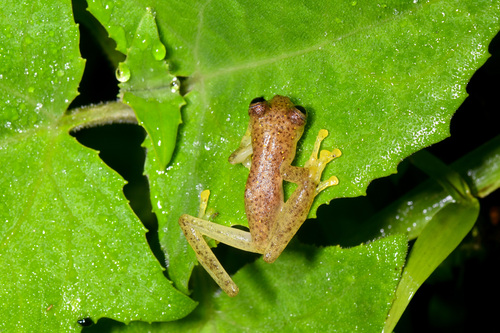
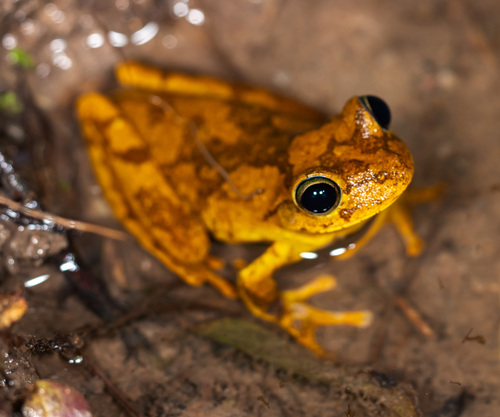
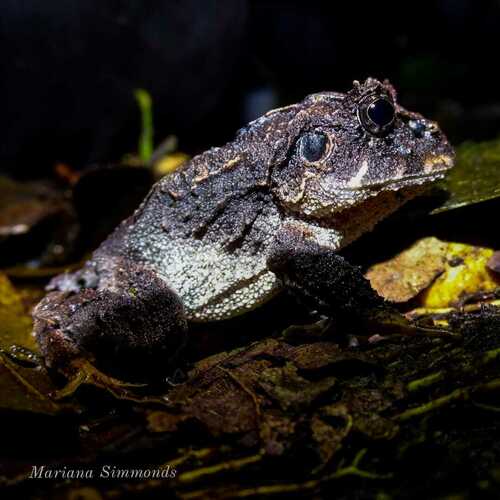
Lehmann's Frog

Lehmann's Frog

Oophaga lehmanni

Silhouette: Steven Traver · PhyloPic

LCNTVUENCRCritically Endangered Endemic
Daily sighting probability ~10% · With luck
at Farallones de Cali National Natural Park

In 3 days ~30% in a week ~50%

16 Verified sightings at Farallones de Cali National Natural Park From 2019 to 2026
16 In 1 park
December Best month
☀️🌙 Day & Night When it's spotted

About the Lehmann's Frog

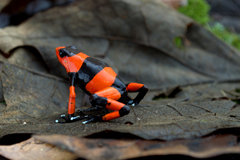
Lehmann's poison frog or the red-banded poison frog (Oophaga lehmanni) is a species of frogs in the family Dendrobatidae endemic to a small part of western Colombia. Its natural habitats are submontane tropical rainforests. It is threatened by habitat loss and collection for the pet trade, and the IUCN lists it as being "critically endangered". It was named after Colombian conservation biologist Federico Carlos Lehmann.

Lehmann's poison frog has a smooth skin and exhibits aposematic colouration, which warns predators that it is inedible. There are red, orange and yellow morphs of this frog. The background colour is black or dark brown which contrasts with the two bright, broad bands of colour round the body and further coloured bands on the limbs. The first toe is shorter than the second and the toes of males have silver tips. This frog grows to a snout-to-vent length of 31 to 36 mm (1.2 to 1.4 in).

It is very similar in appearance to the harlequin poison frog (Oophaga histrionicus), a species with which it can hybridise, and there is ongoing debate as to whether it is in fact a separate species. There are distinct differences in the calls of the males between northern... Wikipedia →

Global Distribution

Parks Where Found

# Park Country Daily sighting probability
1 Farallones de Cali National Natural Park 🇨🇴 Colombia
~10%

More parks will be added in future updates.

Zoos & Centres Where Found

# Zoo / Centre Country
1 Cali Zoo 🇨🇴 Colombia In captivity

Before you go

What are the chances of seeing a Lehmann's Frog in Farallones de Cali National Natural Park?

With luck

About 10% of wildlife watchers report a Lehmann's Frog sighting in Farallones de Cali National Natural Park on a given day, based on 16 verified sightings from GBIF citizen-science data from 2019 to 2026. It is the 10th most-seen of the 11 amphibians we can rate there. Over three days the chance rises to about 30%, and over a week to about 50%, if each day is a fresh chance.

When is the best time to see a Lehmann's Frog in Farallones de Cali National Natural Park?

June–July and December

In those months about 20% of wildlife watchers report a Lehmann's Frog in Farallones de Cali National Natural Park on a given day, against under 5% in January–February, May and October, the lowest months.

What time of day is best to see a Lehmann's Frog?

Between 10 am and 1 pm

Across all the parks we cover, that three-hour window holds the most Lehmann's Frog sightings with a recorded time, and about 7 in 10 of them come between 6 am and 6 pm: it is seen both by day and at night.

Where else can you see a Lehmann's Frog?

Only Farallones de Cali National Natural Park, in our data

Farallones de Cali National Natural Park is the only park on Wallace's Line with enough records to rate Lehmann's Frog sightings: about 10% of wildlife watchers there report one on a given day.

Which relatives of the Lehmann's Frog live in Farallones de Cali National Natural Park?

Same order: Anura

The closest relatives of the Lehmann's Frog that you can see in Farallones de Cali National Natural Park (order Anura, Frogs and Toads) are Giant Marine Toad (about 20%), Palmer's Robber Frog (about 10%) and Colombian Robber Frog (about 10%), with each one's daily chance of a sighting.

Where does the Lehmann's Frog sighting chance come from?

GBIF citizen-science records

It is estimated from how often the Lehmann's Frog is recorded against all the amphibians logged in Farallones de Cali National Natural Park (16 verified sightings from 2019 to 2026), calibrated against known sighting rates. Figures are rounded to the nearest 10% because citizen-science data supports honest approximations, not decimals, and months with records from fewer than five people show "—". How it works.

← Back to Farallones de Cali National Natural Park