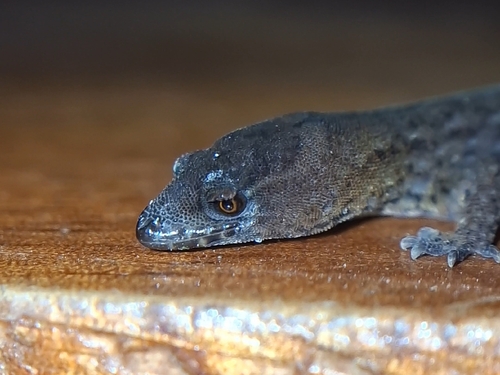
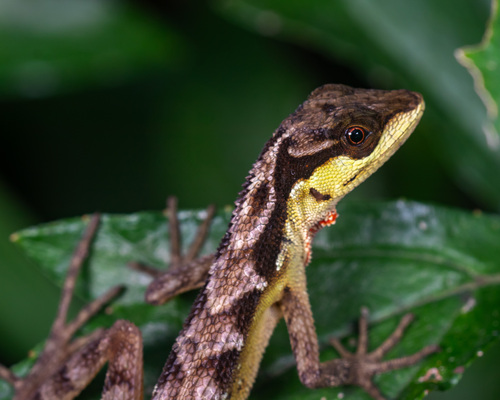
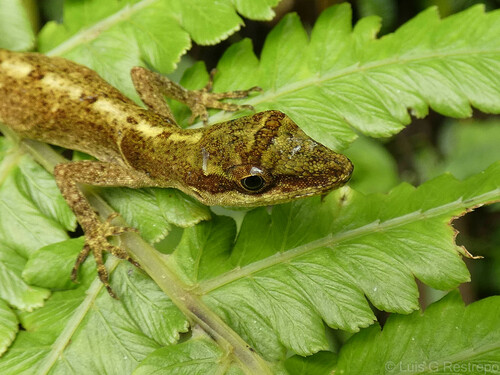
Lepidoblepharis duolepis

Lepidoblepharis duolepis

Lepidoblepharis duolepis

Silhouette: Jose Carlos Arenas-Monroy · PhyloPic

LCLeast ConcernNTVUENCR
Daily sighting probability ~10% · With luck
at Farallones de Cali National Natural Park

In 3 days ~30% in a week ~60%

5 Verified sightings at Farallones de Cali National Natural Park From 2019 to 2026
5 In 1 park
June Best month
☀️🌙 Day & Night When it's spotted

About the Lepidoblepharis duolepis

Lepidoblepharis duolepis is a species of gecko, a lizard in the family Sphaerodactylidae. The species is endemic to Colombia. L. duolepis is found in Antioquia Department and Valle del Cauca Department, Colombia. L. duolepis is oviparous.

Ayala, Stephen C.; Castro, Fernando (1983). "Dos nuevos geckos (Sauria: Gekkonidae, Sphaerodactylinae) para Colombia: Lepidoblepharis xanthostigma (Noble) y descripcion de una nueva especie ". Caldasia 13 (65): 743–753. (Lepidoblepharis duolepis, new species, pp. 749–752, Figure 5). (in Spanish, with an abstract in English).

Valencia-Zuleta A, Jaramillo-Martínez AF, Echeverry-Bocanegra A, Viáfra-Vega R, Hernández-Córdoba O, Cardona-Botero VE, Gutiérrez-Zúñiga J, Castro-Herrera F (2014). "Conservation status of the herpetofauna, protected areas, and current problems in Valle del Cauca, Colombia". Amphibian & Reptile Conservation 8 (2): 1–18. Wikipedia →

Global Distribution

Parks Where Found

# Park Country Daily sighting probability
1 Farallones de Cali National Natural Park 🇨🇴 Colombia
~10%

More parks will be added in future updates.

Before you go

What are the chances of seeing a Lepidoblepharis duolepis in Farallones de Cali National Natural Park?

With luck

About 10% of wildlife watchers report a Lepidoblepharis duolepis sighting in Farallones de Cali National Natural Park on a given day, based on 5 verified sightings from GBIF citizen-science data from 2019 to 2026. It is the 7th most-seen of the 13 reptiles we can rate there. Over three days the chance rises to about 30%, and over a week to about 60%, if each day is a fresh chance.

When is the best time to see a Lepidoblepharis duolepis in Farallones de Cali National Natural Park?

June

In that month about 30% of wildlife watchers report a Lepidoblepharis duolepis in Farallones de Cali National Natural Park on a given day, against under 5% in February, April and July–November, the lowest months.

What time of day is best to see a Lepidoblepharis duolepis?

Between 4 and 7 pm

Across all the parks we cover, that three-hour window holds the most Lepidoblepharis duolepis sightings with a recorded time, and about 6 in 10 of them come between 6 am and 6 pm: it is seen both by day and at night.

Where else can you see a Lepidoblepharis duolepis?

Only Farallones de Cali National Natural Park, in our data

Farallones de Cali National Natural Park is the only park on Wallace's Line with enough records to rate Lepidoblepharis duolepis sightings: about 10% of wildlife watchers there report one on a given day.

Where does the Lepidoblepharis duolepis sighting chance come from?

GBIF citizen-science records

It is estimated from how often the Lepidoblepharis duolepis is recorded against all the reptiles logged in Farallones de Cali National Natural Park (5 verified sightings from 2019 to 2026), calibrated against known sighting rates. Figures are rounded to the nearest 10% because citizen-science data supports honest approximations, not decimals, and months with records from fewer than five people show "—". How it works.

← Back to Farallones de Cali National Natural Park