Black Rain Frog

Black Rain Frog

Breviceps fuscus

Silhouette: Jose Carlos Arenas-Monroy · PhyloPic

LCLeast ConcernNTVUENCR Endemic
Daily sighting probability ~10% · With luck
at Garden Route National Park

In 3 days ~30% in a week ~60%

45 Verified sightings at Garden Route National Park From 2019 to 2026
45 In 1 park
January Best month
☀️ Diurnal When it's spotted

About the Black Rain Frog

Breviceps fuscus, also known as black rain frog, plain rain frog, brown short-headed frog, and Tsitsikamma rainfrog, is a species of frogs in the family Brevicipitidae. It is endemic to the southern coast of South Africa.

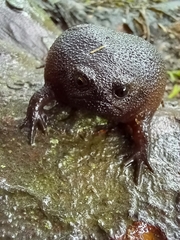
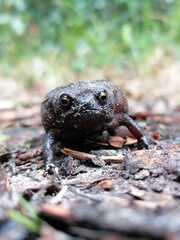
Breviceps fuscus have a round body with short limbs and toes. Its feet are inward facing which allows the frog to burrow much more effectively. They grow to about 40–51 mm (1.6–2.0 in) in snout–vent length.This species can also live anywhere from 4 to 15 years in age. Skin has no warts, but pronounced widely spaced lumps or small tubercles and pitting are present. Colouration is typically dark brown or nearly black, with a slightly lighter ventrum and no pigmented patterns. They have a squat body and their legs are rather short, which gives the frog its distinctive, avocado-like appearance.

The species is only found on the southern slopes of the Cape Fold Belt from Swellendam to the Outeniqua Mountains, at elevations of up to over 1,000 m (3,300 ft). It is a burrowing species inhabiting fynbos and forest fringes and does not require the presence of open water. They prefer to dwell near dislodged sand piles due to their... Wikipedia →

Sounds

Recording0:15

South Africa · 2024

© hinata · iNaturalist · CC BY-NC 4.0

Recording0:07

South Africa · 2018

© Alex Rebelo · iNaturalist · CC BY-NC 4.0

Recording0:11

South Africa · 2025

Marius Burger · iNaturalist · CC0

Global Distribution

Parks Where Found

# Park Country Daily sighting probability
1 Garden Route National Park 🇿🇦 South Africa
~10%

More parks will be added in future updates.

Before you go

What are the chances of seeing a Black Rain Frog in Garden Route National Park?

With luck

About 10% of wildlife watchers report a Black Rain Frog sighting in Garden Route National Park on a given day, based on 45 verified sightings from GBIF citizen-science data from 2019 to 2026. It is the 6th most-seen of the 12 amphibians we can rate there. Over three days the chance rises to about 30%, and over a week to about 60%, if each day is a fresh chance.

When is the best time to see a Black Rain Frog in Garden Route National Park?

January and November

In those months about 20% of wildlife watchers report a Black Rain Frog in Garden Route National Park on a given day, against about 10% in February–October and December, the lowest months.

What time of day is best to see a Black Rain Frog?

Between 10 am and 1 pm

Across all the parks we cover, that three-hour window holds the most Black Rain Frog sightings with a recorded time, and about 9 in 10 of them come between 6 am and 6 pm: it is a daytime animal.

Where else can you see a Black Rain Frog?

Only Garden Route National Park, in our data

Garden Route National Park is the only park on Wallace's Line with enough records to rate Black Rain Frog sightings: about 10% of wildlife watchers there report one on a given day.

Where does the Black Rain Frog sighting chance come from?

GBIF citizen-science records

It is estimated from how often the Black Rain Frog is recorded against all the amphibians logged in Garden Route National Park (45 verified sightings from 2019 to 2026), calibrated against known sighting rates. Figures are rounded to the nearest 10% because citizen-science data supports honest approximations, not decimals, and months with records from fewer than five people show "—". How it works.

← Back to Garden Route National Park