Black Rosy-Finch

Black Rosy-Finch

Leucosticte atrata

Silhouette: PhyloPic

LCNTVUENEndangeredCR Endemic
Daily sighting probability <5% · Rare
at Grand Teton National Park

In 3 days ~10%

85 Verified sightings at Grand Teton National Park From 2019 to 2026
163 In all 3 parks
March Best month
☀️ Diurnal When it's spotted

About the Black Rosy-Finch

The black rosy finch or black rosy-finch (Leucosticte atrata) is a species of passerine bird in the family Fringillidae native to alpine areas above treeline, of the western United States. It is the most range-restricted member of its genus, and a popular photography subject for birdwatchers.

The black rosy finch was first classified by American ornithologist Robert Ridgway in 1874. This bird has been thought to form a superspecies with the three other rosy finches: grey-crowned rosy finch (L. tephrocotis) and the brown-capped rosy finch (L. australis), all of which were classified as the same species as the Asian rosy finch (L. arctoa) from 1983–1993. Recent mitochondrial DNA evidence shows the rosy finches are all indeed very closely related and can be easily confused with one another. Along with four Asian rosy finches, the three North American rosy finches form the mountain finch genus Leucosticte. There are no recognized subspecies of the black rosy finch. Alternative common names include: roselin (in French), Rußschneegimpel (in German), and pinzón montano negro (in Spanish).

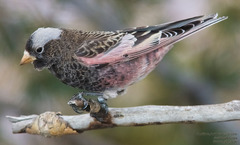
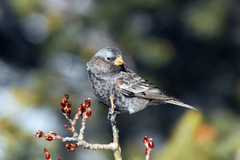
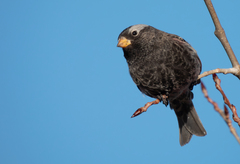
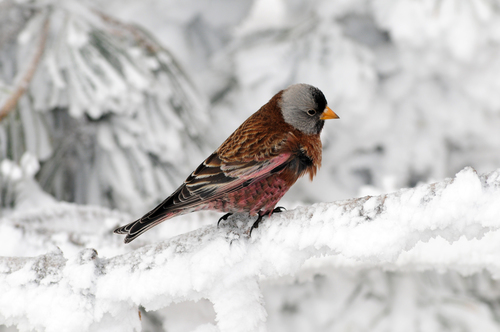
Adults are black on the head, back and breast with pink on the belly... Wikipedia →

Sounds

Call0:43

United States · 2013

© Andrew Spencer · XC143904 · CC BY-NC-SA 3.0

Flight call0:19

United States · 2015

© Paul Marvin · XC285095 · CC BY-NC-SA 4.0

Begging juvenile0:10

United States · 2012

© Steve Hampton · XC105946 · CC BY-NC-ND 2.5

Global Distribution

Parks Where Found

# Park Country Daily sighting probability
1 Grand Teton National Park 🇺🇸 United States
<5%
2 Rocky Mountain National Park 🇺🇸 United States
<5%
3 Yellowstone National Park 🇺🇸 United States
<5%

Before you go

What are the chances of seeing a Black Rosy-Finch in Grand Teton National Park?

Rare

Under 5% of wildlife watchers report a Black Rosy-Finch sighting in Grand Teton National Park on a given day, based on 85 verified sightings from GBIF citizen-science data from 2019 to 2026. It is the 126th most-seen of the 185 birds we can rate there. Over three days the chance rises to about 10%, if each day is a fresh chance.

When is the best time to see a Black Rosy-Finch in Grand Teton National Park?

March

In that month about 10% of wildlife watchers report a Black Rosy-Finch in Grand Teton National Park on a given day, against under 5% in April to February, the lowest months.

What time of day is best to see a Black Rosy-Finch?

Between 9 am and noon

Across all the parks we cover, that three-hour window holds the most Black Rosy-Finch sightings with a recorded time, and nearly all of them come between 6 am and 6 pm: it is a daytime animal.

Is Grand Teton National Park the best place to see a Black Rosy-Finch?

Yes

Of the 3 parks where we can rate Black Rosy-Finch sightings, Grand Teton National Park has the highest daily chance: under 5%. Next come Rocky Mountain National Park (United States, under 5%) and Yellowstone National Park (United States, under 5%).

Where does the Black Rosy-Finch sighting chance come from?

GBIF citizen-science records

It is estimated from how often the Black Rosy-Finch is recorded against all the birds logged in Grand Teton National Park (85 verified sightings from 2019 to 2026), calibrated against known sighting rates. Figures are rounded to the nearest 10% because citizen-science data supports honest approximations, not decimals, and months with records from fewer than five people show "—". How it works.

← Back to Grand Teton National Park