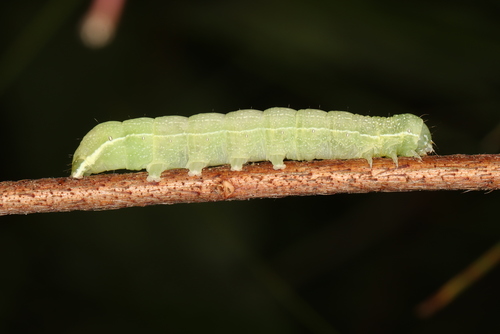
Green Arches

Green Arches

Anaplectoides prasina

Daily sighting probability ~10% · With luck
at Great Bear Rainforest

In 3 days ~20% in a week ~30%

9 Verified sightings at Great Bear Rainforest From 2019 to 2026
33 In all 3 parks
August Best month
☀️🌙 Day & Night When it's spotted

About the Green Arches

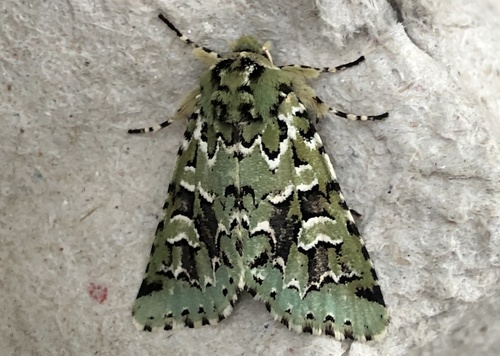
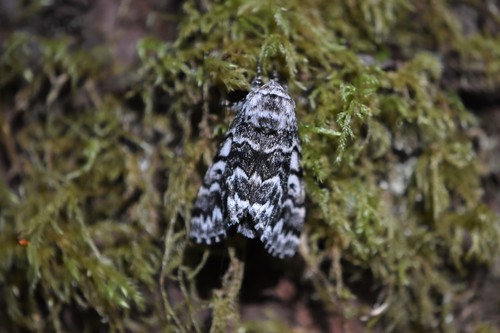
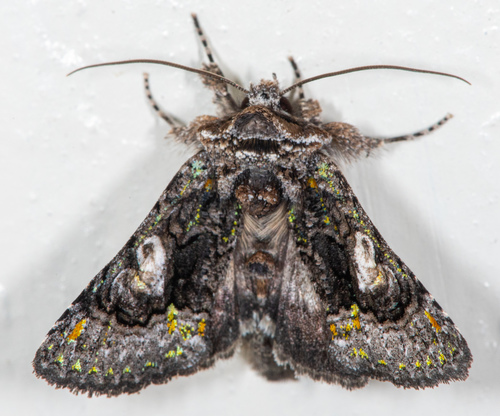
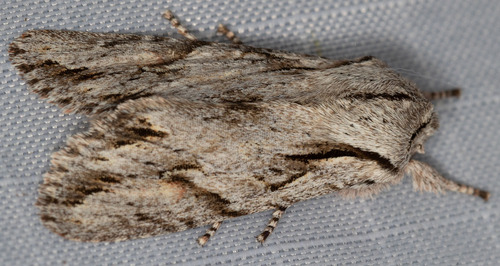
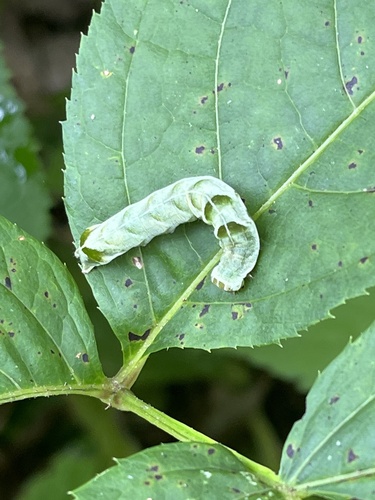
Anaplectoides prasina (green arches) is a species of moth of the family Noctuidae. It is found in both the Palearctic and Nearctic realms. Europe East to Siberia, Central Asia, Mongolia, China, Tibet, Korea and Japan. Also in Armenia and the Caucasus. In North America South Canada, Washington, Oregon, North Utah, New Mexico, New Jersey, Ohio, North Carolina.

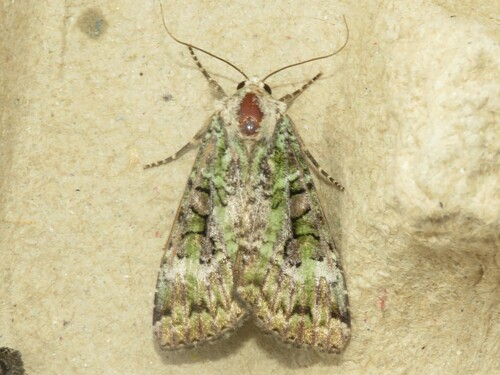
The wingspan is 40–50 mm. Green, variously tinged with dark green or blackish; a green-tinged cream coloured or whitish blotch between the reniform stigma and outer line; stigmata dark green edged with black; inner and outer lines black, conversely edged with white, or whitish green, or concolorous; hindwing fuscous with a paler fringe. — In jaspidea Bkh. the pale patch beyond the reniform stigma is wanting and the stigmata are blacker; ab. pallida Tutt represents the extreme pale form, the whole wing being whitish green, in which the white patch beyond the reniform is absorbed, and the lines and shades are distinct only in the costal half of wing; — ab. suffusa Tutt is a rare form in which the green tints are superseded by red brown with the area round the stigmata blackish; — in albimacula... Wikipedia →
Global Distribution

Parks Where Found

# Park Country Daily sighting probability
1 Cairngorms National Park 🇬🇧 United Kingdom
~10%
2 Great Bear Rainforest 🇨🇦 Canada
~10%
3 Bavarian Forest National Park 🇩🇪 Germany
~10%

Cities Where Found

# City Country Daily sighting probability
1 Nizhny Novgorod 🇷🇺 Russia
<5%
2 Helsinki 🇫🇮 Finland
<5%
3 Montreal 🇨🇦 Canada
<5%
4 Moscow 🇷🇺 Russia
<5%
5 Toronto 🇨🇦 Canada
<5%

Before you go

What are the chances of seeing a Green Arches in Great Bear Rainforest?

With luck

About 10% of wildlife watchers report a Green Arches sighting in Great Bear Rainforest on a given day, based on 9 verified sightings from GBIF citizen-science data from 2019 to 2026. It is the 137th most-seen of the 235 insects we can rate there. Over three days the chance rises to about 20%, and over a week to about 30%, if each day is a fresh chance.

When is the best time to see a Green Arches in Great Bear Rainforest?

July and August

In those months about 10% of wildlife watchers report a Green Arches in Great Bear Rainforest on a given day, against under 5% in September to June, the lowest months. Those are among Great Bear Rainforest's driest months, with about 140 mm of rain a month against 480 mm in November.

What time of day is best to see a Green Arches?

Between 7 and 10 am

Across all the parks we cover, that three-hour window holds the most Green Arches sightings with a recorded time, and about 6 in 10 of them come between 6 am and 6 pm: it is seen both by day and at night.

Is Great Bear Rainforest the best place to see a Green Arches?

Among the best

Of the 3 parks where we can rate Green Arches sightings, Great Bear Rainforest ranks 2nd at about 10%, level with the leaders once rounded. The best odds are in Cairngorms National Park (United Kingdom, about 10%).

Which relatives of the Green Arches live in Great Bear Rainforest?

Same family: Noctuidae

The closest relatives of the Green Arches that you can see in Great Bear Rainforest (family Noctuidae, Cutworm Moths and Allies) are Large Yellow Underwing (about 20%), Large Gray Dagger (about 10%) and American Angle Shades (about 10%), with each one's daily chance of a sighting.

Where does the Green Arches sighting chance come from?

GBIF citizen-science records

It is estimated from how often the Green Arches is recorded against all the insects logged in Great Bear Rainforest (9 verified sightings from 2019 to 2026), calibrated against known sighting rates. Figures are rounded to the nearest 10% because citizen-science data supports honest approximations, not decimals, and months with records from fewer than five people show "—". How it works.

← Back to Great Bear Rainforest