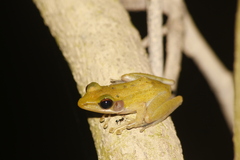

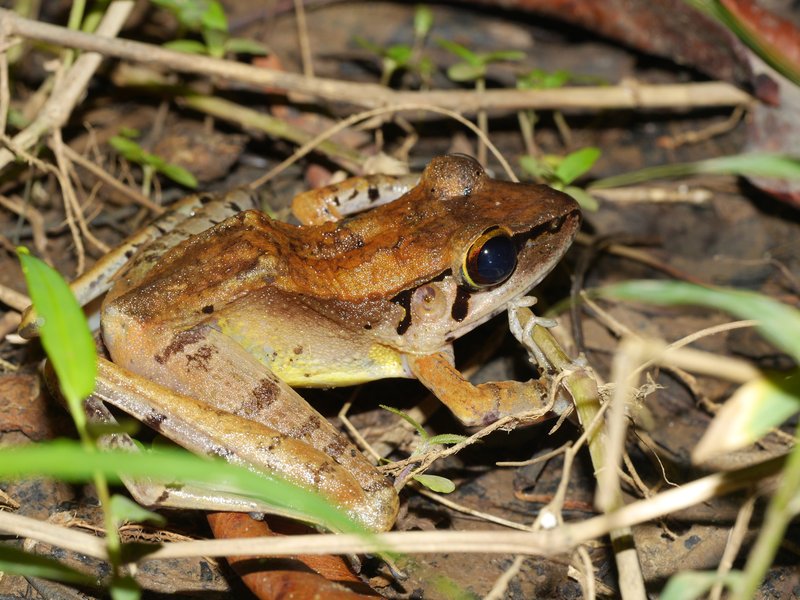
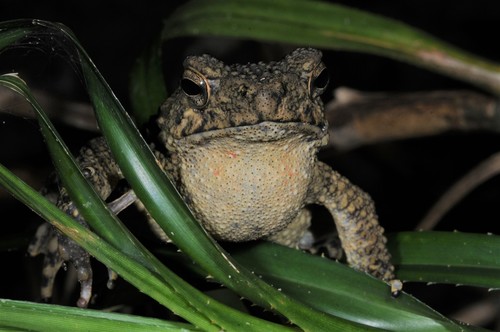
North Sumatra White-lipped Frog

North Sumatra White-lipped Frog

Chalcorana parvaccola

Silhouette: Michael Scroggie, from original photograph by John Bettaso, USFWS (original photograph in public domain). · PhyloPic

LCLeast ConcernNTVUENCR
Daily sighting probability ~20% · Possible
at Gunung Leuser National Park

In 3 days ~40% in a week ~70%

8 Verified sightings at Gunung Leuser National Park From 2019 to 2026
8 In 1 park
November Best month
☀️ Diurnal When it's spotted

About the North Sumatra White-lipped Frog

Chalcorana parvaccola is a species of "true frog" in the family Ranidae. It is endemic to Sumatra, Indonesia. It was split off from Chalcorana chalconota by Robert Inger and colleagues in 2009, along with a number of other species. The specific name parvaccola is derived from Latin parvus meaning small and accola meaning neighbor, and refers to this species being smaller than its "neighbor", the related Sumatran species Chalcorana rufipes.

Chalcorana parvaccola are relatively small frogs: adult males measure 28–38 mm (1.1–1.5 in) and females 38–43 mm (1.5–1.7 in) in snout–vent length. Body is slender and legs are long. The snout is narrowly rounded. The tympanum is distinct, larger in males than in females. The outer fingers have large discs; no webbing is present. The toe tips have discs that are smaller than the fingers ones. The webbing between the toes is extensive. Preserved specimens are brown dorsally and on the sides. The sides of the head are darker. The upper lip is lighter but is dusted with melanophores. There are small black spots on the dorsal surfaces. The venter is whitish and lightly dusted with melanophores. Most individuals lack dark crossbars on... Wikipedia →

Global Distribution

Parks Where Found

# Park Country Daily sighting probability
1 Gunung Leuser National Park 🇮🇩 Indonesia
~20%

More parks will be added in future updates.

Before you go

What are the chances of seeing a North Sumatra White-lipped Frog in Gunung Leuser National Park?

Possible

About 20% of wildlife watchers report a North Sumatra White-lipped Frog sighting in Gunung Leuser National Park on a given day, based on 8 verified sightings from GBIF citizen-science data from 2019 to 2026. It is the 5th most-seen of the 11 amphibians we can rate there. Over three days the chance rises to about 40%, and over a week to about 70%, if each day is a fresh chance.

When is the best time to see a North Sumatra White-lipped Frog in Gunung Leuser National Park?

November

In that month about 40% of wildlife watchers report a North Sumatra White-lipped Frog in Gunung Leuser National Park on a given day, against under 5% in February, May–July, September and December, the lowest months.

What time of day is best to see a North Sumatra White-lipped Frog?

Between 2 and 5 pm

Across all the parks we cover, that three-hour window holds the most North Sumatra White-lipped Frog sightings with a recorded time, and about 9 in 10 of them come between 6 am and 6 pm: it is a daytime animal.

Where else can you see a North Sumatra White-lipped Frog?

Only Gunung Leuser National Park, in our data

Gunung Leuser National Park is the only park on Wallace's Line with enough records to rate North Sumatra White-lipped Frog sightings: about 20% of wildlife watchers there report one on a given day.

Which relatives of the North Sumatra White-lipped Frog live in Gunung Leuser National Park?

Same family: Ranidae

The closest relatives of the North Sumatra White-lipped Frog that you can see in Gunung Leuser National Park (family Ranidae, Typical Frogs) are Poisonous Rock Frog (about 30%), Green Paddy Frog (about 10%) and Sumatra Huia Frog (about 10%), with each one's daily chance of a sighting.

Where does the North Sumatra White-lipped Frog sighting chance come from?

GBIF citizen-science records

It is estimated from how often the North Sumatra White-lipped Frog is recorded against all the amphibians logged in Gunung Leuser National Park (8 verified sightings from 2019 to 2026), calibrated against known sighting rates. Figures are rounded to the nearest 10% because citizen-science data supports honest approximations, not decimals, and months with records from fewer than five people show "—". How it works.

← Back to Gunung Leuser National Park