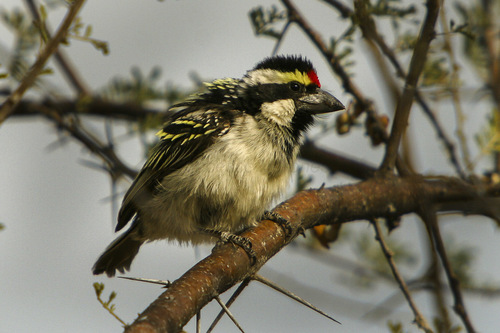
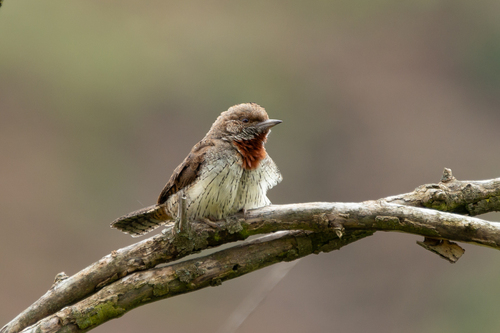
Southern Red-fronted Tinkerbird

Southern Red-fronted Tinkerbird

Pogoniulus pusillus

Silhouette: PhyloPic

LCLeast ConcernNTVUENCR
Daily sighting probability ~10% · With luck
at Hluhluwe-Imfolozi Park

In 3 days ~20% in a week ~40%

30 Verified sightings at Hluhluwe-Imfolozi Park From 2019 to 2026
310 In all 4 parks
December Best month
☀️ Diurnal When it's spotted

About the Southern Red-fronted Tinkerbird

The southern red-fronted tinkerbird, (Pogoniulus pusillus) is a small bird in the African barbet family Lybiidae. It is found in southern Mozambique and eastern South Africa. This species was formerly regarded as conspecific with the northern red-fronted tinkerbird (Pogoniulus uropygialis).

The southern red-fronted tinkerbird is associated with juniper forest and scrub. It nests in a tree hole and lays two or three eggs. It eats berries and fruit, particularly mistletoe, but also takes insects as it forages in deep cover.

The southern red-fronted tinkerbird is 9–10.5 cm (3.5–4.1 in) in length. It is a plump bird, with a short neck, large head, and short tail. The adult has black upper parts heavily streaked with yellow and white, and a golden wing patch. Its head has a strong black and white pattern, with a red forecrown spot. Its underparts and rump are lemon yellow. Sexes are similar in appearance, but young birds lack the red forehead.

This species is distinguished from the yellow-fronted tinkerbird by the colour of the forehead spot, the golden wing patch, and its overall darker appearance. It is often confused with the red-fronted barbet, but it is significantly... Wikipedia →

Sounds

Song0:46

South Africa · 2023

© Albert Lastukhin · XC895540 · CC BY-NC-ND 4.0

Call0:19

Kenya · 2022

© isaac kilusu · XC736069 · CC BY-NC-SA 4.0

Song0:22

South Africa · 2022

© Maarten Sluijter · XC802688 · CC BY-NC-SA 4.0

Global Distribution

Parks Where Found

# Park Country Daily sighting probability
1 uMkhuze Game Reserve 🇿🇦 South Africa
~30%
2 Hluhluwe-Imfolozi Park 🇿🇦 South Africa
~10%
3 iSimangaliso Wetland Park 🇿🇦 South Africa
~10%
4 Addo Elephant National Park 🇿🇦 South Africa
<5%

Cities Where Found

# City Country Daily sighting probability
1 Durban 🇿🇦 South Africa
<5%

Before you go

What are the chances of seeing a Southern Red-fronted Tinkerbird in Hluhluwe-Imfolozi Park?

With luck

About 10% of wildlife watchers report a Southern Red-fronted Tinkerbird sighting in Hluhluwe-Imfolozi Park on a given day, based on 30 verified sightings from GBIF citizen-science data from 2019 to 2026. It is the 124th most-seen of the 220 birds we can rate there. Over three days the chance rises to about 20%, and over a week to about 40%, if each day is a fresh chance.

When is the best time to see a Southern Red-fronted Tinkerbird in Hluhluwe-Imfolozi Park?

April and December

In those months about 20% of wildlife watchers report a Southern Red-fronted Tinkerbird in Hluhluwe-Imfolozi Park on a given day, against under 5% in May to September, the lowest months.

What time of day is best to see a Southern Red-fronted Tinkerbird?

Between 8 and 11 am

Across all the parks we cover, that three-hour window holds the most Southern Red-fronted Tinkerbird sightings with a recorded time, and nearly all of them come between 6 am and 6 pm: it is a daytime animal.

Is Hluhluwe-Imfolozi Park the best place to see a Southern Red-fronted Tinkerbird?

2nd of 4

Of the 4 parks where we can rate Southern Red-fronted Tinkerbird sightings, Hluhluwe-Imfolozi Park ranks 2nd at about 10%. The best odds are in uMkhuze Game Reserve (South Africa, about 30%).

Where does the Southern Red-fronted Tinkerbird sighting chance come from?

GBIF citizen-science records

It is estimated from how often the Southern Red-fronted Tinkerbird is recorded against all the birds logged in Hluhluwe-Imfolozi Park (30 verified sightings from 2019 to 2026), calibrated against known sighting rates. Figures are rounded to the nearest 10% because citizen-science data supports honest approximations, not decimals, and months with records from fewer than five people show "—". How it works.

← Back to Hluhluwe-Imfolozi Park