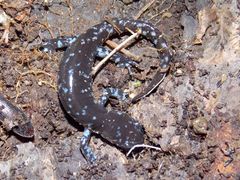
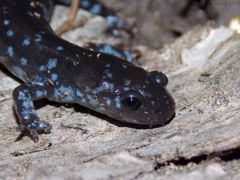
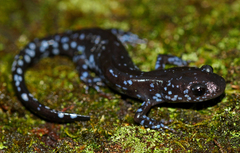
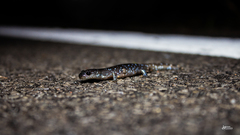

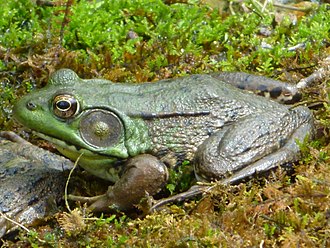
Blue-spotted Salamander

Blue-spotted Salamander

Ambystoma laterale

Silhouette: Matt Reinbold (modified by T. Michael Keesey) · PhyloPic

LCLeast ConcernNTVUENCR
Daily sighting probability ~10% · With luck
at Isle Royale National Park

In 3 days ~30% in a week ~60%

29 Verified sightings at Isle Royale National Park From 2019 to 2026
29 In 1 park
July Best month
☀️ Diurnal When it's spotted

About the Blue-spotted Salamander

The blue-spotted salamander (Ambystoma laterale) is a mole salamander native to the Great Lakes states and northeastern United States, and parts of Ontario and Quebec in Canada. Their range is known to extend to James Bay to the north, and southeastern Manitoba to the west. Blue-spotted salamanders include unisexual lineages that can reproduce without fertilization (gynogenesis).

Blue-spotted salamanders are between 10 and 14 cm (3.9 and 5.5 in) in length, of which the tail comprises 40%. Generally, males are slightly smaller than their female counterparts. Their skin is bluish-black, with characteristic blue and white flecks on its back, and bluish-white spots on the sides of its body and tail. They have elongated bodies. The vent is typically black, which contrasts with the paler belly. Larvae that have transformed may have yellow splotches; these turn blue once the individual becomes terrestrial. Occasionally, a melanistic individual may be found in the wild.

They have long toes: four on the front feet and five on the hind feet. Typically, specimens will have 12–14 costal grooves. Males tend to be smaller than females, though they have longer, flattened tails.... Wikipedia →

Global Distribution

Parks Where Found

# Park Country Daily sighting probability
1 Isle Royale National Park 🇺🇸 United States
~10%

More parks will be added in future updates.

Cities Where Found

# City Country Daily sighting probability
1 Montreal 🇨🇦 Canada
~10%

Zoos & Centres Where Found

# Zoo / Centre Country
1 Ecomuseum Zoo 🇨🇦 Canada In captivity

Before you go

What are the chances of seeing a Blue-spotted Salamander in Isle Royale National Park?

With luck

About 10% of wildlife watchers report a Blue-spotted Salamander sighting in Isle Royale National Park on a given day, based on 29 verified sightings from GBIF citizen-science data from 2019 to 2026. It is the 6th most-seen of the 6 amphibians we can rate there. Over three days the chance rises to about 30%, and over a week to about 60%, if each day is a fresh chance.

When is the best time to see a Blue-spotted Salamander in Isle Royale National Park?

April to November

In those months about 10% of wildlife watchers report a Blue-spotted Salamander in Isle Royale National Park on a given day, against under 5% in December to March, the lowest months.

What time of day is best to see a Blue-spotted Salamander?

Between noon and 3 pm

Across all the parks we cover, that three-hour window holds the most Blue-spotted Salamander sightings with a recorded time, and about 8 in 10 of them come between 6 am and 6 pm: it is a daytime animal.

Where else can you see a Blue-spotted Salamander?

Only Isle Royale National Park, in our data

Isle Royale National Park is the only park on Wallace's Line with enough records to rate Blue-spotted Salamander sightings: about 10% of wildlife watchers there report one on a given day.

Where does the Blue-spotted Salamander sighting chance come from?

GBIF citizen-science records

It is estimated from how often the Blue-spotted Salamander is recorded against all the amphibians logged in Isle Royale National Park (29 verified sightings from 2019 to 2026), calibrated against known sighting rates. Figures are rounded to the nearest 10% because citizen-science data supports honest approximations, not decimals, and months with records from fewer than five people show "—". How it works.

← Back to Isle Royale National Park