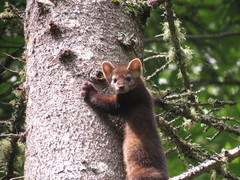
American Marten

American Marten

Martes americana

Silhouette: Margot Michaud · PhyloPic

LCLeast ConcernNTVUENCR
Daily sighting probability ~20% · Possible
at Jasper National Park

In 3 days ~40% in a week ~70%

22 Verified sightings at Jasper National Park From 2019 to 2026
103 In all 4 parks
November Best month
☀️ Diurnal When it's spotted

About the American Marten

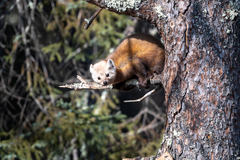
The American marten (Martes americana), also known as the American pine marten, is a species of North American mammal, a member of the family Mustelidae. The species is sometimes referred to as simply the pine marten. The name "pine marten" is derived from the common name of the related but distinct Eurasian species, Martes martes. Martes americana is found throughout Canada and parts of the northern United States including Alaska. It is a long, slender-bodied marten, with fur ranging from yellowish to brown to near black. It may be confused with the fisher (Pekania pennanti), but the marten is lighter in color and smaller. Identification of the marten is further eased by a characteristic bib that is a distinctly different color from the body. Sexual dimorphism is pronounced, with males being much larger.

These martens are omnivorous and their diet varies by season, but they rely chiefly on small mammals, such as voles. They are solitary except during the midsummer breeding season. Embryonic implantation is delayed until late winter, however, with a litter of one to five kits born the following spring. Young stay with the mother in a constructed den until the fall, and they reach sexual maturity by one year old.

Their sable-like fur made them a thoroughly trapped species during the height of the North American fur trade. Trapping peaked in 1820, and populations were depleted until after the turn of the century. Populations have rebounded since, with them being considered a species of least concern by the IUCN, but they remain extirpated from some areas of the Northeast, and of the seven subspecies, one is threatened. Wikipedia →

Sounds

Recording0:26

Canada · 2021

© Cerys_just_Cerys · iNaturalist · CC BY-NC 4.0

Recording0:32

Canada · 2024

© Tracy · iNaturalist · CC BY-NC 4.0

Global Distribution

Parks Where Found

# Park Country Daily sighting probability
1 Banff National Park 🇨🇦 Canada
~20%
2 Jasper National Park 🇨🇦 Canada
~20%
3 Riding Mountain National Park 🇨🇦 Canada
~10%
4 Glacier National Park 🇺🇸 United States
~10%

Zoos & Centres Where Found

# Zoo / Centre Country
1 Ecomuseum Zoo 🇨🇦 Canada In captivity
2 Minnesota Zoo 🇺🇸 United States In captivity
3 Alaska Wildlife Conservation Center 🇺🇸 United States In captivity
4 Bear Country USA 🇺🇸 United States In captivity

Before you go

What are the chances of seeing an American Marten in Jasper National Park?

Possible

About 20% of wildlife watchers report an American Marten sighting in Jasper National Park on a given day, based on 22 verified sightings from GBIF citizen-science data from 2019 to 2026. It is the 17th most-seen of the 25 mammals we can rate there. Over three days the chance rises to about 40%, and over a week to about 70%, if each day is a fresh chance.

When is the best time to see an American Marten in Jasper National Park?

March–April and October–January

In those months about 30% of wildlife watchers report an American Marten in Jasper National Park on a given day, against under 5% in February and August–September, the lowest months.

What time of day is best to see an American Marten?

Between 9 am and noon

Across all the parks we cover, that three-hour window holds the most American Marten sightings with a recorded time, and about 9 in 10 of them come between 6 am and 6 pm: it is a daytime animal.

Is Jasper National Park the best place to see an American Marten?

Among the best

Of the 4 parks where we can rate American Marten sightings, Jasper National Park ranks 2nd at about 20%, level with the leaders once rounded. The best odds are in Banff National Park (Canada, about 20%).

Where does the American Marten sighting chance come from?

GBIF citizen-science records

It is estimated from how often the American Marten is recorded against all the mammals logged in Jasper National Park (22 verified sightings from 2019 to 2026), calibrated against known sighting rates. Figures are rounded to the nearest 10% because citizen-science data supports honest approximations, not decimals, and months with records from fewer than five people show "—". How it works.

← Back to Jasper National Park