Fea's Muntjac

Fea's Muntjac

Muntiacus feae

Silhouette: Steven Traver · PhyloPic

Daily sighting probability ~10% · With luck
at Kaeng Krachan National Park

In 3 days ~20% in a week ~40%

8 Verified sightings at Kaeng Krachan National Park From 2019 to 2026
8 In 1 park
April Best month
☀️ Diurnal When it's spotted

About the Fea's Muntjac

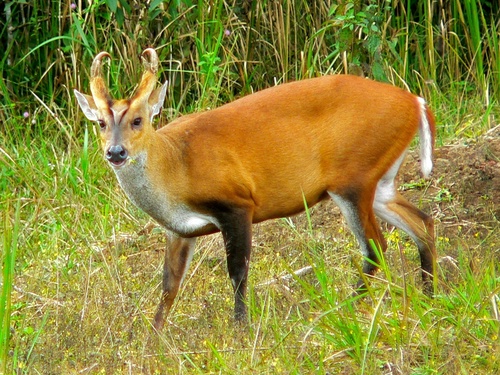
Fea's muntjac (Muntiacus feae) also called the Tenasserim muntjac, is a species of muntjac native to southern Myanmar and Thailand. Fea's muntjac has a brown, dark orange, or gray coat. The limbs and posterior tail are black. A lighter yellow-hued triangular patch extends down from the forehead with darker fur stretching from the muzzle to the orbital glands under the eyes. Two black lines extend down from the horns.

Fea's muntac weighs around 25kg. The holotype specimen (a male) was 88cm in length, not including the tail. It is larger and lighter in color than the Gongshan muntjac (Muntiacus gongshanensis), with which its range overlaps. It is similar in size to the red muntjac (Muntiacus vaginalis), with which it may also overlap but can be distinguished by its black tail.

Fea's muntjac lives along the border between Myanmar and Thailand. The species has also been observed in southwestern China and Tibet, however these veracity of these identifications have been called into question by the International Union for the Conservation of Nature (best known for creating the IUCN red list); the assessors note that many of the published reports... Wikipedia →

Global Distribution

Parks Where Found

# Park Country Daily sighting probability
1 Kaeng Krachan National Park 🇹🇭 Thailand
~10%

More parks will be added in future updates.

Zoos & Centres Where Found

# Zoo / Centre Country
1 Nakhon Ratchasima Zoo 🇹🇭 Thailand In captivity
2 Zoo Koki (Parque zoológico y botánico) 🇪🇸 Spain In captivity

Before you go

What are the chances of seeing a Fea's Muntjac in Kaeng Krachan National Park?

With luck

About 10% of wildlife watchers report a Fea's Muntjac sighting in Kaeng Krachan National Park on a given day, based on 8 verified sightings from GBIF citizen-science data from 2019 to 2026. It is the 23rd most-seen of the 32 mammals we can rate there. Over three days the chance rises to about 20%, and over a week to about 40%, if each day is a fresh chance.

When is the best time to see a Fea's Muntjac in Kaeng Krachan National Park?

April

In that month about 20% of wildlife watchers report a Fea's Muntjac in Kaeng Krachan National Park on a given day, against under 5% in March and June–January, the lowest months.

What time of day is best to see a Fea's Muntjac?

Between 5 and 8 am

Across all the parks we cover, that three-hour window holds the most Fea's Muntjac sightings with a recorded time, and about 8 in 10 of them come between 6 am and 6 pm: it is a daytime animal.

Where else can you see a Fea's Muntjac?

Only Kaeng Krachan National Park, in our data

Kaeng Krachan National Park is the only park on Wallace's Line with enough records to rate Fea's Muntjac sightings: about 10% of wildlife watchers there report one on a given day.

Where does the Fea's Muntjac sighting chance come from?

GBIF citizen-science records

It is estimated from how often the Fea's Muntjac is recorded against all the mammals logged in Kaeng Krachan National Park (8 verified sightings from 2019 to 2026), calibrated against known sighting rates. Figures are rounded to the nearest 10% because citizen-science data supports honest approximations, not decimals, and months with records from fewer than five people show "—". How it works.

← Back to Kaeng Krachan National Park