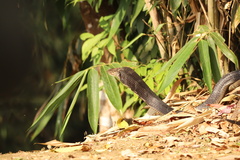
King Cobra

King Cobra

Ophiophagus hannah

Silhouette: V. Deepak · PhyloPic

LCNTVUVulnerableENCR
Daily sighting probability ~10% · With luck
at Kaeng Krachan National Park

In 3 days ~30% in a week ~60%

19 Verified sightings at Kaeng Krachan National Park From 2019 to 2026
25 In all 2 parks
June Best month
☀️ Diurnal When it's spotted

About the King Cobra

The king cobra (Ophiophagus hannah) is a species complex of snakes endemic to Asia. With an average length of 3.18 to 4 m (10.4 to 13.1 ft) and a record length of 5.85 m (19.2 ft), it is the world's longest venomous snake and among the heaviest. Under the genus Ophiophagus, it is not phylogenetically a true cobra despite its common name and some resemblance. Spanning from the Indian subcontinent through Southeastern Asia to Southern China, the king cobra is widely distributed albeit not commonly seen.

Individuals have diversified colouration across its habitats, from black with white strips to unbroken brownish grey, although after taxonomic re-evaluation, it is no longer the sole member of its genus but is now a species complex; these differences in pattern and other aspects may cause the genus to be split into at least four species, spread across its large geographic range.

It chiefly hunts other snakes, including those of its own kind, although other lizards and rodents are also occasional prey. This is the only ophidian that constructs an above-ground nest for its eggs, which are purposefully and meticulously gathered and protected by the female throughout the incubation period. Typical threat display of this elapid includes neck-flap spreading, head raising, hissing and sometimes charging. Capable of striking at a considerable range and height with an immense venom yield, envenomation from this species may induce rapid onset of neurotoxic and cytotoxic symptoms, requiring prompt antivenom administration. Despite the fearsome reputation, aggression toward humans usually only arises from an individual inadvertently exposing itself or being cornered; encounters happen through chance, including negative interactions.

Threatened by habitat destruction, it has been listed as Vulnerable on the IUCN Red List since 2010. Regarded as the national reptile of India, it has an eminent position in the mythology and folk traditions of India, Bangladesh, Sri Lanka and Myanmar. Wikipedia →

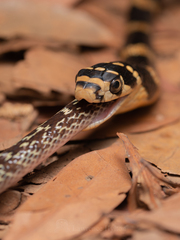
Global Distribution

Parks Where Found

# Park Country Daily sighting probability
1 Kaeng Krachan National Park 🇹🇭 Thailand
~10%
2 Khao Yai National Park 🇹🇭 Thailand
~10%

Zoos & Centres Where Found

# Zoo / Centre Country
1 San Diego Zoo 🇺🇸 United States In captivity
2 Cincinnati Zoo and Botanical Garden 🇺🇸 United States In captivity
3 Australia Zoo 🇦🇺 Australia In captivity
4 Cabarceno Natural Park 🇪🇸 Spain In captivity
5 Zoo Pilsen 🇨🇿 Czechia In captivity
6 Nandankanan Zoological Park 🇮🇳 India In captivity
7 Nehru Zoological Park 🇮🇳 India In captivity
8 Bronx Zoo 🇺🇸 United States In captivity
9 Toledo Zoo 🇺🇸 United States In captivity
10 Guangzhou Zoo 🇨🇳 China In captivity
11 Saint Louis Zoo 🇺🇸 United States In captivity
12 Fort Worth Zoo 🇺🇸 United States In captivity
13 Virginia Zoological Park 🇺🇸 United States In captivity
14 Saigon Zoo and Botanical Gardens 🇻🇳 Vietnam In captivity
15 Faunia 🇪🇸 Spain In captivity
16 Riverbanks Zoo 🇺🇸 United States In captivity
17 Reptile Gardens 🇺🇸 United States In captivity
18 Siam Serpentarium 🇹🇭 Thailand In captivity
19 Snake Farm of Queen Saovabha Memorial Institute 🇹🇭 Thailand In captivity
20 Underwater World Pattaya 🇹🇭 Thailand In captivity
21 Terrariet 🇩🇰 Denmark In captivity
22 Città della Domenica 🇮🇹 Italy In captivity
23 Seattle Marine Aquarium 🇺🇸 United States In captivity

Before you go

What are the chances of seeing a King Cobra in Kaeng Krachan National Park?

With luck

About 10% of wildlife watchers report a King Cobra sighting in Kaeng Krachan National Park on a given day, based on 19 verified sightings from GBIF citizen-science data from 2019 to 2026. It is the 29th most-seen of the 56 reptiles we can rate there. Over three days the chance rises to about 30%, and over a week to about 60%, if each day is a fresh chance.

When is the best time to see a King Cobra in Kaeng Krachan National Park?

March, June, August and October

In those months about 20% of wildlife watchers report a King Cobra in Kaeng Krachan National Park on a given day, against under 5% in July and September, the lowest months.

What time of day is best to see a King Cobra?

Between 9 am and noon

Across all the parks we cover, that three-hour window holds the most King Cobra sightings with a recorded time, and about 7 in 10 of them come between 6 am and 6 pm: it is a daytime animal.

Is Kaeng Krachan National Park the best place to see a King Cobra?

Yes

Of the 2 parks where we can rate King Cobra sightings, Kaeng Krachan National Park has the highest daily chance: about 10%. Next come Khao Yai National Park (Thailand, about 10%).

Where does the King Cobra sighting chance come from?

GBIF citizen-science records

It is estimated from how often the King Cobra is recorded against all the reptiles logged in Kaeng Krachan National Park (19 verified sightings from 2019 to 2026), calibrated against known sighting rates. Figures are rounded to the nearest 10% because citizen-science data supports honest approximations, not decimals, and months with records from fewer than five people show "—". How it works.

← Back to Kaeng Krachan National Park