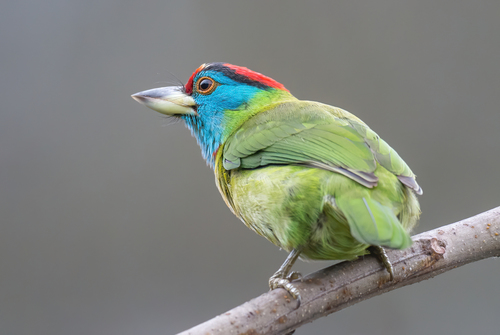
Moustached Barbet

Moustached Barbet

Psilopogon incognitus

Silhouette: Vijay Cavale (photo), John E. McCormack, Michael G. Harvey, Brant C. Faircloth, Nicholas G. Crawford, Travis C. Glenn, Robb T. Brumfield & T. Michael Keesey · PhyloPic

LCLeast ConcernNTVUENCR
Daily sighting probability <5% · Rare
at Kaeng Krachan National Park

In 3 days ~10% in a week ~20%

164 Verified sightings at Kaeng Krachan National Park From 2019 to 2026
2,339 In all 2 parks
September Best month
🌅 Crepuscular When it's spotted

About the Moustached Barbet

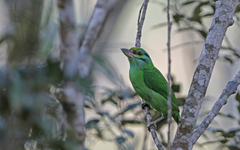
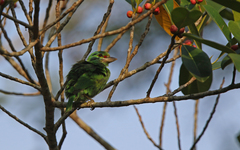
The moustached barbet (Psilopogon incognitus) is an Asian barbet. Barbets are a group of near passerine birds with a world-wide tropical distribution. They get their name from the bristles which fringe their heavy bills.

The moustached barbet is a resident breeder in the hills of Myanmar, Thailand, Cambodia, Laos and Vietnam. It is a species of broadleaf evergreen forest from 600 to 700 m. It nests in a tree hole. This barbet is 23 cm in length. It is a plump bird, with a short neck, large head and short tail. The bill is dark horn, and the body plumage is green. The adult of the form, P. i. elbeli, which occurs in northern Thailand has a red forehead, green crown with a red spot at the rear, a blue face and throat, and black eyestripe and moustache. The sexes are similar, but the juvenile has a duller, greener head and throat with a narrower moustache..

The male's territorial call is a repeated loud u'ik-a-ruk u'ik-a-ruk u'ik-a-ruk. Birdlife International Robson, Craig A Field Guide to the Birds of Thailand ISBN 1... Wikipedia →

Sounds

Song0:20

Thailand · 2025

© Peter Ericsson · XC973204 · CC BY-NC-SA 4.0

Call0:40

Cambodia · 2022

© Brad Kremer · XC702904 · CC BY-NC-SA 4.0

Song0:34

Laos · 2021

© Bram Piot · XC632756 · CC BY-NC-SA 4.0

Global Distribution

Parks Where Found

# Park Country Daily sighting probability
1 Khao Yai National Park 🇹🇭 Thailand
~60%
2 Kaeng Krachan National Park 🇹🇭 Thailand
<5%

Before you go

What are the chances of seeing a Moustached Barbet in Kaeng Krachan National Park?

Rare

Under 5% of wildlife watchers report a Moustached Barbet sighting in Kaeng Krachan National Park on a given day, based on 164 verified sightings from GBIF citizen-science data from 2019 to 2026. It is the 212th most-seen of the 360 birds we can rate there. Over three days the chance rises to about 10%, and over a week to about 20%, if each day is a fresh chance.

When is the best time to see a Moustached Barbet in Kaeng Krachan National Park?

March and September

In those months about 10% of wildlife watchers report a Moustached Barbet in Kaeng Krachan National Park on a given day, against under 5% in April–August and October–February, the lowest months.

What time of day is best to see a Moustached Barbet?

Between 2 and 5 am

Across all the parks we cover, that three-hour window holds the most Moustached Barbet sightings with a recorded time, and about half of them come between 6 pm and 6 am: it is most active around dawn and dusk.

Is Kaeng Krachan National Park the best place to see a Moustached Barbet?

2nd of 2

Of the 2 parks where we can rate Moustached Barbet sightings, Kaeng Krachan National Park ranks 2nd at under 5%. The best odds are in Khao Yai National Park (Thailand, about 60%).

Which relatives of the Moustached Barbet live in Kaeng Krachan National Park?

Same genus: Psilopogon

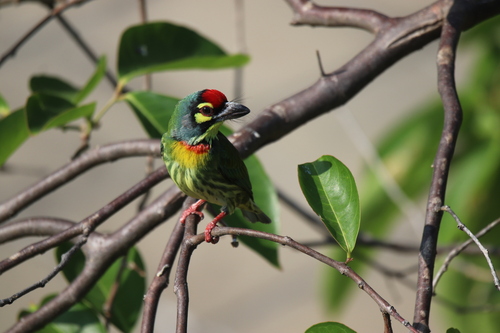
The closest relatives of the Moustached Barbet that you can see in Kaeng Krachan National Park (genus Psilopogon, Typical Asian Barbets) are Black-eared Barbet (about 40%), Green-eared Barbet (about 40%) and Coppersmith Barbet (about 30%), with each one's daily chance of a sighting.

Where does the Moustached Barbet sighting chance come from?

GBIF citizen-science records

It is estimated from how often the Moustached Barbet is recorded against all the birds logged in Kaeng Krachan National Park (164 verified sightings from 2019 to 2026), calibrated against known sighting rates. Figures are rounded to the nearest 10% because citizen-science data supports honest approximations, not decimals, and months with records from fewer than five people show "—". How it works.

← Back to Kaeng Krachan National Park