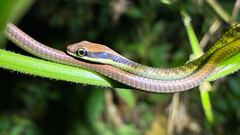
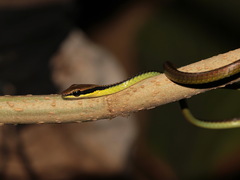
Wall's Bronzeback

Wall's Bronzeback

Dendrelaphis cyanochloris

Silhouette: Alex Slavenko · PhyloPic

LCLeast ConcernNTVUENCR
Daily sighting probability ~10% · With luck
at Kaeng Krachan National Park

In 3 days ~20% in a week ~40%

6 Verified sightings at Kaeng Krachan National Park From 2019 to 2026
11 In all 2 parks
July Best month
☀️ Diurnal When it's spotted

About the Wall's Bronzeback

Dendrelaphis cyanochloris, commonly known as Wall's bronzeback or the blue bronzeback, is a species of colubrid snake found in Southeast Asia. Dendrelaphis cyanochloris belongs to the genus Dendrelaphis, which contains 48 other described species. D. cyanochloris is most closely related to Dendrelaphis ngansonensis, and together the two might form a species complex.

Dendrelaphis is one of five genera belonging to the vine snake subfamily Ahaetuliinae, of which Dendrelaphis is most closely related to Chrysopelea, as shown in the cladogram below: The species occurs in India (Assam, Arunachal Pradesh (Namdapha - Changlang district); Andaman Islands, northern parts of West Bengal), Bangladesh, Myanmar, southern Thailand, and western Malaysia (Pulau Pinang, Pahang, Pulau Tioman), possibly also in Bhutan. It is predominantly arboreal and inhabits primary and mature secondary lowland rainforest, at altitudes of up to 1,000 m.

Like other bronzebacks, this snake is diurnal and fully arboreal, and has oviparous reproduction. Common and widespread, Wall's bronzeback is currently classified as Least Concern by the IUCN, although... Wikipedia →

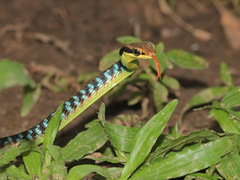
Global Distribution

Parks Where Found

# Park Country Daily sighting probability
1 Taman Negara National Park 🇲🇾 Malaysia
~20%
2 Kaeng Krachan National Park 🇹🇭 Thailand
~10%

Cities Where Found

# City Country Daily sighting probability
1 Kuala Lumpur 🇲🇾 Malaysia
~10%
2 Singapore 🇸🇬 Singapore
<5%

Before you go

What are the chances of seeing a Wall's Bronzeback in Kaeng Krachan National Park?

With luck

About 10% of wildlife watchers report a Wall's Bronzeback sighting in Kaeng Krachan National Park on a given day, based on 6 verified sightings from GBIF citizen-science data from 2019 to 2026. It is the 44th most-seen of the 56 reptiles we can rate there. Over three days the chance rises to about 20%, and over a week to about 40%, if each day is a fresh chance.

When is the best time to see a Wall's Bronzeback in Kaeng Krachan National Park?

July

In that month about 20% of wildlife watchers report a Wall's Bronzeback in Kaeng Krachan National Park on a given day, against under 5% in January–April, June and August–September, the lowest months. That is one of Kaeng Krachan National Park's wettest months, with about 230 mm of rain against 30 mm in December.

What time of day is best to see a Wall's Bronzeback?

Between 5 and 8 am

Across all the parks we cover, that three-hour window holds the most Wall's Bronzeback sightings with a recorded time, and about 7 in 10 of them come between 6 am and 6 pm: it is a daytime animal.

Is Kaeng Krachan National Park the best place to see a Wall's Bronzeback?

2nd of 2

Of the 2 parks where we can rate Wall's Bronzeback sightings, Kaeng Krachan National Park ranks 2nd at about 10%. The best odds are in Taman Negara National Park (Malaysia, about 20%).

Which relatives of the Wall's Bronzeback live in Kaeng Krachan National Park?

Same genus: Dendrelaphis

The closest relatives of the Wall's Bronzeback that you can see in Kaeng Krachan National Park (genus Dendrelaphis, Bronzebacks) are Common Bronze-back (about 10%) and sawtooth-necked bronzeback (about 10%), with each one's daily chance of a sighting.

Where does the Wall's Bronzeback sighting chance come from?

GBIF citizen-science records

It is estimated from how often the Wall's Bronzeback is recorded against all the reptiles logged in Kaeng Krachan National Park (6 verified sightings from 2019 to 2026), calibrated against known sighting rates. Figures are rounded to the nearest 10% because citizen-science data supports honest approximations, not decimals, and months with records from fewer than five people show "—". How it works.

← Back to Kaeng Krachan National Park