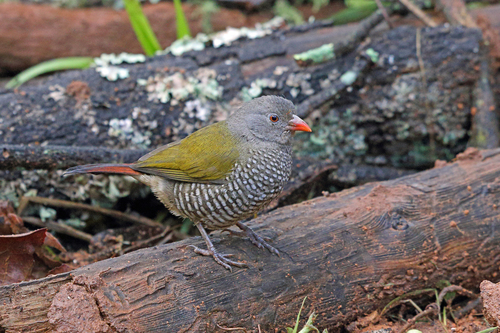
Locustfinch

Locustfinch

Paludipasser locustella

Silhouette: Sheatherius · PhyloPic

LCLeast ConcernNTVUENCR
Daily sighting probability <5% · Rare
at Kafue National Park

In 3 days ~10% in a week ~20%

14 Verified sightings at Kafue National Park From 2019 to 2026
14 In 1 park
March Best month
☀️ Diurnal When it's spotted

About the Locustfinch

The locust finch or locustfinch (Paludipasser locustella) is a species of waxbill found in south-central and south-eastern Africa. It is the only species in the genus Paludipasser. It is sometimes placed in the genus Ortygospiza.

The locust finch was first formally described in 1909 by the English naturalist and entomologist Sheffield Airey Neave with the type, a subadult male, being collected at the Upper Luansenshi River, north-east of Bangweolo, Northern Rhodesia, i.e. Zambia. Neave placed it in the monotypic genus Paludipasser within the waxbill family Estrildidae, but it has also been placed in the same genus as the quailfinch, Ortygospiza.

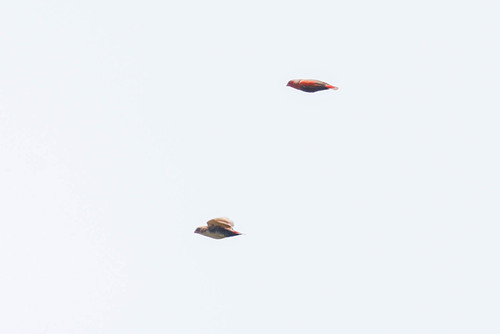
The locust finch is similar to the quailfinch but males have a red face, throat and breast with rufous wings and black body with white spots but with a plain back belly. The females also have rufous wings and lack the white face markings of female quailfinches while immatures have black and brown streaks on the upperparts and browner underparts than females. This species has a body which is 9 to 10 cm (3.5 to 3.9 in) in length.

It is mainly native to the Uele River basin, Zambia... Wikipedia →
Sounds

Flight call0:16

Zambia · 2021

© Hans Matheve · XC699699 · CC BY-NC-ND 4.0

Call0:15

Zambia · 2020

© Dries Van de Loock · XC585231 · CC BY-NC-SA 4.0

Flight call0:06

Malawi · 2015

© Frank Lambert · XC309954 · CC BY-NC-ND 4.0

Global Distribution

Parks Where Found

# Park Country Daily sighting probability
1 Kafue National Park 🇿🇲 Zambia
<5%

More parks will be added in future updates.

Before you go

What are the chances of seeing a Locustfinch in Kafue National Park?

Rare

Under 5% of wildlife watchers report a Locustfinch sighting in Kafue National Park on a given day, based on 14 verified sightings from GBIF citizen-science data from 2019 to 2026. It is the 273rd most-seen of the 338 birds we can rate there. Over three days the chance rises to about 10%, and over a week to about 20%, if each day is a fresh chance.

When is the best time to see a Locustfinch in Kafue National Park?

March and September–October

In those months about 10% of wildlife watchers report a Locustfinch in Kafue National Park on a given day, against under 5% in April–August and November–February, the lowest months. Those are among Kafue National Park's driest months, with about 40 mm of rain a month against 290 mm in January.

What time of day is best to see a Locustfinch?

Between 8 and 11 am

Across all the parks we cover, that three-hour window holds the most Locustfinch sightings with a recorded time, and about 9 in 10 of them come between 6 am and 6 pm: it is a daytime animal.

Where else can you see a Locustfinch?

Only Kafue National Park, in our data

Kafue National Park is the only park on Wallace's Line with enough records to rate Locustfinch sightings: under 5% of wildlife watchers there report one on a given day.

Which relatives of the Locustfinch live in Kafue National Park?

Same family: Estrildidae

The closest relatives of the Locustfinch that you can see in Kafue National Park (family Estrildidae, Waxbills and Allies) are Blue-breasted Cordonbleu (about 40%), Red-billed Firefinch (about 20%) and Peters's Twinspot (about 10%), with each one's daily chance of a sighting.

Where does the Locustfinch sighting chance come from?

GBIF citizen-science records

It is estimated from how often the Locustfinch is recorded against all the birds logged in Kafue National Park (14 verified sightings from 2019 to 2026), calibrated against known sighting rates. Figures are rounded to the nearest 10% because citizen-science data supports honest approximations, not decimals, and months with records from fewer than five people show "—". How it works.

← Back to Kafue National Park