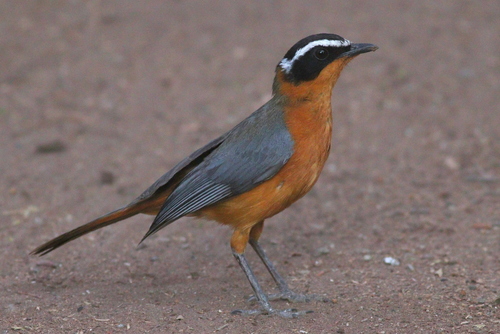
Red-capped Crombec

Red-capped Crombec

Sylvietta ruficapilla

Silhouette: PhyloPic

LCLeast ConcernNTVUENCR
Daily sighting probability <5% · Rare
at Kafue National Park

In 3 days ~10%

10 Verified sightings at Kafue National Park From 2019 to 2026
10 In 1 park
March Best month
☀️ Diurnal When it's spotted

About the Red-capped Crombec

The red-capped crombec (Sylvietta ruficapilla) is a species of African warbler, formerly placed in the family Sylviidae. It is found in Angola, Republic of the Congo, the DRC, Malawi, Mozambique, Tanzania, Zambia, Zimbabwe, and possibly Botswana.

Its natural habitats are subtropical or tropical dry forests, subtropical or tropical dry shrubland, and subtropical or tropical moist shrubland. The red-capped crombec belongs to the Sylviidae family, a family considered Old World Warblers with it being a member of the genus Sylvietta. The red-capped crombec are found in sub-Saharan Africa near countries like the Republic of Congo, DRC, Zambia, and Mozambique.

The red-capped crombec has been observed to breed at the end of the dry season for countries like the Republic of Congo, DRC, Zambia, and Mozambique. They are stationary birds that nest using grass, and spider webs creating a cup shaped nest. They are often found nesting in trees and occasional tall, thick shrubs. Red-capped crombecs are found to be territorial of their nesting sites, often having 2-4 eggs, and the eggs incubate for around 12 days. Typical African warblers such as the red capped... Wikipedia →

Sounds

Call0:13

Zambia · 2023

© Dries Van de Loock · XC810318 · CC BY-NC-ND 4.0

Uncertain0:20

Zambia · 2021

© Hans Matheve · XC699727 · CC BY-NC-ND 4.0

Song0:16

Angola · 2019

© Arnon Dattner · XC568077 · CC BY-NC-SA 4.0

Global Distribution

Parks Where Found

# Park Country Daily sighting probability
1 Kafue National Park 🇿🇲 Zambia
<5%

More parks will be added in future updates.

Before you go

What are the chances of seeing a Red-capped Crombec in Kafue National Park?

Rare

Under 5% of wildlife watchers report a Red-capped Crombec sighting in Kafue National Park on a given day, based on 10 verified sightings from GBIF citizen-science data from 2019 to 2026. It is the 300th most-seen of the 338 birds we can rate there. Over three days the chance rises to about 10%, if each day is a fresh chance.

When is the best time to see a Red-capped Crombec in Kafue National Park?

March, May and August

In those months about 10% of wildlife watchers report a Red-capped Crombec in Kafue National Park on a given day, against under 5% in April, June–July and September–February, the lowest months. Those are among Kafue National Park's driest months, with about 40 mm of rain a month against 290 mm in January.

What time of day is best to see a Red-capped Crombec?

Between 10 am and 1 pm

Across all the parks we cover, that three-hour window holds the most Red-capped Crombec sightings with a recorded time, and nearly all of them come between 6 am and 6 pm: it is a daytime animal.

Where else can you see a Red-capped Crombec?

Only Kafue National Park, in our data

Kafue National Park is the only park on Wallace's Line with enough records to rate Red-capped Crombec sightings: under 5% of wildlife watchers there report one on a given day.

Where does the Red-capped Crombec sighting chance come from?

GBIF citizen-science records

It is estimated from how often the Red-capped Crombec is recorded against all the birds logged in Kafue National Park (10 verified sightings from 2019 to 2026), calibrated against known sighting rates. Figures are rounded to the nearest 10% because citizen-science data supports honest approximations, not decimals, and months with records from fewer than five people show "—". How it works.

← Back to Kafue National Park