
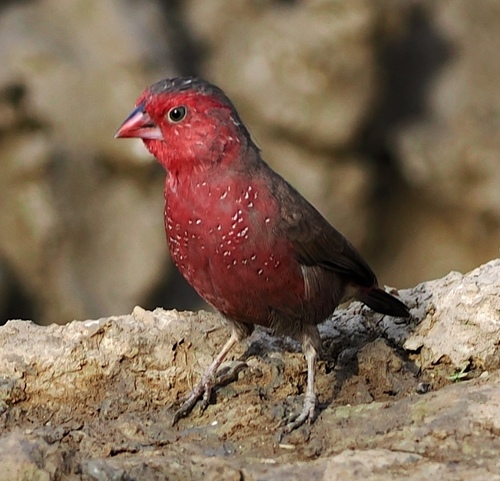
Western Bluebill

Western Bluebill

Spermophaga haematina

Silhouette: Sheatherius · PhyloPic

LCLeast ConcernNTVUENCR
Daily sighting probability ~20% · Possible
at Kakum National Park

In 3 days ~40% in a week ~70%

90 Verified sightings at Kakum National Park From 2019 to 2026
90 In 1 park
May Best month
☀️ Diurnal When it's spotted

About the Western Bluebill

The western bluebill (Spermophaga haematina) is a common species of estrildid finch found in Africa. It has an estimated global extent of occurrence of 1,900,000 km2. It is native to the Guineo-Congolian region, as well as the Jos Plateau and from western Gambia to Guinea Bissau.

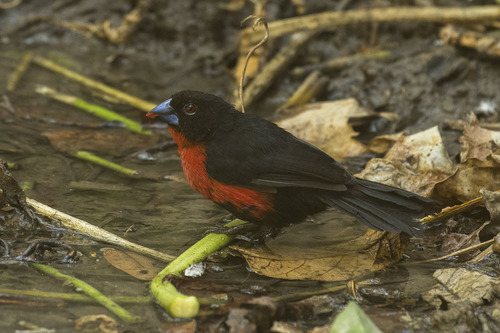
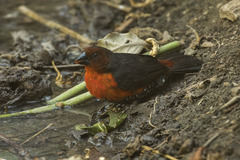
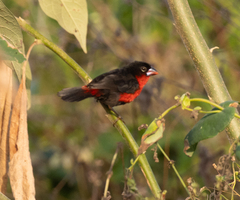
The IUCN has classified the species as being of least concern. The male of this species has a red tipped blue bill, and red flanks from the chin to the breast. They also have a characteristic white-blue eye ring. The female has a blue bill with not as much red at the tip, and face color of either black, washed red or maroon.

Wikipedia →

Sounds

Call0:29

Ghana · 2022

© Peter Boesman · XC719478 · CC BY-NC-ND 4.0

Song0:55

Central African Republic · 2021

© Rod Cassidy · XC621205 · CC BY-NC-SA 4.0

Call0:31

Gambia · 2023

© Albert Vrielink · XC857085 · CC BY-NC-SA 4.0

Global Distribution

Parks Where Found

# Park Country Daily sighting probability
1 Kakum National Park 🇬🇭 Ghana
~20%

More parks will be added in future updates.

Cities Where Found

# City Country Daily sighting probability
1 Brazzaville 🇨🇬 Republic of the Congo
~10%
2 Serrekunda 🇬🇲 Gambia
~10%

Before you go

What are the chances of seeing a Western Bluebill in Kakum National Park?

Possible

About 20% of wildlife watchers report a Western Bluebill sighting in Kakum National Park on a given day, based on 90 verified sightings from GBIF citizen-science data from 2019 to 2026. It is the 118th most-seen of the 250 birds we can rate there. Over three days the chance rises to about 40%, and over a week to about 70%, if each day is a fresh chance.

When is the best time to see a Western Bluebill in Kakum National Park?

May and September

In those months about 30% of wildlife watchers report a Western Bluebill in Kakum National Park on a given day, against about 10% in February–March and November–December, the lowest months. Those are among Kakum National Park's wettest months, with about 210 mm of rain a month against 35 mm in January.

What time of day is best to see a Western Bluebill?

Between 6 and 9 am

Across all the parks we cover, that three-hour window holds the most Western Bluebill sightings with a recorded time, and about 7 in 10 of them come between 6 am and 6 pm: it is a daytime animal.

Where else can you see a Western Bluebill?

Only Kakum National Park, in our data

Kakum National Park is the only park on Wallace's Line with enough records to rate Western Bluebill sightings: about 20% of wildlife watchers there report one on a given day.

Where does the Western Bluebill sighting chance come from?

GBIF citizen-science records

It is estimated from how often the Western Bluebill is recorded against all the birds logged in Kakum National Park (90 verified sightings from 2019 to 2026), calibrated against known sighting rates. Figures are rounded to the nearest 10% because citizen-science data supports honest approximations, not decimals, and months with records from fewer than five people show "—". How it works.

← Back to Kakum National Park