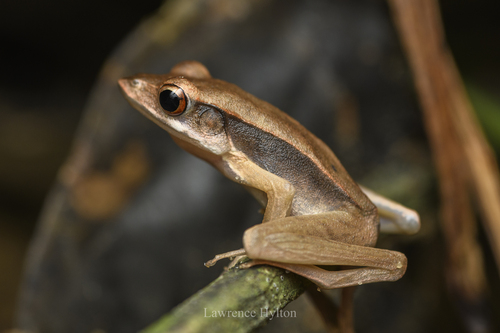
Blyth's River Frog

Blyth's River Frog

Limnonectes blythii

Silhouette: Jose Carlos Arenas-Monroy · PhyloPic

LCLeast ConcernNTVUENCR
Daily sighting probability ~20% · Possible
at Khao Sok National Park

In 3 days ~50% in a week ~80%

13 Verified sightings at Khao Sok National Park From 2019 to 2026
42 In all 4 parks
July Best month
☀️ Diurnal When it's spotted

About the Blyth's River Frog

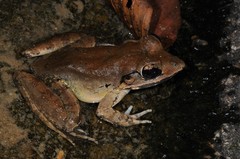
Blyth's river frog (Limnonectes blythii), also known as Blyth's frog, giant Asian river frog or (ambiguously) giant frog, is a species of frog in the family Dicroglossidae found from Myanmar through western Thailand and the Malay Peninsula (Malaysia, Singapore) to Sumatra and Borneo (Indonesia). Earlier records from Laos and Vietnam are considered misidentifications.

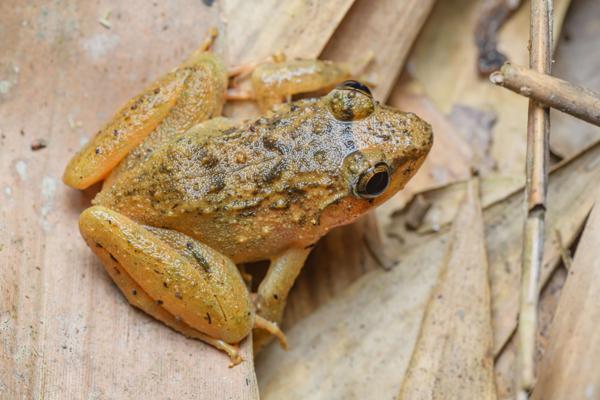
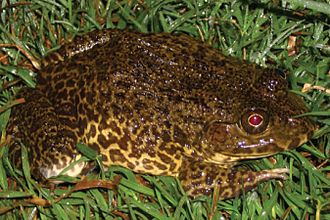
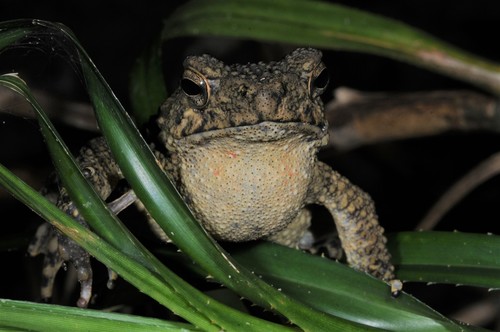
Blyth's river frog is a large frog. Females grow to a snout–vent length of 90–260 mm (3.5–10.2 in) and males to 85–125 mm (3.3–4.9 in). Large adults can weigh more than 1 kg (2.2 lb). The skin is smooth on the dorsum, with or without scattered tubercles or longitudinal skin folds. They are brownish, grey, or yellowish above and white or yellowish below. They may or may not have a vertebral stripe on their backs.

These frogs inhabit streams with gravel and rocks in primary and secondary evergreen forest. Males build a nesting hollow in a sandy stream bed area, and the tadpoles develop in streams. They can also be found far away from streams.

The major threat to this species is collection for food, both for local consumption and for trade. It is also locally impacted... Wikipedia →

Global Distribution

Parks Where Found

# Park Country Daily sighting probability
1 Khao Luang National Park 🇹🇭 Thailand
~30%
2 Khao Sok National Park 🇹🇭 Thailand
~20%
3 Gunung Leuser National Park 🇮🇩 Indonesia
~10%
4 Kaeng Krachan National Park 🇹🇭 Thailand
~10%

Cities Where Found

# City Country Daily sighting probability
1 Kuala Lumpur 🇲🇾 Malaysia
~10%
2 Singapore 🇸🇬 Singapore
<5%

Zoos & Centres Where Found

# Zoo / Centre Country
1 Night Safari 🇸🇬 Singapore In captivity
2 Singapore Zoo 🇸🇬 Singapore In captivity
3 River Wonders 🇸🇬 Singapore In captivity

Before you go

What are the chances of seeing a Blyth's River Frog in Khao Sok National Park?

Possible

About 20% of wildlife watchers report a Blyth's River Frog sighting in Khao Sok National Park on a given day, based on 13 verified sightings from GBIF citizen-science data from 2019 to 2026. It is the 12th most-seen of the 21 amphibians we can rate there. Over three days the chance rises to about 50%, and over a week to about 80%, if each day is a fresh chance.

When is the best time to see a Blyth's River Frog in Khao Sok National Park?

May, July and September

In those months about 40% of wildlife watchers report a Blyth's River Frog in Khao Sok National Park on a given day, against under 5% in February, April and June, the lowest months. Those are among Khao Sok National Park's wettest months, with about 230 mm of rain a month against 35 mm in February.

What time of day is best to see a Blyth's River Frog?

Between 2 and 5 pm

Across all the parks we cover, that three-hour window holds the most Blyth's River Frog sightings with a recorded time, and about 9 in 10 of them come between 6 am and 6 pm: it is a daytime animal.

Is Khao Sok National Park the best place to see a Blyth's River Frog?

2nd of 4

Of the 4 parks where we can rate Blyth's River Frog sightings, Khao Sok National Park ranks 2nd at about 20%. The best odds are in Khao Luang National Park (Thailand, about 30%).

Which relatives of the Blyth's River Frog live in Khao Sok National Park?

Same genus: Limnonectes

The closest relatives of the Blyth's River Frog that you can see in Khao Sok National Park (genus Limnonectes) are Red Stream Frog (about 20%) and Hill Forest Frog (about 20%), with each one's daily chance of a sighting.

Where does the Blyth's River Frog sighting chance come from?

GBIF citizen-science records

It is estimated from how often the Blyth's River Frog is recorded against all the amphibians logged in Khao Sok National Park (13 verified sightings from 2019 to 2026), calibrated against known sighting rates. Figures are rounded to the nearest 10% because citizen-science data supports honest approximations, not decimals, and months with records from fewer than five people show "—". How it works.

← Back to Khao Sok National Park