Pileated Gibbon

Pileated Gibbon

Hylobates pileatus

Silhouette: Kai R. Caspar · PhyloPic

LCNTVUENEndangeredCR
Daily sighting probability ~30% · Possible
at Khao Yai National Park

In 3 days ~60% in a week ~90%

48 Verified sightings at Khao Yai National Park From 2019 to 2026
48 In 1 park
October Best month
🌅 Crepuscular When it's spotted

About the Pileated Gibbon

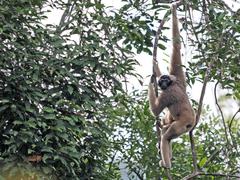
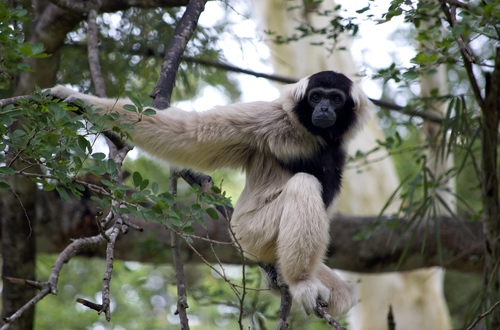
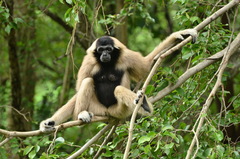
The pileated gibbon (Hylobates pileatus) is a primate in the gibbon family, Hylobatidae. The pileated gibbon has sexual dimorphism in fur coloration: males have purely black fur, while females have buff-coloured or white-grey fur with only the belly and head black. The white and often shaggy hair ring around the head is common to both sexes.

The species has been identified as endangered and is listed in CITES Appendix I. Their main threat is habitat destruction, with the natural forest they live in being converted into farmland. This has led to local extinction in some areas. Also, like many other primate species, they are hunted and captured for meat and sold into wildlife smuggling. Many attempts have been made to survey and increase the species' numbers, both concerning their status in the wild, and in zoos.

The range of the pileated gibbon is eastern Thailand, western Cambodia and southwest Laos. Its lifestyle is much like other gibbons: diurnal and arboreal, it lives together in a monogamous pair, brachiates through the trees with its long arms, and predominantly eats fruits, leaves and small animals. Reproduction habits are not well known, but are presumed to be similar... Wikipedia →
Sounds

Call0:20

Thailand · 2024

© GABRIEL LEITE · XC1091560 · CC BY-NC-SA 4.0

Duet0:20

Thailand · 2016

© Marc Anderson · XC960736 · CC BY-NC-ND 4.0

Recording0:22

Thailand · 2026

© Amaël Borzée · iNaturalist · CC BY-NC 4.0

Global Distribution

Parks Where Found

# Park Country Daily sighting probability
1 Khao Yai National Park 🇹🇭 Thailand
~30%

More parks will be added in future updates.

Zoos & Centres Where Found

# Zoo / Centre Country
1 Phnom Tamao Wildlife Rescue Centre 🇰🇭 Cambodia In captivity
2 Zoo and Botanical Garden of Branféré 🇫🇷 France In captivity
3 Wildlife World Zoo 🇺🇸 United States In captivity
4 Nanning Zoo 🇨🇳 China In captivity
5 Colchester Zoo 🇬🇧 United Kingdom In captivity
6 Twycross Zoo 🇬🇧 United Kingdom In captivity
7 Parc Zoologique et Botanique de Mulhouse 🇫🇷 France In captivity
8 Langenberg Wildlife Park 🇨🇭 Switzerland In captivity
9 Saigon Zoo and Botanical Gardens 🇻🇳 Vietnam In captivity
10 Łódź Zoo 🇵🇱 Poland In captivity
11 Johor Zoo 🇲🇾 Malaysia In captivity
12 Aquarium Barcelona 🇪🇸 Spain In captivity

Before you go

What are the chances of seeing a Pileated Gibbon in Khao Yai National Park?

Possible

About 30% of wildlife watchers report a Pileated Gibbon sighting in Khao Yai National Park on a given day, based on 48 verified sightings from GBIF citizen-science data from 2019 to 2026. It is the 13th most-seen of the 24 mammals we can rate there. Over three days the chance rises to about 60%, and over a week to about 90%, if each day is a fresh chance.

When is the best time to see a Pileated Gibbon in Khao Yai National Park?

June and October–November

In those months about 40% of wildlife watchers report a Pileated Gibbon in Khao Yai National Park on a given day, against under 5% in April and August–September, the lowest months.

What time of day is best to see a Pileated Gibbon?

Between 4 and 7 am

Across all the parks we cover, that three-hour window holds the most Pileated Gibbon sightings with a recorded time, and about half of them come between 6 pm and 6 am: it is most active around dawn and dusk.

Where else can you see a Pileated Gibbon?

Only Khao Yai National Park, in our data

Khao Yai National Park is the only park on Wallace's Line with enough records to rate Pileated Gibbon sightings: about 30% of wildlife watchers there report one on a given day.

Where does the Pileated Gibbon sighting chance come from?

GBIF citizen-science records

It is estimated from how often the Pileated Gibbon is recorded against all the mammals logged in Khao Yai National Park (48 verified sightings from 2019 to 2026), calibrated against known sighting rates. Figures are rounded to the nearest 10% because citizen-science data supports honest approximations, not decimals, and months with records from fewer than five people show "—". How it works.

← Back to Khao Yai National Park