Southern Serow

Southern Serow

Capricornis sumatraensis

Silhouette: [unknown] · PhyloPic

LCNTVUVulnerableENCR
Daily sighting probability ~30% · Possible
at Khao Yai National Park

In 3 days ~60% in a week ~90%

331 Verified sightings at Khao Yai National Park From 2019 to 2026
331 In 1 park
March Best month
🌅 Crepuscular When it's spotted

About the Southern Serow

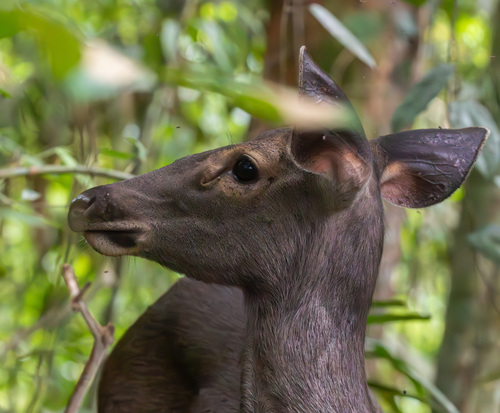
The mainland serow (Capricornis sumatraensis) is a species of serow native to the Himalayas, Southeast Asia and China. The mainland serow is related closely to the red serow. In 1831, Brian Houghton Hodgson first described a goat-like animal with short annulated horns occurring in montane regions between the Sutlej and Teesta Rivers under the name "Bubaline Antelope". As "Bubaline" was preoccupied, he gave it the scientific name Antelope thar a few months later.

When William Ogilby described the genus Capricornis in 1838, he determined the Himalayan serow as type species of this genus. Teeth from a mainland serow were found in a dig in Khok Sung district, estimated to originate from the Middle Pleistocene.

The mainland serow possesses guard hairs on its coat that are bristly or coarse and cover the layer of fur closest to its skin to varying degrees. The animal has a mane that runs from the horns to the middle of the dorsal aspect of the animal between the scapulae covering the skin. The horns are only characteristic of the males and are light-colored, approximately 150 mm (6 in) in length, and curve slightly towards its back. Both male and female... Wikipedia →
Global Distribution

Parks Where Found

# Park Country Daily sighting probability
1 Khao Yai National Park 🇹🇭 Thailand
~30%

More parks will be added in future updates.

Zoos & Centres Where Found

# Zoo / Centre Country
1 Yangon Zoological Gardens 🇲🇲 Myanmar (Burma) In captivity
2 Assam State Zoo cum Botanical Garden 🇮🇳 India In captivity
3 Khao Kheow Open Zoo 🇹🇭 Thailand In captivity
4 Thailand Tiger Rescue Center 🇹🇭 Thailand In captivity
5 Himalayan Zoological Park 🇮🇳 India In captivity
6 Motithang Takin Preserve 🇧🇹 Bhutan In captivity

Before you go

What are the chances of seeing a Southern Serow in Khao Yai National Park?

Possible

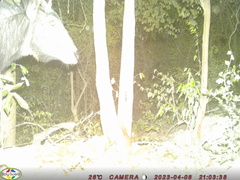
About 30% of wildlife watchers report a Southern Serow sighting in Khao Yai National Park on a given day, based on 331 verified sightings from GBIF citizen-science data from 2019 to 2026. It is the 14th most-seen of the 24 mammals we can rate there. Over three days the chance rises to about 60%, and over a week to about 90%, if each day is a fresh chance.

When is the best time to see a Southern Serow in Khao Yai National Park?

March and August

In those months about 40% of wildlife watchers report a Southern Serow in Khao Yai National Park on a given day, against under 5% in September and October, the lowest months.

What time of day is best to see a Southern Serow?

Between 3 and 6 am

Across all the parks we cover, that three-hour window holds the most Southern Serow sightings with a recorded time, and about 6 in 10 of them come between 6 am and 6 pm: it is most active around dawn and dusk.

Where else can you see a Southern Serow?

Only Khao Yai National Park, in our data

Khao Yai National Park is the only park on Wallace's Line with enough records to rate Southern Serow sightings: about 30% of wildlife watchers there report one on a given day.

Where does the Southern Serow sighting chance come from?

GBIF citizen-science records

It is estimated from how often the Southern Serow is recorded against all the mammals logged in Khao Yai National Park (331 verified sightings from 2019 to 2026), calibrated against known sighting rates. Figures are rounded to the nearest 10% because citizen-science data supports honest approximations, not decimals, and months with records from fewer than five people show "—". How it works.

← Back to Khao Yai National Park