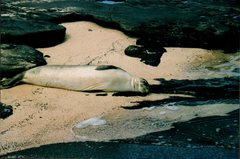
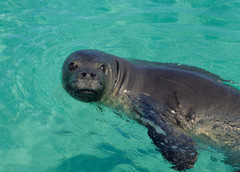
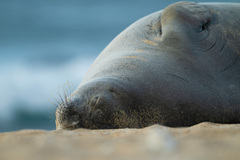
Hawaiian Monk Seal

Hawaiian Monk Seal

Neomonachus schauinslandi

Endemic
Daily sighting probability ~20% · Possible
at Kilauea Point National Wildlife Refuge

In 3 days ~60% in a week ~90%

8 Verified sightings at Kilauea Point National Wildlife Refuge From 2019 to 2026
8 In 1 park
October Best month
☀️ Diurnal When it's spotted

About the Hawaiian Monk Seal

The Hawaiian monk seal (Neomonachus schauinslandi) is a vulnerable species of earless seal in the family Phocidae that is endemic to the Hawaiian Islands. The Hawaiian monk seal is one of two extant monk seal species; the other is the Mediterranean monk seal. A third species, the Caribbean monk seal, is extinct. It is the last living member of the genus Neomonachus.

The Hawaiian monk seal is the only seal native to Hawaii, and, along with the Hawaiian hoary bat, is one of only two mammals endemic to the islands. N. schauinslandi is a conservation reliant species. The small population of about 1,400 individuals is threatened by human encroachment, very low levels of genetic variation, entanglement in fishing nets, marine debris, disease, and past commercial hunting for skins. There are many methods of conservation biology when it comes to endangered species; translocation, captive care, habitat cleanup, and educating the public about the Hawaiian monk seal are some of the methods that can be employed.

Known to native Hawaiians as ʻīlio-holo-i-ka-uaua, or "dog that runs in rough water", its scientific name is from Hugo Schauinsland, a German scientist who discovered a...

Wikipedia →

Global Distribution

Parks Where Found

# Park Country Daily sighting probability
1 Kilauea Point National Wildlife Refuge 🇺🇸 United States
~20%

More parks will be added in future updates.

Zoos & Centres Where Found

# Zoo / Centre Country
1 Minnesota Zoo 🇺🇸 United States In captivity
2 Honolulu Zoo 🇺🇸 United States In captivity
3 Sea Life Park Hawaii 🇺🇸 United States In captivity
4 Waikiki Aquarium 🇺🇸 United States In captivity

Closest Relatives at Kilauea Point National Wildlife Refuge

No species of the same family or order lives in Kilauea Point National Wildlife Refuge, so these are its closest relatives here: other mammals.

Before you go

What are the chances of seeing a Hawaiian Monk Seal in Kilauea Point National Wildlife Refuge?

Possible

About 20% of wildlife watchers report a Hawaiian Monk Seal sighting in Kilauea Point National Wildlife Refuge on a given day, based on 8 verified sightings from GBIF citizen-science data from 2019 to 2026. Over three days the chance rises to about 60%, and over a week to about 90%, if each day is a fresh chance.

When is the best time to see a Hawaiian Monk Seal in Kilauea Point National Wildlife Refuge?

October

In that month about 40% of wildlife watchers report a Hawaiian Monk Seal in Kilauea Point National Wildlife Refuge on a given day, against under 5% in January, April and August–September, the lowest months.

What time of day is best to see a Hawaiian Monk Seal?

Between noon and 3 pm

Across all the parks we cover, that three-hour window holds the most Hawaiian Monk Seal sightings with a recorded time, and about 8 in 10 of them come between 6 am and 6 pm: it is a daytime animal.

Where else can you see a Hawaiian Monk Seal?

Only Kilauea Point National Wildlife Refuge, in our data

Kilauea Point National Wildlife Refuge is the only park on Wallace's Line with enough records to rate Hawaiian Monk Seal sightings: about 20% of wildlife watchers there report one on a given day.

Where does the Hawaiian Monk Seal sighting chance come from?

GBIF citizen-science records

It is estimated from how often the Hawaiian Monk Seal is recorded against all the mammals logged in Kilauea Point National Wildlife Refuge (8 verified sightings from 2019 to 2026), calibrated against known sighting rates. Figures are rounded to the nearest 10% because citizen-science data supports honest approximations, not decimals, and months with records from fewer than five people show "—". How it works.

← Back to Kilauea Point National Wildlife Refuge