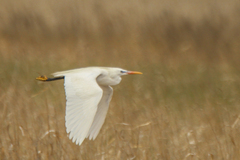
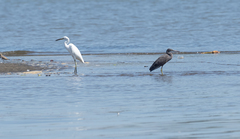





Chinese Egret

Chinese Egret

Egretta eulophotes

Silhouette: L. Shyamal · PhyloPic

LCNTVUVulnerableENCR
Daily sighting probability <5% · Rare
at Kinabatangan Wildlife Sanctuary

In 3 days <5%

12 Verified sightings at Kinabatangan Wildlife Sanctuary From 2019 to 2026
12 In 1 park
January Best month
☀️ Diurnal When it's spotted

About the Chinese Egret

The Chinese egret or Swinhoe's egret (Egretta eulophotes) is a threatened species of egret from east Asia, first described by Robert Swinhoe in 1860. The Chinese egret averages 68 cm in height. The plumage is white throughout the bird's life and resembles the little egret (Egretta garzetta). Outside the breeding season the bill is dusky with the basal portion being tannish peach and the lores and legs yellow green, while the iris is yellow. All individuals are similar in this season. In the breeding season the adults develop a luxuriant crest which is sometimes over 11 cm long. It also develops long lanceolate plumes on its breast and dorsal plumes extending beyond the tail, called aigrettes and similar to those of little egret. The bare parts change too, the bill becomes a bright, almost orange, yellow while the lores turn bright blue and the legs black with yellow feet.

The Chinese egret breeds on small islands off the coasts of far eastern Russia, North Korea, South Korea and mainland China. It formerly bred in Taiwan and the New Territories of Hong Kong although it is now only a non-breeding visitor or passage migrant to these... Wikipedia →

Global Distribution

Parks Where Found

# Park Country Daily sighting probability
1 Kinabatangan Wildlife Sanctuary 🇲🇾 Malaysia
<5%

More parks will be added in future updates.

Cities Where Found

# City Country Daily sighting probability
1 Davao City 🇵🇭 Philippines
~10%
2 Cebu City 🇵🇭 Philippines
~10%
3 Manila 🇵🇭 Philippines
<5%
4 Shanghai 🇨🇳 China
<5%
5 Taipei 🇹🇼 Taiwan
<5%
6 Seoul 🇰🇷 South Korea
<5%
7 Kaohsiung 🇹🇼 Taiwan
<5%
8 Tokyo 🇯🇵 Japan
<5%

Before you go

What are the chances of seeing a Chinese Egret in Kinabatangan Wildlife Sanctuary?

Rare

Under 5% of wildlife watchers report a Chinese Egret sighting in Kinabatangan Wildlife Sanctuary on a given day, based on 12 verified sightings from GBIF citizen-science data from 2019 to 2026. It is the 196th most-seen of the 231 birds we can rate there. Over three days the chance rises to under 5%, if each day is a fresh chance.

When is the best time to see a Chinese Egret in Kinabatangan Wildlife Sanctuary?

Any time of year

In every month with enough records, under 5% of wildlife watchers report a Chinese Egret in Kinabatangan Wildlife Sanctuary on a given day, so our monthly data shows no clear season.

What time of day is best to see a Chinese Egret?

Between 9 am and noon

Across all the parks we cover, that three-hour window holds the most Chinese Egret sightings with a recorded time, and nearly all of them come between 6 am and 6 pm: it is a daytime animal.

Where else can you see a Chinese Egret?

Only Kinabatangan Wildlife Sanctuary, in our data

Kinabatangan Wildlife Sanctuary is the only park on Wallace's Line with enough records to rate Chinese Egret sightings: under 5% of wildlife watchers there report one on a given day.

Which relatives of the Chinese Egret live in Kinabatangan Wildlife Sanctuary?

Same genus: Egretta

The closest relatives of the Chinese Egret that you can see in Kinabatangan Wildlife Sanctuary (genus Egretta, Small Egrets and Herons) are Little Egret (about 40%) and intermediate egret (about 20%), with each one's daily chance of a sighting.

Where does the Chinese Egret sighting chance come from?

GBIF citizen-science records

It is estimated from how often the Chinese Egret is recorded against all the birds logged in Kinabatangan Wildlife Sanctuary (12 verified sightings from 2019 to 2026), calibrated against known sighting rates. Figures are rounded to the nearest 10% because citizen-science data supports honest approximations, not decimals, and months with records from fewer than five people show "—". How it works.

← Back to Kinabatangan Wildlife Sanctuary