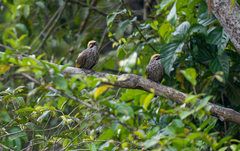
Straw-headed Bulbul

Straw-headed Bulbul

Pycnonotus zeylanicus

Silhouette: Andy Wilson · PhyloPic

LCNTVUENCRCritically Endangered
Daily sighting probability ~10% · With luck
at Kinabatangan Wildlife Sanctuary

In 3 days ~40% in a week ~70%

22 Verified sightings at Kinabatangan Wildlife Sanctuary From 2019 to 2026
22 In 1 park
October Best month
🌅 Crepuscular When it's spotted

About the Straw-headed Bulbul

The straw-headed bulbul (Pycnonotus zeylanicus) is a species of songbird in the bulbul family, Pycnonotidae. It is found from the Malay Peninsula to Borneo. Its natural habitats are subtropical or tropical moist lowland forest, subtropical or tropical mangrove forest, subtropical or tropical moist shrubland, arable land, plantations, and rural gardens. It is threatened by habitat loss and poaching from humans.

The straw-headed bulbul is prized for its singing ability and is a highly sought-after species by bird enthusiasts in Southeast Asia, especially Indonesia. This trade is causing population reductions across the species' range and is a major barrier to its conservation. Trapping has been facilitated in recent years by the spread of logging roads across its forest habitat. Due to this, the straw-headed bulbul was uplisted from endangered to critically endangered on the IUCN Red List in 2018.

The straw-headed bulbul was formally described in 1789 by the German naturalist Johann Friedrich Gmelin in his revised and expanded edition of Carl Linnaeus's Systema Naturae. He placed it with the starlings in the genus Sturnus and coined the binomial name Sturnus... Wikipedia →

Sounds

Recording0:06

Singapore · 2025

© jo815 · iNaturalist · CC BY-NC 4.0

Recording0:08

Singapore · 2025

© Rui · iNaturalist · CC BY-NC 4.0

Recording0:11

Singapore · 2026

© corinnachoong · iNaturalist · CC BY-NC 4.0

Global Distribution

Parks Where Found

# Park Country Daily sighting probability
1 Kinabatangan Wildlife Sanctuary 🇲🇾 Malaysia
~10%

More parks will be added in future updates.

Zoos & Centres Where Found

# Zoo / Centre Country
1 Taman Safari Indonesia 🇮🇩 Indonesia In captivity
2 Khao Kheow Open Zoo 🇹🇭 Thailand In captivity
3 Gembira Loka Zoo 🇮🇩 Indonesia In captivity
4 Kuala Lumpur Bird Park 🇲🇾 Malaysia In captivity
5 Hong Kong Zoological and Botanical Gardens 🇨🇳 China In captivity

Before you go

What are the chances of seeing a Straw-headed Bulbul in Kinabatangan Wildlife Sanctuary?

With luck

About 10% of wildlife watchers report a Straw-headed Bulbul sighting in Kinabatangan Wildlife Sanctuary on a given day, based on 22 verified sightings from GBIF citizen-science data from 2019 to 2026. It is the 65th most-seen of the 231 birds we can rate there. Over three days the chance rises to about 40%, and over a week to about 70%, if each day is a fresh chance.

When is the best time to see a Straw-headed Bulbul in Kinabatangan Wildlife Sanctuary?

April–June and October–November

In those months about 20% of wildlife watchers report a Straw-headed Bulbul in Kinabatangan Wildlife Sanctuary on a given day, against under 5% in February, August and December, the lowest months.

What time of day is best to see a Straw-headed Bulbul?

Between 1 and 4 am

Across all the parks we cover, that three-hour window holds the most Straw-headed Bulbul sightings with a recorded time, and about half of them come between 6 pm and 6 am: it is most active around dawn and dusk.

Where else can you see a Straw-headed Bulbul?

Only Kinabatangan Wildlife Sanctuary, in our data

Kinabatangan Wildlife Sanctuary is the only park on Wallace's Line with enough records to rate Straw-headed Bulbul sightings: about 10% of wildlife watchers there report one on a given day.

Which relatives of the Straw-headed Bulbul live in Kinabatangan Wildlife Sanctuary?

Same genus: Pycnonotus

The closest relatives of the Straw-headed Bulbul that you can see in Kinabatangan Wildlife Sanctuary (genus Pycnonotus, Typical Bulbuls) are Yellow-vented Bulbul (about 20%), Red-eyed Bulbul (about 20%) and Olive-winged Bulbul (about 10%), with each one's daily chance of a sighting.

Where does the Straw-headed Bulbul sighting chance come from?

GBIF citizen-science records

It is estimated from how often the Straw-headed Bulbul is recorded against all the birds logged in Kinabatangan Wildlife Sanctuary (22 verified sightings from 2019 to 2026), calibrated against known sighting rates. Figures are rounded to the nearest 10% because citizen-science data supports honest approximations, not decimals, and months with records from fewer than five people show "—". How it works.

← Back to Kinabatangan Wildlife Sanctuary