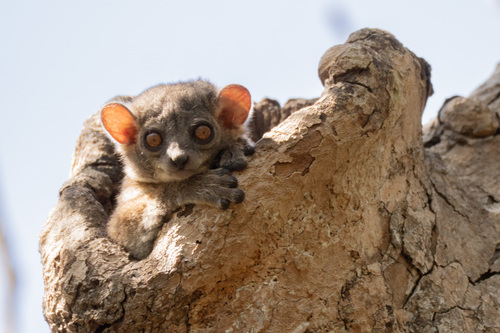
Pale Fork-marked Lemur

Pale Fork-marked Lemur

Phaner pallescens

LCNTVUENEndangeredCR Endemic
Daily sighting probability ~60% · Likely
at Kirindy Mitea National Park

In 3 days >90%

7 Verified sightings at Kirindy Mitea National Park From 2019 to 2026
7 In 1 park
August Best month
🌙 Nocturnal When it's spotted

About the Pale Fork-marked Lemur

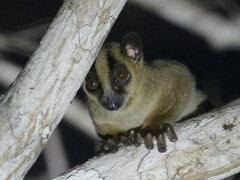
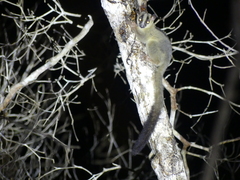
The pale fork-marked lemur (Phaner pallescens), or western fork-marked lemur, is a species of lemur known from western Madagascar; south of the Fiherenana River to the region of Soalala. It is said to be the smallest fork-marked species. It is listed on CITES Appendix I as Endangered. They are about 9–11 in (230–280 mm) long from head to rump and their tail adds another 11–15 in (280–380 mm). Pale fork-marked lemur's weigh around 11–18 oz (310–510 g)

Pale fork-marked lemurs live up to around 12 years in captivity. Their chances of surviving to that age is suspected to decrease when in the wild. Pale fork-marked lemurs are nocturnal animals. They live in pairs but partners spend about 75% of their activity time apart, and females mate with several males. Pair relationships are strained, with rates of combative interactions up to four times greater than affiliative interactions. This is likely due to intense feeding competition.

Mothers of juveniles make a bleating call resembling that of a goat. Researchers have also identified a fighting call, a low-contact call accompanying locomotion, field location calls, and a call admitted exclusively by males.

Calls emitted by males...

Wikipedia →

Global Distribution

Parks Where Found

# Park Country Daily sighting probability
1 Kirindy Mitea National Park 🇲🇬 Madagascar
~60%

More parks will be added in future updates.

Before you go

What are the chances of seeing a Pale Fork-marked Lemur in Kirindy Mitea National Park?

Likely

About 60% of wildlife watchers report a Pale Fork-marked Lemur sighting in Kirindy Mitea National Park on a given day, based on 7 verified sightings from GBIF citizen-science data from 2019 to 2026. Over three days the chance rises to over 90%, if each day is a fresh chance.

What time of day is best to see a Pale Fork-marked Lemur?

Between 5 and 8 pm

Across all the parks we cover, that three-hour window holds the most Pale Fork-marked Lemur sightings with a recorded time, and about 7 in 10 of them come between 6 pm and 6 am: it is mostly seen at night.

Where else can you see a Pale Fork-marked Lemur?

Only Kirindy Mitea National Park, in our data

Kirindy Mitea National Park is the only park on Wallace's Line with enough records to rate Pale Fork-marked Lemur sightings: about 60% of wildlife watchers there report one on a given day.

Where does the Pale Fork-marked Lemur sighting chance come from?

GBIF citizen-science records

It is estimated from how often the Pale Fork-marked Lemur is recorded against all the mammals logged in Kirindy Mitea National Park (7 verified sightings from 2019 to 2026), calibrated against known sighting rates. Figures are rounded to the nearest 10% because citizen-science data supports honest approximations, not decimals, and months with records from fewer than five people show "—". How it works.

← Back to Kirindy Mitea National Park