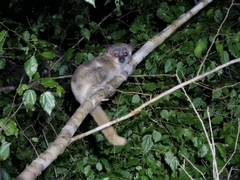
Red-tailed Sportive Lemur

Red-tailed Sportive Lemur

Lepilemur ruficaudatus

LCNTVUENCRCritically Endangered Endemic
Daily sighting probability ~60% · Likely
at Kirindy Mitea National Park

In 3 days ~90% in a week >90%

7 Verified sightings at Kirindy Mitea National Park From 2019 to 2026
7 In 1 park
August Best month
🌅 Crepuscular When it's spotted

About the Red-tailed Sportive Lemur

The red-tailed sportive lemur (Lepilemur ruficaudatus), or red-tailed weasel lemur, is native to Madagascar like all lemurs. It is a nocturnal species feeding largely on leaves, though they also eat some fruit. Individuals weigh around 800 g (1.8 lb), and there is little sexual dimorphism. In general they live in mated pairs, with a home range of about 10,000 square metres. Both members of the pair use the same home range, and there is little overlap between the home ranges of neighbouring pairs. Travel distances each night are between 100 m (330 ft) and 1 km (0.6 mi), making this a relatively inactive species. This species can be found in the Madagascar dry deciduous forests.

Red-tailed sportive lemurs travel in these pairs because it can be difficult for a male to produce roaming strategies and move further away from the homeland. Therefore, they typically pair up with only one female for reproduction, hence their "partner". Additionally, these Lemurs don't typically have a strong early warning system, making it difficult for them to warn others or send a signal. Instead, they have grown to develop strong escape mechanisms for them to flee danger. Many studies and experiments have been conducted to produce this information.
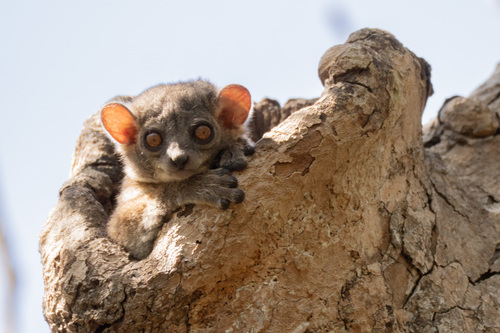
Wikipedia →

Global Distribution

Parks Where Found

# Park Country Daily sighting probability
1 Kirindy Mitea National Park 🇲🇬 Madagascar
~60%

More parks will be added in future updates.

Before you go

What are the chances of seeing a Red-tailed Sportive Lemur in Kirindy Mitea National Park?

Likely

About 60% of wildlife watchers report a Red-tailed Sportive Lemur sighting in Kirindy Mitea National Park on a given day, based on 7 verified sightings from GBIF citizen-science data from 2019 to 2026. Over three days the chance rises to about 90%, and over a week to over 90%, if each day is a fresh chance.

What time of day is best to see a Red-tailed Sportive Lemur?

Between 5 and 8 pm

Across all the parks we cover, that three-hour window holds the most Red-tailed Sportive Lemur sightings with a recorded time, and about half of them come between 6 pm and 6 am: it is most active around dawn and dusk.

Where else can you see a Red-tailed Sportive Lemur?

Only Kirindy Mitea National Park, in our data

Kirindy Mitea National Park is the only park on Wallace's Line with enough records to rate Red-tailed Sportive Lemur sightings: about 60% of wildlife watchers there report one on a given day.

Where does the Red-tailed Sportive Lemur sighting chance come from?

GBIF citizen-science records

It is estimated from how often the Red-tailed Sportive Lemur is recorded against all the mammals logged in Kirindy Mitea National Park (7 verified sightings from 2019 to 2026), calibrated against known sighting rates. Figures are rounded to the nearest 10% because citizen-science data supports honest approximations, not decimals, and months with records from fewer than five people show "—". How it works.

← Back to Kirindy Mitea National Park