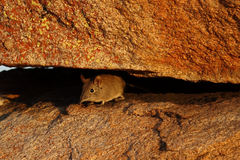

Eastern Rock Elephant Shrew

Eastern Rock Elephant Shrew

Elephantulus myurus

Silhouette: Kai Caspar · PhyloPic

LCLeast ConcernNTVUENCR
Daily sighting probability <5% · Rare
at Kruger National Park

In 3 days ~10% in a week ~30%

10 Verified sightings at Kruger National Park From 2019 to 2026
10 In 1 park
November Best month
☀️ Diurnal When it's spotted

About the Eastern Rock Elephant Shrew

The eastern rock sengi or eastern rock elephant shrew (Elephantulus myurus) is a species of sengi in the family Macroscelididae. It is found in Botswana, Mozambique, South Africa, and Zimbabwe. Its natural habitats are subtropical or tropical dry lowland grassland and rocky areas. Their foraging habitat mainly consists of rocky areas, and they prefer to eat insects.

Eastern rock sengis are one of three sengi species known to breed seasonally, during the spring and summer. Environmental factors that influence breeding patterns include temperature, rainfall, and lack of food. Mothers normally give birth to two sets of twins. Their young are known to walk very soon. Although rainfall affects food availability, it does not seem to have direct impact on female E. myurus reproduction. Rainfall and ambient temperature do affect male E. myurus reproduction. Wikipedia →

Global Distribution

Parks Where Found

# Park Country Daily sighting probability
1 Kruger National Park 🇿🇦 South Africa
<5%

More parks will be added in future updates.

Before you go

What are the chances of seeing an Eastern Rock Elephant Shrew in Kruger National Park?

Rare

Under 5% of wildlife watchers report an Eastern Rock Elephant Shrew sighting in Kruger National Park on a given day, based on 10 verified sightings from GBIF citizen-science data from 2019 to 2026. It is the 51st most-seen of the 60 mammals we can rate there. Over three days the chance rises to about 10%, and over a week to about 30%, if each day is a fresh chance.

When is the best time to see an Eastern Rock Elephant Shrew in Kruger National Park?

May, July and November–December

In those months about 10% of wildlife watchers report an Eastern Rock Elephant Shrew in Kruger National Park on a given day, against under 5% in January–April, June and August–October, the lowest months.

What time of day is best to see an Eastern Rock Elephant Shrew?

Between 7 and 10 am

Across all the parks we cover, that three-hour window holds the most Eastern Rock Elephant Shrew sightings with a recorded time, and about 7 in 10 of them come between 6 am and 6 pm: it is a daytime animal.

Where else can you see an Eastern Rock Elephant Shrew?

Only Kruger National Park, in our data

Kruger National Park is the only park on Wallace's Line with enough records to rate Eastern Rock Elephant Shrew sightings: under 5% of wildlife watchers there report one on a given day.

Where does the Eastern Rock Elephant Shrew sighting chance come from?

GBIF citizen-science records

It is estimated from how often the Eastern Rock Elephant Shrew is recorded against all the mammals logged in Kruger National Park (10 verified sightings from 2019 to 2026), calibrated against known sighting rates. Figures are rounded to the nearest 10% because citizen-science data supports honest approximations, not decimals, and months with records from fewer than five people show "—". How it works.

← Back to Kruger National Park