Glistening Demoiselle

Glistening Demoiselle

Phaon iridipennis

Daily sighting probability ~10% · With luck
at Kruger National Park

In 3 days ~20% in a week ~40%

66 Verified sightings at Kruger National Park From 2019 to 2026
74 In all 2 parks
January Best month
☀️ Diurnal When it's spotted

About the Glistening Demoiselle

Phaon iridipennis, commonly known as the glistening demoiselle or glinsterjuffertjie, is a species of damselfly in the family Calopterygidae. This is a large (length: up to 75 mm (3.0 in), wingspan: up to 87 mm (3.4 in)) damselfly with long legs. The common name comes from its iridescent wings, which sparkle with purple-blue flecks in the sunlight. The wings become more smoky with age. pterostigmata may or may not be present, although it is unclear what drives this difference. When present, they start off as light brown in colour and become darker with age. The thorax and abdomen are a coppery green in both sexes, although females are duller and browner than the males.

This species is common and widespread. It is found in most countries in sub-Saharan Africa; from South Africa to Ethiopia and Senegal, particularly in more tropical areas. It also occurs on Madagascar. It is most common along rivers and streams with gallery forest, but also occurs in coastal, dune and swamp forests, as well as the forested edges of pans and marshes. It is highly dependent on shade, and is rarely seen out in open sunlight. It does, however, sometimes occur... Wikipedia →
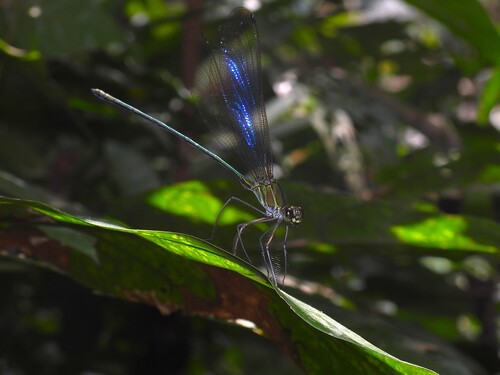
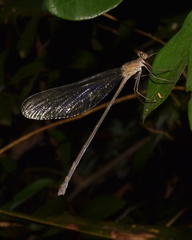
Global Distribution

Parks Where Found

# Park Country Daily sighting probability
1 Semuliki National Park 🇺🇬 Uganda
~60%
2 Kruger National Park 🇿🇦 South Africa
~10%

Cities Where Found

# City Country Daily sighting probability
1 Durban 🇿🇦 South Africa
~10%

Before you go

What are the chances of seeing a Glistening Demoiselle in Kruger National Park?

With luck

About 10% of wildlife watchers report a Glistening Demoiselle sighting in Kruger National Park on a given day, based on 66 verified sightings from GBIF citizen-science data from 2019 to 2026. It is the 111th most-seen of the 748 insects we can rate there. Over three days the chance rises to about 20%, and over a week to about 40%, if each day is a fresh chance.

When is the best time to see a Glistening Demoiselle in Kruger National Park?

January–March, May, July–September and November

In those months about 10% of wildlife watchers report a Glistening Demoiselle in Kruger National Park on a given day, against under 5% in April, June, October and December, the lowest months.

What time of day is best to see a Glistening Demoiselle?

Between 10 am and 1 pm

Across all the parks we cover, that three-hour window holds the most Glistening Demoiselle sightings with a recorded time, and nearly all of them come between 6 am and 6 pm: it is a daytime animal.

Is Kruger National Park the best place to see a Glistening Demoiselle?

2nd of 2

Of the 2 parks where we can rate Glistening Demoiselle sightings, Kruger National Park ranks 2nd at about 10%. The best odds are in Semuliki National Park (Uganda, about 60%).

Which relatives of the Glistening Demoiselle live in Kruger National Park?

Same order: Odonata

The closest relatives of the Glistening Demoiselle that you can see in Kruger National Park (order Odonata, Dragonflies and Damselflies) are Southern Banded Groundling (about 20%), Violet Dropwing (about 20%) and Orange-Winged Dropwing (about 20%), with each one's daily chance of a sighting.

Where does the Glistening Demoiselle sighting chance come from?

GBIF citizen-science records

It is estimated from how often the Glistening Demoiselle is recorded against all the insects logged in Kruger National Park (66 verified sightings from 2019 to 2026), calibrated against known sighting rates. Figures are rounded to the nearest 10% because citizen-science data supports honest approximations, not decimals, and months with records from fewer than five people show "—". How it works.

← Back to Kruger National Park