Mohol Bushbaby

Mohol Bushbaby

Galago moholi

Silhouette: Joseph Wolf, 1863 (vectorization by Dinah Challen) · PhyloPic

LCLeast ConcernNTVUENCR
Daily sighting probability ~10% · With luck
at Kruger National Park

In 3 days ~30% in a week ~60%

56 Verified sightings at Kruger National Park From 2019 to 2026
56 In 1 park
July Best month
🌅 Crepuscular When it's spotted

About the Mohol Bushbaby

The Mohol bushbaby (Galago moholi) is a species of primate in the family Galagidae which is native to mesic woodlands of southern Africa. It is physically very similar to the Senegal bushbaby, and was formerly considered to be its southern variety. The two species differ markedly in their biology however, and no hybrids have been recorded in captivity.

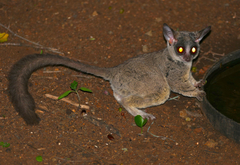
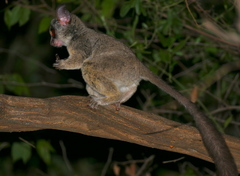
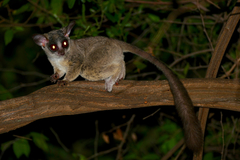
The Mohol bushbaby is a medium size species with a head-and-body length of 15 cm (6 in) and a tail of 23 cm (9 in). The head is broad, with a short muzzle, orange eyes and diamond-shaped black eye-rings. The nose-stripe is whitish and the ears are large and grey. The dorsal surface of the body has a greyish-brown pelage, and the underparts are white, sometimes with a yellowish tinge. The flanks, inside of the limbs, hands and feet are yellowish. The fingers and toes have spatulate tips. The tail is darker than the rest of the fur but is not very bushy.

The species is found in Angola, Botswana, the Democratic Republic of the Congo, Malawi, Mozambique, Namibia, South Africa, Eswatini, Tanzania, Zambia and Zimbabwe. It is perhaps also present in Rwanda and Burundi. The species is naturally found... Wikipedia →

Sounds

Call0:29

Zambia · 2023

© Marc Anderson · XC1065485 · CC BY-NC-ND 4.0

Recording0:34

Zimbabwe · 2026

© i_c_riddell · iNaturalist · CC BY 4.0

Global Distribution

Parks Where Found

# Park Country Daily sighting probability
1 Kruger National Park 🇿🇦 South Africa
~10%

More parks will be added in future updates.

Cities Where Found

# City Country Daily sighting probability
1 Pretoria 🇿🇦 South Africa
~10%

Zoos & Centres Where Found

# Zoo / Centre Country
1 National Zoological Park 🇺🇸 United States In captivity
2 Cleveland Metroparks Zoo 🇺🇸 United States In captivity
3 Bronx Zoo 🇺🇸 United States In captivity
4 Milwaukee County Zoo 🇺🇸 United States In captivity
5 Berlin Zoological Garden 🇩🇪 Germany In captivity
6 London Zoo 🇬🇧 United Kingdom In captivity
7 Faunia 🇪🇸 Spain In captivity
8 Touroparc Zoo 🇫🇷 France In captivity
9 Aquarium Berlin 🇩🇪 Germany In captivity

Before you go

What are the chances of seeing a Mohol Bushbaby in Kruger National Park?

With luck

About 10% of wildlife watchers report a Mohol Bushbaby sighting in Kruger National Park on a given day, based on 56 verified sightings from GBIF citizen-science data from 2019 to 2026. It is the 35th most-seen of the 60 mammals we can rate there. Over three days the chance rises to about 30%, and over a week to about 60%, if each day is a fresh chance.

When is the best time to see a Mohol Bushbaby in Kruger National Park?

Any time of year

In every month with enough records, about 10% of wildlife watchers report a Mohol Bushbaby in Kruger National Park on a given day, so our monthly data shows no clear season.

What time of day is best to see a Mohol Bushbaby?

Between 5 and 8 pm

Across all the parks we cover, that three-hour window holds the most Mohol Bushbaby sightings with a recorded time, and about 7 in 10 of them come between 6 pm and 6 am: it is most active around dawn and dusk.

Where else can you see a Mohol Bushbaby?

Only Kruger National Park, in our data

Kruger National Park is the only park on Wallace's Line with enough records to rate Mohol Bushbaby sightings: about 10% of wildlife watchers there report one on a given day.

Where does the Mohol Bushbaby sighting chance come from?

GBIF citizen-science records

It is estimated from how often the Mohol Bushbaby is recorded against all the mammals logged in Kruger National Park (56 verified sightings from 2019 to 2026), calibrated against known sighting rates. Figures are rounded to the nearest 10% because citizen-science data supports honest approximations, not decimals, and months with records from fewer than five people show "—". How it works.

← Back to Kruger National Park