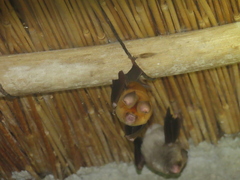
Sundevall's roundleaf bat

Sundevall's roundleaf bat

Hipposideros caffer

Silhouette: T. Michael Keesey · PhyloPic

LCLeast ConcernNTVUENCR
Daily sighting probability <5% · Rare
at Kruger National Park

In 3 days ~10% in a week ~20%

7 Verified sightings at Kruger National Park From 2019 to 2026
7 In 1 park
May Best month
☀️🌙 Day & Night When it's spotted

About the Sundevall's roundleaf bat

Sundevall's roundleaf bat (Hipposideros caffer), also called Sundevall's leaf-nosed bat, is a species of bat in the family Hipposideridae. These bats are very similar in appearance to the closely related Noack's roundleaf bat, and the two have in the past been considered to be the same species. Although more recent research suggests that they are distinct, taken together, they possibly represent a species group containing a number of cryptic species or subspecies that have yet to be distinguished.

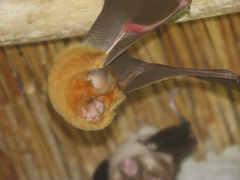
Sundevall's roundleaf bat is a medium-sized bat, with a head-body length of 8 to 9 cm (3.1 to 3.5 in), and a wingspan of 20 to 29 cm (7.9 to 11.4 in). Adults have a body weight of 8 to 10 g (0.28 to 0.35 oz). They have long fur, which may be either grey or a bright golden-orange in colour, and brown wings. The fur is generally paler on the underside of the body.

The bats have large, rounded, ears with a well-developed antitragus, and a horseshoe-shaped nose-leaf, with a distinctive small projection on either side. There is also an additional serrated ridge of skin behind the main nose-leaf. Both females and males have an extra pair of teats in the pubic region. Although these... Wikipedia →

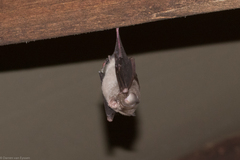
Global Distribution

Parks Where Found

# Park Country Daily sighting probability
1 Kruger National Park 🇿🇦 South Africa
<5%

More parks will be added in future updates.

Before you go

What are the chances of seeing a Sundevall's roundleaf bat in Kruger National Park?

Rare

Under 5% of wildlife watchers report a Sundevall's roundleaf bat sighting in Kruger National Park on a given day, based on 7 verified sightings from GBIF citizen-science data from 2019 to 2026. It is the 57th most-seen of the 60 mammals we can rate there. Over three days the chance rises to about 10%, and over a week to about 20%, if each day is a fresh chance.

When is the best time to see a Sundevall's roundleaf bat in Kruger National Park?

May and August

In those months about 10% of wildlife watchers report a Sundevall's roundleaf bat in Kruger National Park on a given day, against under 5% in June–July and September–April, the lowest months. Those are among Kruger National Park's driest months, with about 10 mm of rain a month against 110 mm in February.

What time of day is best to see a Sundevall's roundleaf bat?

Between 4 and 7 pm

Across all the parks we cover, that three-hour window holds the most Sundevall's roundleaf bat sightings with a recorded time, and about 6 in 10 of them come between 6 am and 6 pm: it is seen both by day and at night.

Where else can you see a Sundevall's roundleaf bat?

Only Kruger National Park, in our data

Kruger National Park is the only park on Wallace's Line with enough records to rate Sundevall's roundleaf bat sightings: under 5% of wildlife watchers there report one on a given day.

Where does the Sundevall's roundleaf bat sighting chance come from?

GBIF citizen-science records

It is estimated from how often the Sundevall's roundleaf bat is recorded against all the mammals logged in Kruger National Park (7 verified sightings from 2019 to 2026), calibrated against known sighting rates. Figures are rounded to the nearest 10% because citizen-science data supports honest approximations, not decimals, and months with records from fewer than five people show "—". How it works.

← Back to Kruger National Park