Thick-billed Cuckoo

Thick-billed Cuckoo

Pachycoccyx audeberti

Silhouette: Nicolas Huet le Jeune and Jean-Gabriel Prêtre (vectorized by T. Michael Keesey) · PhyloPic

LCLeast ConcernNTVUENCR
Daily sighting probability <5% · Rare
at Kruger National Park

In 3 days <5%

30 Verified sightings at Kruger National Park From 2019 to 2026
42 In all 3 parks
November Best month
☀️ Diurnal When it's spotted

About the Thick-billed Cuckoo

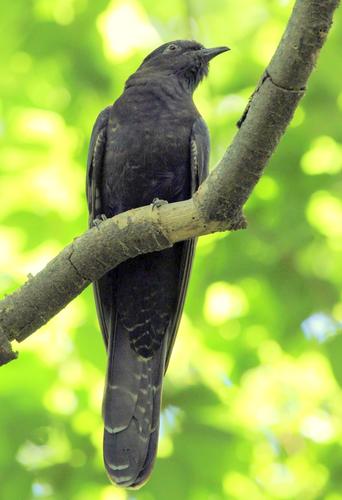
The thick-billed cuckoo (Pachycoccyx audeberti) is a species of cuckoo in the family Cuculidae. It is monotypic within the genus Pachycoccyx. It can easily be distinguished from other brood parasitic cuckoo species by its very thick bill, which is shaped in a rather hawk-like fashion.

In a molecular genetic study by Sorenson and Payne (2005), the thick-billed cuckoo appeared to be most closely related to the koels, consisting of the dwarf koel (Microdynamis parva) and the true koels (Eudynamys), although the evidence was not very strong and further research was required.

The thick-billed cuckoo is found in humid to subhumid woodlands and gallery forests from Guinea in the northwest to Mozambique in the southeast, though it is absent from large areas of the Congo Basin. It formerly occurred in the rainforests of northeastern Madagascar, but has not been reported from that island since 1922. In its southernmost regions the thick-billed cuckoo is partially migratory, spending the southern dry season in East Africa.

It is a typical cuckoo in terms of behaviour, feeding on hairy caterpillars, but also having a strong preference for grasshoppers... Wikipedia →

Sounds

Song0:33

Uganda · 2022

© Peter Boesman · XC739879 · CC BY-NC-ND 4.0

Alarm call0:06

South Africa · 2019

© Daniel Danckwerts · XC524844 · CC BY-NC-SA 4.0

Call0:06

Ghana · 2016

© James Lidster · XC360441 · CC BY-NC-SA 4.0

Global Distribution

Parks Where Found

# Park Country Daily sighting probability
1 Ruaha National Park 🇹🇿 Tanzania
<5%
2 Kafue National Park 🇿🇲 Zambia
<5%
3 Kruger National Park 🇿🇦 South Africa
<5%

Before you go

What are the chances of seeing a Thick-billed Cuckoo in Kruger National Park?

Rare

Under 5% of wildlife watchers report a Thick-billed Cuckoo sighting in Kruger National Park on a given day, based on 30 verified sightings from GBIF citizen-science data from 2019 to 2026. It is the 378th most-seen of the 464 birds we can rate there. Over three days the chance rises to under 5%, if each day is a fresh chance.

When is the best time to see a Thick-billed Cuckoo in Kruger National Park?

Any time of year

In every month with enough records, under 5% of wildlife watchers report a Thick-billed Cuckoo in Kruger National Park on a given day, so our monthly data shows no clear season.

What time of day is best to see a Thick-billed Cuckoo?

Between 7 and 10 am

Across all the parks we cover, that three-hour window holds the most Thick-billed Cuckoo sightings with a recorded time, and about 9 in 10 of them come between 6 am and 6 pm: it is a daytime animal.

Is Kruger National Park the best place to see a Thick-billed Cuckoo?

Among the best

Of the 3 parks where we can rate Thick-billed Cuckoo sightings, Kruger National Park ranks 3rd at under 5%, level with the leaders once rounded. The best odds are in Ruaha National Park (Tanzania, under 5%) and Kafue National Park (Zambia, under 5%).

Which relatives of the Thick-billed Cuckoo live in Kruger National Park?

Same family: Cuculidae

The closest relatives of the Thick-billed Cuckoo that you can see in Kruger National Park (family Cuculidae, Cuckoos) are White-browed Coucal (about 40%), Dideric Cuckoo (about 20%) and Jacobin Cuckoo (about 20%), with each one's daily chance of a sighting.

Where does the Thick-billed Cuckoo sighting chance come from?

GBIF citizen-science records

It is estimated from how often the Thick-billed Cuckoo is recorded against all the birds logged in Kruger National Park (30 verified sightings from 2019 to 2026), calibrated against known sighting rates. Figures are rounded to the nearest 10% because citizen-science data supports honest approximations, not decimals, and months with records from fewer than five people show "—". How it works.

← Back to Kruger National Park