
Blue-and-white Mockingbird

Blue-and-white Mockingbird

Melanotis hypoleucus

Silhouette: Sheatherius · PhyloPic

LCLeast ConcernNTVUENCR
Daily sighting probability <5% · Rare
at La Tigra National Park

In 3 days ~10%

10 Verified sightings at La Tigra National Park From 2019 to 2026
84 In all 3 parks
May Best month
☀️ Diurnal When it's spotted

About the Blue-and-white Mockingbird

The blue-and-white mockingbird (Melanotis hypoleucus) is a species of bird in the family Mimidae. It is found in El Salvador, Guatemala, Honduras, and Mexico. The blue-and-white mockingbird is monotypic. It and the blue mockingbird (Melanotis caerulescens) are the only species in their genus.

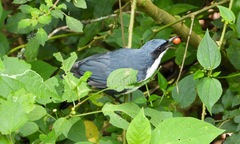
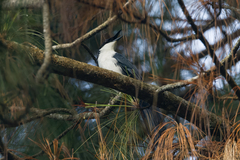
The blue-and-white mockingbird is 24.2 to 28 cm (9.5 to 11.0 in) long; 20 specimens had a mean mass of 68 g (2.4 oz). The adults' upperparts are a dull slate blue that is slightly brighter on the crown. The wings and tail are slaty black. A conspicuous black "mask" covers from the lores past the eye. The underparts are white darkening to bluish or slate gray on the flanks and vent area. The juvenile has a similar pattern but its upperparts are dull slaty gray instead of blue.

The blue-and-white mockingbird is a year round resident of Mexico from south of the Isthmus of Tehuantepec through Guatemala to El Salvador and southern Honduras. It inhabits a variety of landscapes including the edges of humid evergreen forest, pine-oak forest, second growth, and humid and semi-arid scrublands. In elevation it ranges between... Wikipedia →

Sounds

Song0:36

Guatemala · 2024

© Brendan Sloan · XC972676 · CC BY-NC-ND 4.0

Call0:40

El Salvador · 2016

© Guillermo Funes · XC343950 · CC BY-NC-SA 4.0

Call0:24

Mexico · 2015

© Frank Lambert · XC260220 · CC BY-NC-ND 4.0

Global Distribution

Parks Where Found

# Park Country Daily sighting probability
1 Cañón del Sumidero National Park 🇲🇽 Mexico
~10%
2 Celaque National Park 🇭🇳 Honduras
~10%
3 La Tigra National Park 🇭🇳 Honduras
<5%

Cities Where Found

# City Country Daily sighting probability
1 Guatemala City 🇬🇹 Guatemala
~10%

Before you go

What are the chances of seeing a Blue-and-white Mockingbird in La Tigra National Park?

Rare

Under 5% of wildlife watchers report a Blue-and-white Mockingbird sighting in La Tigra National Park on a given day, based on 10 verified sightings from GBIF citizen-science data from 2019 to 2026. It is the 155th most-seen of the 176 birds we can rate there. Over three days the chance rises to about 10%, if each day is a fresh chance.

When is the best time to see a Blue-and-white Mockingbird in La Tigra National Park?

April and May

In those months about 10% of wildlife watchers report a Blue-and-white Mockingbird in La Tigra National Park on a given day, against under 5% in June to March, the lowest months.

What time of day is best to see a Blue-and-white Mockingbird?

Between 6 and 9 am

Across all the parks we cover, that three-hour window holds the most Blue-and-white Mockingbird sightings with a recorded time, and about 9 in 10 of them come between 6 am and 6 pm: it is a daytime animal.

Is La Tigra National Park the best place to see a Blue-and-white Mockingbird?

3rd of 3

Of the 3 parks where we can rate Blue-and-white Mockingbird sightings, La Tigra National Park ranks 3rd at under 5%. The best odds are in Cañón del Sumidero National Park (Mexico, about 10%) and Celaque National Park (Honduras, about 10%).

Where does the Blue-and-white Mockingbird sighting chance come from?

GBIF citizen-science records

It is estimated from how often the Blue-and-white Mockingbird is recorded against all the birds logged in La Tigra National Park (10 verified sightings from 2019 to 2026), calibrated against known sighting rates. Figures are rounded to the nearest 10% because citizen-science data supports honest approximations, not decimals, and months with records from fewer than five people show "—". How it works.

← Back to La Tigra National Park