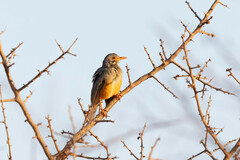
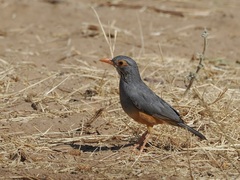
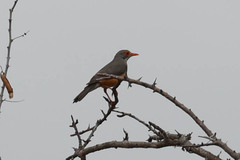

African Bare-eyed Thrush

African Bare-eyed Thrush

Turdus tephronotus

Silhouette: Sharon Wegner-Larsen · PhyloPic

LCLeast ConcernNTVUENCR
Daily sighting probability <5% · Rare
at Lake Manyara National Park

In 3 days ~10% in a week ~20%

11 Verified sightings at Lake Manyara National Park From 2019 to 2026
459 In all 8 parks
August Best month
☀️ Diurnal When it's spotted

About the African Bare-eyed Thrush

The bare-eyed thrush (Turdus tephronotus) is a species of bird in the family Turdidae. It is found in Ethiopia, Kenya, Somalia, and Tanzania. Its natural habitats are dry savanna and subtropical or tropical dry shrubland. It breeds during the rainy season.

This species has a very large range, and hence does not approach the thresholds for Vulnerable under the range size criterion (Extent of Occurrence <20,000 km2 combined with a declining or fluctuating range size, habitat extent/quality, or population size and a small number of locations or severe fragmentation). The population trend is not known, but the population is not believed to be decreasing sufficiently rapidly to approach the thresholds under the population trend criterion (>30% decline over ten years or three generations). The population size has not been quantified, but it is not believed to approach the thresholds for Vulnerable under the population size criterion (<10,000 mature individuals with a continuing decline estimated to be >10% in ten years or three generations, or with a specified population structure). For these reasons the species is evaluated as Least Concern. Wikipedia →

Sounds

Song0:20

Tanzania · 2019

© Peter Ericsson · XC467122 · CC BY-NC-SA 4.0

Call0:35

Kenya · 2024

© Peter Boesman · XC948547 · CC BY-NC-ND 4.0

Song0:29

Kenya · 2017

© James Bradley · XC363503 · CC BY-NC-SA 4.0

Global Distribution

Parks Where Found

# Park Country Daily sighting probability
1 Mkomazi National Park 🇹🇿 Tanzania
~30%
2 Tsavo West National Park 🇰🇪 Kenya
~20%
3 Tsavo East National Park 🇰🇪 Kenya
~20%
4 Samburu National Reserve 🇰🇪 Kenya
~10%
5 Ruaha National Park 🇹🇿 Tanzania
<5%
6 Lake Manyara National Park 🇹🇿 Tanzania
<5%
7 Tarangire National Park 🇹🇿 Tanzania
<5%
8 Amboseli National Park 🇰🇪 Kenya
<5%

Cities Where Found

# City Country Daily sighting probability
1 Mombasa 🇰🇪 Kenya
~50%

Before you go

What are the chances of seeing an African Bare-eyed Thrush in Lake Manyara National Park?

Rare

Under 5% of wildlife watchers report an African Bare-eyed Thrush sighting in Lake Manyara National Park on a given day, based on 11 verified sightings from GBIF citizen-science data from 2019 to 2026. It is the 235th most-seen of the 307 birds we can rate there. Over three days the chance rises to about 10%, and over a week to about 20%, if each day is a fresh chance.

When is the best time to see an African Bare-eyed Thrush in Lake Manyara National Park?

August and October

In those months about 10% of wildlife watchers report an African Bare-eyed Thrush in Lake Manyara National Park on a given day, against under 5% in September and November–July, the lowest months. Those are among Lake Manyara National Park's driest months, with about 40 mm of rain a month against 260 mm in April.

What time of day is best to see an African Bare-eyed Thrush?

Between 6 and 9 am

Across all the parks we cover, that three-hour window holds the most African Bare-eyed Thrush sightings with a recorded time, and about 8 in 10 of them come between 6 am and 6 pm: it is a daytime animal.

Is Lake Manyara National Park the best place to see an African Bare-eyed Thrush?

6th of 8

Of the 8 parks where we can rate African Bare-eyed Thrush sightings, Lake Manyara National Park ranks 6th at under 5%. The best odds are in Mkomazi National Park (Tanzania, about 30%), Tsavo West National Park (Kenya, about 20%) and Tsavo East National Park (Kenya, about 20%).

Which relatives of the African Bare-eyed Thrush live in Lake Manyara National Park?

Same order: Passeriformes

The closest relatives of the African Bare-eyed Thrush that you can see in Lake Manyara National Park (order Passeriformes, Perching Birds) are Common Bulbul (about 70%), Fork-tailed Drongo (about 50%) and Northern White-crowned Shrike (about 40%), with each one's daily chance of a sighting.

Where does the African Bare-eyed Thrush sighting chance come from?

GBIF citizen-science records

It is estimated from how often the African Bare-eyed Thrush is recorded against all the birds logged in Lake Manyara National Park (11 verified sightings from 2019 to 2026), calibrated against known sighting rates. Figures are rounded to the nearest 10% because citizen-science data supports honest approximations, not decimals, and months with records from fewer than five people show "—". How it works.

← Back to Lake Manyara National Park