Striped Pipit

Striped Pipit

Anthus lineiventris

Silhouette: Susan Murphy (original photograph), T. Michael Keesey (vectorization) · PhyloPic

LCLeast ConcernNTVUENCR
Daily sighting probability <5% · Rare
at Lake Mburo National Park

In 3 days <5% in a week ~10%

12 Verified sightings at Lake Mburo National Park From 2019 to 2026
30 In all 3 parks
February Best month
☀️ Diurnal When it's spotted

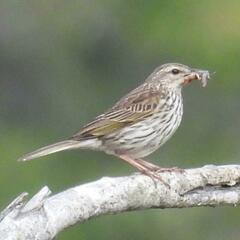
About the Striped Pipit

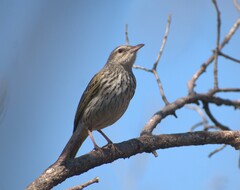
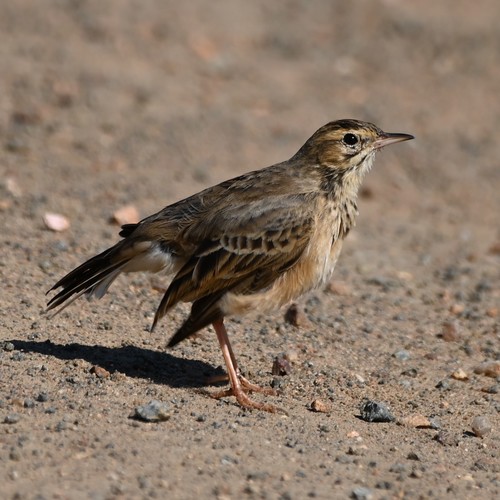
The striped pipit (Anthus lineiventris) is a species of bird in the family Motacillidae, which is native to Africa southwards of the equator. It is found in Angola, Botswana, Burundi, DRC, Eswatini, Kenya, Malawi, Mozambique, Rwanda, South Africa, Tanzania, Zambia, and Zimbabwe.

Its natural habitat is rocky areas in dry to mesic savanna. The striped pipit forms a species complex with the African rock pipit. It is a large pipit, ranging from 17 to 18 centimeters in length and weighing 31-37 grams. The wing coverts have yellow-green edges, and the underparts are olive brown with dark brown streaking. A loud, penetrating, thrush-like song, uttered from a rock or perch.

It feeds on insects and other arthropods, particularly grasshoppers. Striped pipit - Species text in The Atlas of Southern African Birds. Wikipedia →

Sounds

Song0:29

South Africa · 2023

© Marc Anderson · XC876987 · CC BY-NC-ND 4.0

Call0:09

Zambia · 2023

© Dries Van de Loock · XC854447 · CC BY-NC-ND 4.0

Song0:30

Kenya · 2022

© Lars Lachmann · XC755414 · CC BY-NC-SA 4.0

Global Distribution

Parks Where Found

# Park Country Daily sighting probability
1 Lake Mburo National Park 🇺🇬 Uganda
<5%
2 iSimangaliso Wetland Park 🇿🇦 South Africa
<5%
3 Kruger National Park 🇿🇦 South Africa
<5%

Cities Where Found

# City Country Daily sighting probability
1 Kigali 🇷🇼 Rwanda
<5%
2 Johannesburg 🇿🇦 South Africa
<5%

Before you go

What are the chances of seeing a Striped Pipit in Lake Mburo National Park?

Rare

Under 5% of wildlife watchers report a Striped Pipit sighting in Lake Mburo National Park on a given day, based on 12 verified sightings from GBIF citizen-science data from 2019 to 2026. It is the 311th most-seen of the 362 birds we can rate there. Over three days the chance rises to under 5%, and over a week to about 10%, if each day is a fresh chance.

When is the best time to see a Striped Pipit in Lake Mburo National Park?

Any time of year

In every month with enough records, under 5% of wildlife watchers report a Striped Pipit in Lake Mburo National Park on a given day, so our monthly data shows no clear season.

What time of day is best to see a Striped Pipit?

Between 9 am and noon

Across all the parks we cover, that three-hour window holds the most Striped Pipit sightings with a recorded time, and about 9 in 10 of them come between 6 am and 6 pm: it is a daytime animal.

Is Lake Mburo National Park the best place to see a Striped Pipit?

Yes

Of the 3 parks where we can rate Striped Pipit sightings, Lake Mburo National Park has the highest daily chance: under 5%. Next come iSimangaliso Wetland Park (South Africa, under 5%) and Kruger National Park (South Africa, under 5%).

Which relatives of the Striped Pipit live in Lake Mburo National Park?

Same genus: Anthus

The closest relatives of the Striped Pipit that you can see in Lake Mburo National Park (genus Anthus, Pipits) are Plain-backed Pipit (about 20%) and Grassveld Pipit (about 10%), with each one's daily chance of a sighting.

Where does the Striped Pipit sighting chance come from?

GBIF citizen-science records

It is estimated from how often the Striped Pipit is recorded against all the birds logged in Lake Mburo National Park (12 verified sightings from 2019 to 2026), calibrated against known sighting rates. Figures are rounded to the nearest 10% because citizen-science data supports honest approximations, not decimals, and months with records from fewer than five people show "—". How it works.

← Back to Lake Mburo National Park